
In This Dispatch
The Debut
After having seen A Real Pain, one might ascribe a certain set of proclivities to Jesse Eisenberg-as-director: an easygoing affability, a penchant for the gentle ramble, and, most prominently, a lackadaisical sensibility in the spirit of Linklater or Holofcener. He stumbled into a quiet profundity with his second feature, and one might reasonably expect him to continue in this vein considering the subject matter of his newest film, The Debut. One might even assume it would resemble that far better low-key American film about the same milieu, Patrick Wang’s A Bread Factory. One would be wrong.
Set in the wild world of community theater, The Debut charts the modest dramatic ambitions of alienated housewife Mona, who auditions for her town’s production of Nosy Neighbors, a fictional musical with book and lyrics by Eisenberg. She doesn’t get the part, yet she quietly obsesses over her loss in the weeks following her audition. One night, parked outside the theater — in a sense stalking the cast and crew — she decides to accost the show’s director, Jerry (Paul Giamatti), for not getting back to her. He offers some glib remarks and quickly dismisses her, only to call her back late at night with an offer: Serena Cherry (Bernadette Peters, who returns at the end of the film to invoke a deeply unearned nod to Jessica Lange’s Angelique from All That Jazz) has quit because the part was too small.
A Bread Factory is about the power of community theater, how it’s a space not only for expression but solidarity. It affirms that, like all politics is local politics, all art is really local art. The Debut, however, has one eye on the local scene and another on Hollywood, drenching its cynicism in a Brooksian (James L., that is) gloss. It feels not like a loving send-up to community theater, but a letter written with a poison pen: The Debut is a calculating satire that condescends to the very people it ostensibly seeks to elevate. Like nailing your mark on stage, Eisenberg neatly hits narrative beats with a spin on the heel and a twinkle in his eye, yet his operating principle causes one to wish he had stayed in that messier, more empathic mode.
Mona begins rehearsals as timid and in way over her head, but, after a Whiplash-y showstopping pivot, she falls all the way into her performance as the superintendent of the apartment building where Nosy Neighbors takes place, striking a domineering pose and taking an overbearing approach to what is effectively a bit part. She retreats into method acting as a distraction from the constricting boundaries of her housewife trappings, a sort of Better Living Through Theater self-help program Jerry concocts for her — which goes totally awry.
There’s commentary to be made on the horrific solipsism of suburban America such as Eisenberg seems interested in here, certainly — it’s just that this particular critique starring Julianne Moore was already made by Todd Haynes with Safe over 30 years ago. Of course, 30 years is plenty of time for Safe to have evaporated from the cultural consciousness so that Eisenberg can freely pull from it, but unlike Haynes, he can neither modulate complex emotion — The Debut is pitched at either hysteria or Zoloft-level depression depending on the given moment — nor muster the necessary empathy for his naïve protagonist. Mona is an empty-nester who succumbs to the pressures of the spotlight, yet rather than critique the egocentric system that enables her fall, Eisenberg thumbs his nose at the suburban bumpkin and pins the blame on her. The character is all anxious mannerisms; moreover, she’s a terrible actor. Playing this so Mona doesn’t come across as a total caricature is a monumental challenge, one that Julianne Moore is, unfortunately, up for. She flicks through feelings like a Rolodex and sells Eisenberg’s cute dialogue; the film asks entirely too much of her, and she willingly sacrifices her talent at the altar of parody.
Eisenberg’s form has evolved — rather, transmogrified — to meet the content. When Mona tells her husband she got the part, the camera pushes in, and a spotlight shines on her; the camera will whip back and forth during pressure-cooker scenes to reflect the whirlwind Mona finds herself caught up in; and a toilet becomes a motif expressing Mona’s impulse to break out of her dull routine. Anything, it seems, can become a storytelling device if you cut back to it enough.
There is a single moment at the very end of the film one could refer to as identifiably Eisenbergian (should one have the desire): Mona infiltrates the theater late at night, only to find Jerry playing sad chords on his piano in the tiny apartment he lives in above the stage. He admits that despite his anger at Mona for her prima donna approach, he envies her. He gave up on his acting career long ago, and he wishes he had the same enthusiasm for the craft as she does. It reverses the power dynamic, slashing the Goliath down to David-like size, similar to Benji’s humbling in A Real Pain’s final moments.
But this is not where The Debut ends. The Debut somersaults into a sour note, resting on an ambiguity which shades Mona as either redemptive or menacing depending on one’s own relationship to both the character and the performing arts in general. It’s an evasive act of legerdemain that only magnifies Eisenberg’s cruel diffidence toward his characters: cutthroat, insecure, angry people looking for the love and acceptance they can’t find at home. In the world according to Jesse Eisenberg, that’s showbiz, folks. — ETHAN J. ROSENBERG
For the Moon
A couple of weeks ago, I went to a screening of Tsai Ming-liang’s Stray Dogs (2013) at the Metrograph in Lower Manhattan. I am a forgetful person, which is why I always take notes during a film, no matter whether at the movies, in the classroom, or at home. Always, except for this one, that is. Ironically, it became one of the most memorable screenings of late, which had little to do with the film’s infamous cabbage scene. There was one person in the room who, the audience quickly seemed to conclude, had some kind of condition that made it impossible for them to remain quiet for any length of time. Whether it be during the five-minute scene in which Lee Kang-sheng, reduced to a human billboard and veiled in a clear rain poncho, recites with ever-greater despair the Man Jiang Hong poem on a Taipei traffic intersection, or the stunning reverse shot that draws the film to a depressingly apt (or aptly depressing?) close — the young person would stretch their loud yawns to a maximum and squeeze out giggles at “inappropriate” moments, occasionally accompanied by expansive gestures noticeable even several rows behind.
I do not doubt that to many this would seem an unpalatable proposition for a filmgoing experience. The purchase of a ticket, the many might argue, entails the promise of non-disturbance, an implicit contract between the moviegoer and both the cinema and the other audience members. I would be lying if I said that I was not distracted from the first incident on — up until the end of the film. My thoughts kept wandering off to the young person and their company, whom I took to be a couple. I wondered whether this was their only evening in a while that they could go to the movies, wondered what I would do in this situation, and how the young person might have felt. Whether a late-night outing to an arthouse cinema meant a greater or smaller effort for everyone involved, compared to other activities. If I were in their shoes, would I be more considerate toward an unknown audience than to my companion who might, despite everything, take joy in this kind of night out? Should this kind of screening experience not be a much more common occurrence? In the eyes of another audience member in the sold-out room, who, once the end credits unfolded, immediately jolted from his seat to shout at the person: “Thank you for ruining my evening, asshole!” — the answer was an emphatic “no.”
The incident stayed with me. What are the conditions that render this such an out-of-the-ordinary event? Or, put the other way around: how seriously do we take the demand for accessibility in public (if commercial) spaces? These questions, inevitably, made me revisit the 2025 essay “Access Against Common Sense” by Jordan Lord, who wrote: “[A]ccess features for disabled audiences are almost always individualized and/or designed to be experienced separately from the version experienced by the abled audience.” It is a practice, Lord continues, that “divorces both access and cinema from their roots in sociality.”
In their own work, Jordan Lord takes these concerns seriously, which is why their film Shared Resources (2021), an essayistic family portrait shot over several years, features open captions and audio description (in their most recent film, the deconstructivist 35-minute archival documentary Concealed and Denied (2026), Lord withholds the direct material used for their exploration of a media landscape that has gradually shifted to the right, evoking it instead through their bare voice). They posit:
“[A]ccess to all moviegoers is a fundamental dimension of filmmaking. Whether or not a filmmaker has considered making their film accessible to disabled audiences, a film’s access features—or lack thereof—show that a set of decisions has been made, implicitly or not, about who belongs in the audience. It’s not simply that certain audiences are not offered the features that might make a film accessible to them; industry norms that regulate the concept of how to enjoy a movie also judge who properly belongs in a theater and whose presence is a potential disruption acceptable only when neither seen nor heard.”
This leads us back to the “disruptor” in the audience, but it also — finally — lays a useful foundation for discussing Éric Baudelaire’s experimental documentary For the Moon (Car la lune), which premiered in the Currents section of the 2026 New York Film Festival. The film takes its French title from a passage of Samuel Beckett’s French-language novel Molloy, the first installment of his trilogy. Whereas the English title For the Moon holds ambiguity as to its directionality — Is something being done to honor or in service of the moon? Is someone headed for the moon? — the French proves much stricter. There, “car” can only figure as the causal conjunction that emerges in the English translation of the programmatic epigraph: “For the moon was moving from left to right, or the room was moving from right to left, or both perhaps together, or both were moving from left to right, but the room not so fast as the moon, or from right to left, but the moon not so fast as the room.”
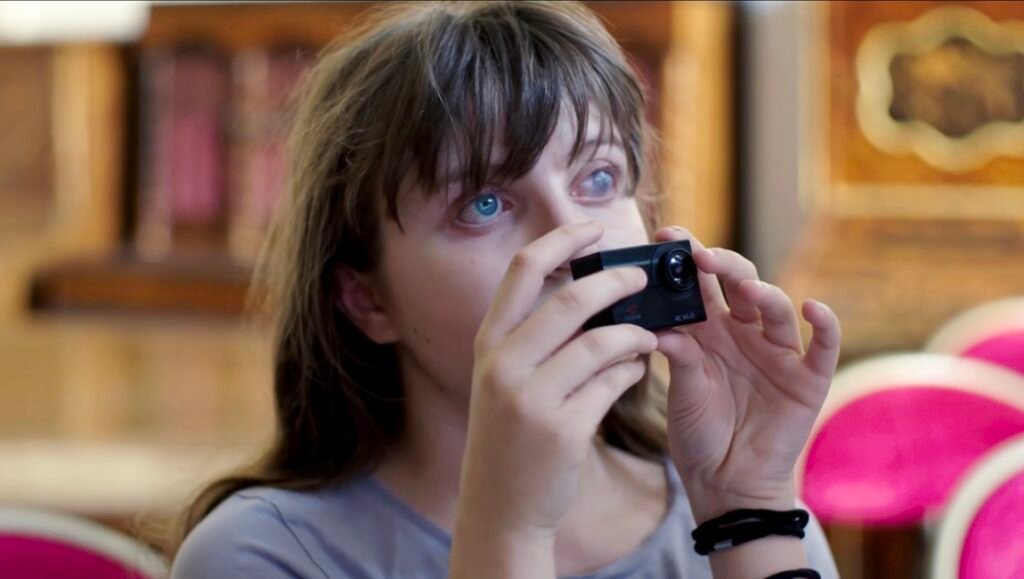
The disorientation in and of Beckett’s prose, presented as unfurling intertitles, prepares us for what is to come. Shot at the Campus Louis Braille (named after the inventor of the tactile code) at the Institut National des Jeunes Aveugles in Paris, the film captures aspects of the lives of five adolescent girls with visual impairment within an institution specifically designed to enable a high degree of independence. What commences in an observational mode captured by DP Claire Mathon (who has worked with Baudelaire before, as well as with Céline Sciamma, Alice and Mati Diop, and Alain Guiraudie) and is reminiscent of a Frederick Wiseman or a Claire Simon film, gradually transitions into cinéma partagé, a prism of diaristic entries filmed by the students Jade Ebara Ossebi, Iris Fontanella, Kadiatou Diakite, Crystal Lau Chang, and Mèï Jendoubi themselves with Sony camcorders. The opening scene seamlessly picks up on Beckett’s words and presents us with two pairs of hands in close-up, the older one helping the younger navigate a wooden miniature model of the institute. Following the instructions of the female pedagogue whose face remains off-screen, the child has to learn by heart: the girls to the left, the boys to the right. Orientation, we may infer, is a matter of habituation.
With like precision and perspicacity, Baudelaire captures several other moments of quotidian consequence: a boy struggling repeatedly to press the lid onto the open pasta container, others learning to write via braillewriters, a match of goalball — a sport developed for athletes with visual impairment in which two teams, wearing special blackout eye shades, attempt to throw a ball with bells inside into their opponents’ goal. It’s a rather episodic mode in which this early segment of the film explores the goings-on inside the institute, one that refrains from the scaffolding devices of protagonicity — the focus resting on the body and its uses rather than on faces — and explanatory voiceover. Crystallizing through the extended time spent with the people in the institute, Baudelaire’s vision in For the Moon clearly privileges the experiment over a narrative arc.
As Jade, Iris, Kadiatou, Crystal, and Mèï become the protagonists, the observational perspective increasingly gives way to the participatory one, up to a point where the baton has been handed over entirely to the five students of the Campus Louis Braille. It is a premise both compelling and moving: what will be shown by those who cannot see? But perhaps, there is already something to take issue with in this question: “For us, listening, touching, tasting, and feeling is seeing,” we hear Kadiatou say. And: “We even use the term for sighted people ‘I watched a film.’” Kadiatou’s family, we learn in the same scene, had moved to France upon hearing that French clinics were now able to separate conjoined twins — “a miracle” — believing that if there was a place to help someone regain their eyesight, it must be France. One of the group, Iris, tells us later that the midwife who had delivered her, once she had realized that Iris’ eyes were white, had tried with all her might to dissuade Iris’ parents from giving her this name. Clearly, Iris and the others have told their life stories many times, to themselves and to others, and their tellings oscillate between anecdotes, theoretical reflections, and the ineffable. “I was born blind, my brain doesn’t know what seeing is,” Kadiatou says. Iris, who lost her right eye at the age of nine and, at the beginning of the film, awaits surgery to remove her other eye, is happy that she is still able to see colors in her dreams — and hopes that this will remain so forever.
There is more beauty — even sublimity — in this film than can be acknowledged here, much of it owing to the sprawling energy, musicality, and openness of Baudelaire’s subjects and collaborators. Still, several things can be true at once, and some of the directorial decisions lead me back to the beginning of this text. What does it mean to make a film about a group of people with severe visual impairments? One mode of showing, a recurring one, finds a particularly convincing answer when the camera tracks the students as they navigate the institute’s winding corridors and tell the audience what they perceive their environment to be like. The act of designation works threefold: it demonstrates the speaker’s sense of and orientation in the world, it activates the sighted viewer to measure the impressions of their observations against what is said, and it communicates what unfolds on the screen to those audience members who cannot see. For the most part, however, a person without eyesight would not be able to follow, a fact underscored by the aforementioned epigraph, which exists as text but not as spoken text. And even if a given cinema, as some do, were able to offer a generic audio description, this would simply not do the film’s emphasis on perspectivity justice, since many of the scenes are directly tied to the — paradoxically captured — perspective of Jade, Iris, Kadiatou, Crystal, and Mèï.
For the sighted viewer, the shift of cameras from the “professionally” shot scenes by Baudelaire and Claire Mathon to the low-res camcorder videos by the students creates the inevitable perception of hierarchy that Baudelaire, according to the end credits, appears to want to abolish. After their names, the credits read: “their images, their sounds, and their music.” Naturally, this acknowledgment is, only seconds later, followed by “images/Claire Mathon” and “directed by Éric Baudelaire.” It is a predicament that traces back to Jean Rouch, whose ostensible carrying of the banner cinéma partagé would routinely collapse in the end credits of his films, identifying him as the sole auteur. These are some of the contradictions in For the Moon. It is a film made about and to a considerable extent by people with visual impairment, but neither are they credited where it would matter — the authorship remains with Baudelaire — nor is the film, as screened, made with them in mind as an audience. It’s also, for those who will be able to see it, quite a marvelous thing to behold. — PATRICK FEY
The 14th
Ava DuVernay’s 13th is one of the most influential documentaries of the 21st century, for better or worse. Released at the tipping point between the Obama and Trump years, it struck a nerve in the shifting cultural ecosystem and set the template for many of the made-for-Netflix documentaries in its wake, emphasizing off-center framing of its subjects, a roving camera, and quick cuts to compete with the second screen. 13th is slick, but its very slickness made palatable the incendiary (and true!) notion that slavery is effectively legal today through a loophole found in the U.S. Constitution’s 13th Amendment that has been exploited through mass incarceration. As far as edutainment goes, you could do worse.
This is a claim that DuVernay (inadvertently) sets out to prove with her follow-up, 14th. Created not in competition with the second screen but in total capitulation to it, 14th crosses the line between politically correct and formally wrong: it doesn’t fight your attention away from your phone, but rather replicates the doomscrolling experience in all its twitchy horror. Infographics, colorful captions, shots that last fewer than five seconds, AI zombification of historical photographs — it’s political documentary for the Cocomelon crowd, an overstimulating buffet of sensations meant to appeal to a populace whose brains are melting.
Consider 14th an inverted 13th. Where the earlier film pokes holes in the Constitution, 14th argues in favor of preserving the document in light of Trump’s ramrod disregard for its tenets. It asserts that the amendments are just as important as the Constitution itself, which is hard to disagree with yet impossible to properly digest because of the film’s ridiculous pacing. The Constitution is quoted rat-a-tat under instrumentals for Kendrick Lamar’s “Alright,” Fleetwood Mac’s “The Chain,” and James Brown’s “The Breakdown,” intercut with commentary from a who’s who of politicians, PhDs, and commentators. For example: expecting literally zero familiarity with American history, DuVernay introduces A.O.C. to tell us that the Civil War was fought between the North and the South. And as we watch the parade of postulation, it slowly dawns on us that 14th is not really about the amendments at all; rather, the United States Constitution serves as window dressing for a cursory overview of all the outbursts of white supremacy we saw on our phones and have been enraged by these past 10 years or so.
The Unite the Right rally and its culminating car attack, the Charleston church shooting, the attempted insurrection on January 6, the cold-blooded murders of Alex Pretti and Renée Goode; all are represented here in one form or another. DuVernay takes nearly everything that made you want to chuck your phone at the wall and consolidates it into a neat, digestible package. One would think it’d be useful to have all this information in a single place; it’s a concrete reminder of events that have evaporated into the cold mist of social media algorithms, and it’s impossible to watch these images and not be agitated. Writer Jelani Cobb states that white supremacists erroneously believe “something has happened to this country in 50 years,” and on its face, he’s right: the fear drummed up by right-wing political leaders is a total mirage, and the violence done in its name is irredeemable. But there has been a change — an economic one. Reaganomics, Citizens United, and the vast accumulation of wealth by billionaires have irrevocably altered the very fabric of society, and right-wing plutocrats have taken the anxiety provoked by that change and spun it into widespread xenophobia and racism. Any film that doesn’t integrate capitalism into its critique of white supremacy is, at best, insufficient.
14th is not only insufficient, but it actively celebrates free market capitalism by proffering Ronald Reagan as one of its voices of reason and deploying AI to animate primary documents. Pictures of free men standing proudly, holding political office, free women sitting at desks, getting an education, and children playing with each other become dioramas that DuVernay pierces through in a bizarro 3D Ken Burns effect. The trick is integrated so the seams (i.e., failures) of AI are indistinguishable to an eye watching 14th on a 4-inch screen, but look closely enough at the periphery, and some of these faces briefly contort into digital screams. It’s baldly irresponsible filmmaking, and as the Buddhist monk Bhante Sujato said during a recent dharma talk, “when you’re participating in AI, it’s an inherently totalitarian philosophy. It’s not a technological project, it’s a political project.”
AI alone would be enough to disqualify the film’s rhetoric, but the rhetoric is so laughably easy that it situates itself comfortably with said use of AI. On the subject of birth tourism, DuVernay platforms a MAGA-ite Florida representative to say birth tourism is a major issue and a good reason to end birthright citizenship. She then puts up the stats proving that fewer than 1% of births in America are the result of birth tourism. Shortly thereafter, (now former) Press Secretary Karoline Leavitt falsely claims that Dr. Carla Hayden, former librarian of Congress, was loaning inappropriate books to kids, and then cuts to a disclaimer that the Library of Congress does not and has never loaned books to children. It’s just lay-up after patronizing lay-up, soothing the egos of those for whom civic engagement begins and ends with calling Trump supporters a basket of deplorables on Facebook.
14th is, ultimately, an important documentary. It demonstrates the limits of the neoliberal paradigm to address troubles unique to our time, and it gives voice to the last gasps of those who hold on to that order for comfort. At the very end of the film, Sherrilyn Ifill implores us to repair the damage done to the Constitution “if we have a democracy when we get out of this.” She’s right; we are in the midst of a major constitutional crisis, and perhaps democracy is hanging on by a thread. If democracy is to be restored, however, 14th will have nothing to do with its repair; if something better comes to replace it, 14th will serve as a document of a past best left behind us. — ETHAN J. ROSENBERG
Comments are closed.