
In This Dispatch
-
- zi
- Sour Minnows
- After Dreaming
- The Haunting of Pennhurst
- Ponderosa
- Here I’m Alive
- Riptides
- Mother Future Self
- Castration Movie Chatper iii.ii Junior Ghosts — Premorphic Drift; a fragmentary passage
- Everytime
- The Arrow At Rest At Every Instant of Its Flight
- It Goes That Quick
- La Gradiva
- Chronovisor
- First They Came For My College
zi
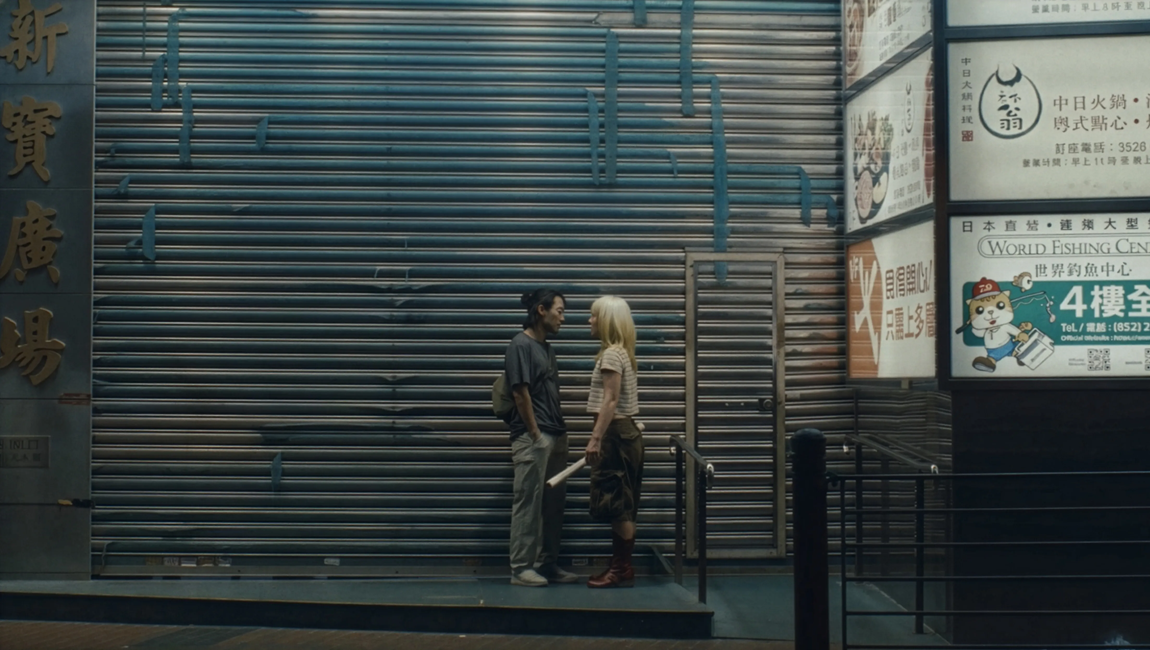
Kogonada’s latest film has a “latest by Kogonada” problem. The video-essayist-turned-director burst onto the scene with Columbus (2017), a quiet, poetic meditation on friendship and architecture that also co-starred Haley Lu Richardson. In zi, her presence is actually one of its death knells; her character Elle is a variation of the manic pixie dream girl (MPDG), as coined by Nathan Rabin, existing solely to guide the lead character through life’s spontaneous delights, mysteries, and optimisms.
zi starts out promisingly enough, a “return to form” for Kogonada after his disastrously melodramatic and pedestrian A Big Bold Beautiful Journey (2025). Here, we are back in the hands of a master of framing, each shot capturing Hong Kong’s kinetic awe with a reverence that could rightly be compared to Wong Kar-wai, except this comparison soon leaves one feeling guilty as the film trudges beyond its first act and enters the domain of the soap opera.
Zi (Michelle Mao) is a woman who seems to be in the throes of a mental health crisis, frantically wandering Hong Kong’s streets while hallucinating future occurrences involving herself and another woman, an American (played by Richardson) donning a blonde wig, combat boots, and baggy jeans. All the while, a man (Jin Ha) suspiciously follows Zi from a distance. In these opening sequences, the viewer is untethered from plot, constructing inferences based on gorgeous shot composition, whiplash-inducing tracking shots, and hyper close-ups, a camera that is as enamored with architecture as in Columbus.
Lo and behold, the women eventually run into each other, thus consummating Zi’s visions. We learn of Zi’s possible tumor that is awaiting diagnosis, of Elle’s fraught relationship with the man named Min who’s been following them, of Min’s role as a doctor or researcher of some kind at a local neurological center that might be able to help Zi, and — most dispiriting of all — Elle’s penchant for recording the sounds of the city and trying incredibly hard to convince the distraught Zi to see the beauty in everything around her even as a looming illness takes hold.
The city symphony peels back and makes way for a far less interesting film, one that sheds its experimental groundwork, its initial sense of mystery that left us adrift alongside the protagonist, trapped (or perhaps ensconced) in a churning, roiling cityscape. Although the original idea of the MPDG pinpointed an archetype that prompted “broodingly soulful young men to embrace life and its infinite mysteries and adventures,” in zi the character of Elle acts toward this same goal primarily for another woman. But yes, also for a broodingly soulful young man who at one point does a painfully awkward a capella rendition of John Denver’s “Leaving on a Jet Plane” for Zi and Elle, who sit there listening, feigning interest, knowing full well they’re in fact in love with each other and had just made out minutes before Min’s karaoke routine. In any case, the principle of Richardson’s MPDG remains the same, and Zi’s illness that forms the central conflict of the film ends up fetishized — sexually, emotionally, visually, narratively. As for Zi, she recedes into a void as our MPDG usurps the spotlight.
This may all sound rather confounding, hokey, scattershot, and to that the only promise this writer can make is: it is. For a brief time, zi isn’t that, but it very quickly overplays its hand, and proves that it absolutely should have been a 30-minute short as opposed to a 100-minute feature. Kogonada’s latest is, unfortunately, Kogonada’s latest and not much more. — TYLER THIER
Sour Minnows
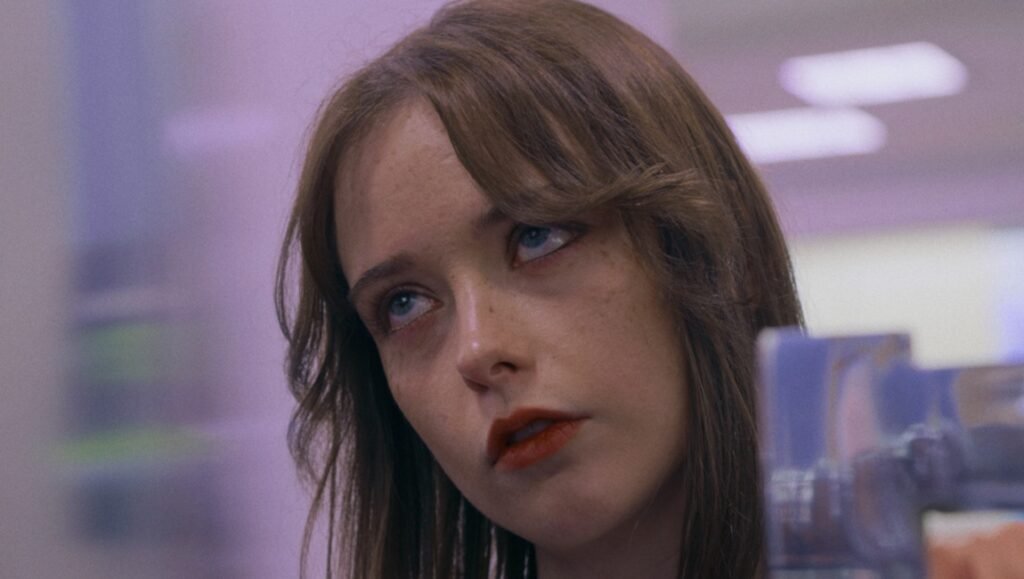
There are exactly two minutes and 39 seconds in which Harrison Atkins’ second feature operates as a straightforward slice of ineffectual mumblecore. We follow our primary protagonist, the glum, John Denver-looking Ricky (David Brown), and his pal Tepper (Chase Williamson) as they wander down a suburban street, shopping in hand, trading small talk about their respective directionless lives and the last dregs of their artistic ambitions. Then they round a corner, and there are six men, prone, licking at the asphalt like libidinous human geckos. The sight seems to upturn something in Ricky, his ambling existence suddenly capsized by a fragmenting sense of time and space. As he tries to understand what is happening, he meets Aura (Suzanna Son), someone who seems to have fallen into a similar alternative world, and the pair attempt to make sense of their increasingly confused reality.
The world is far from short on films in which people scramble to find the truth in L.A.’s vast and baffling labyrinth, but Atkins’ sense of style sets it apart from many of its more straitlaced contemporaries. The camera spends much of its time in a sickly leer, off-balance, either too far away or too close to the action for comfort. When coupled with the Sour Minnows’ increasingly (and wilfully) baffling plot, it doesn’t just evoke paranoia but rather evokes paranoia about feeling paranoid, and fills familiar landscapes and characters with a very real, clammy tension. Even in the film’s most low-key moments, its malls, crummy apartments, and parking lots take on a strange, looming sense of fearfulness, and it means Atkins’ film never lags, even when it occasionally struggles to corral its tangents.
Now, it would be foolish not to mention the elephant in the room of an L.A.-set, nightmare-logic mystery of Hollywood’s dark side, particularly when the elephant has a quiff, a unique, reedy voice, and is named David Lynch. Sour Minnows is clearly operating in the shadow of both Mulholland Drive and Inland Empire, and not in the sense of only a passing comparison either. Beyond the similar premise and a preoccupation with doors to other realities, the film’s whole tone of incomprehensible yet all-consuming dread is one that Lynch mastered and one that Atkins very readily pursues. It’s perhaps an unkind comparison to make as it, as the Lynch tag does with much of the American indie cinema that worships at his altar, shines a light on Sour Minnows’ shortcomings. Its characters are ultimately rather thin, and we struggle to warm to them, meaning the film doesn’t cultivate the emotional investment that cuts through Lynch’s post-millennium L.A. work, ultimately dulling its impact a bit. And like Mulholland Drive, one of the film’s central thematic strands is to act as an elegy for the people that Hollywood has and continues to destroy in their pursuit of its dream (the film is dedicated to Jeff Baena); you don’t for a second doubt its sincerity, but its execution also doesn’t engender the same level of rage at the cruelty of the system that Lynch achieves.
However, the film’s dalliances with the Lynchian are evidently at least partly intentional; there’s a shot that wilfully mimics the scene behind Winkies in Mulholland Drive, and Aura’s red slippers tie the film to the Wizard of Oz, Lynch’s self-described blueprint. These references work to shift the film forward, a new, if not entirely radical take on the Hollywood dreamworld mystery. Where Lynch’s Hollywood was colored by film noir and soap opera, Atkins’ is coloured by AI, influencers, and Lynch himself. This sense of exploring a hell that someone else has already mapped adds a strange desperation to the sickly unreality the film carries, as if the incomprehensible nightmare our characters are in is one that spirals through cinematic history itself.
It’s also worth noting that Sour Minnows is a vast improvement on Atkins’ debut, 2015’s comparatively sluggish Lace Crater, and displays evidence of a talented filmmaker, one with a real handle on their visual style and who can channel it into a distinctly unsettling atmosphere. During its heroically brief runtime, Sour Minnows is a consuming descent into our modern maze of hallucinatory confusion, as if it never quite convinces that there’s as much at the center of its labyrinth as you would hope — or find in Lynch. But shoes to fill don’t get much bigger, and Atkins’ sophomore outing nonetheless makes a strong suggestion that something even better is quite likely still to come. — JOE CREELY
Also Playing at New/Next
Here I’m Alive
The magic of the digital world allows us to be instantly and perpetually connected with one another. Childhood friends, high school crushes, former co-workers, distant family members — we all have the means to keep in touch, no matter where we’re located on the planet. But this can be something of a double-edged sword: since our online identities are completely self-manufactured to our liking, how much of our real selves are we genuinely putting out there? Can a digital avatar accurately reflect the true individual if it’s an ultimately warped personality that only shares the more favorable aspects of one’s life? That’s just one of the many questions that writer/director/producer/cinematographer/editor Joshua Z Weinstein poses in Here I’m Alive, his first feature in nine years after 2017’s Menashe. Spanning the course of a single evening in The Big Apple, Here I’m Alive centers around fewer than a half-dozen New Yorkers who run the gamut from social media influencer to escort to gig economy worker to migrant to shut-in, each of whom is addicted to the screen in their pocket. Despite its scant runtime — 75 minutes before credits — Weinstein captures his subjects with stunning, neo-realist intimacy, delivering a micro-budgeted, semi-fictional, anthropological mosaic about The State of Things.
The film’s striking opening shot is that of a heavily pixelated computer screen, distorting the image to an unrecognizable degree while the garbled audio follows suit, recalling even the harrowing introduction of David Lynch’s Twin Peaks: Fire Walk with Me. The soundscape clears up first, revealing the source to be a YouTube interview with Silicon Valley venture capitalist Marc Andreessen, happily waxing optimistic about the possibilities of digital technology. The billionaire’s thoughts are punctuated by the chime of Discord chat notifications, originating on the computer of Majora (Cheyenne Gallagher), an agoraphobic young man who sees little reason to leave the comfort of his apartment, preferring to socialize with the like-minded individuals of his online forum. Elsewhere, social media influencer Emira (Emira D’Spain) is gearing up to celebrate her birthday party online, rehearsing how to best greet her followers while working through her extensive make-up routine. There’s also Felix (Caleb Zuzga), who himself is currently undergoing lip filler injections in the hopes of wooing a sugar daddy on his LGBTQ dating app. And then there’s Krystaly (Krystaly Figueroa), producer of a new online Flavor of Love-esque reality dating series, laser-focusing her efforts on making this her big shot to online stardom. Rounding out the core cast is Eddie (Eddie Torrenegra), a Venezuelan delivery migrant worker who hopes to bring his children stateside one day, but in the meantime must keep his head down and do his job lest any of the plain-clothed ICE agents scoop him off the streets.
With only a handful of largely non-professional actors to work with, Weinstein effortlessly weaves through the lives of his characters, bouncing from one story to another and occasionally intersecting his players as they pass each other through the night. The throughline here is the internet writ large, wielded by everyone as a means to improve their lives and livelihoods. For Eddie, FaceTime calls offer a direct link to his children, whom he wants to be able to bring into the country to live with him one day, while his social media consists of him boasting about how great life is while driving his fancy orange sports car, when in reality he’s bribing the vehicle’s actual owner to film himself standing near it. Krystaly’s also in a bad spot, ignoring the guidance of her occupational caseworker by neglecting gainful employment working at Target, instead channeling her efforts into making her TikTok reality series a hit, auditioning men to be the potential suitor for the online celebrity host. Felix is searching for a more personal connection, altering his body and heavily utilizing ChatGPT to respond to offers for dates with older men, yearning for one to be his next meal ticket. (This is not the only reference to AI — a fleeting message board user posts that he prefers ChatGPT to a real-life therapist, in case anyone wondered how bad things are out there.) But perhaps most compelling of all is the saga of Majora, a portly lad who has all but rejected the outside world in favor of the World Wide Web. There, he becomes embroiled in the personal life of the latest member of his chat forum, a dejected and suicidal young man, spending the bulk of his plotline figuratively talking him off a ledge.
Suffice to say, the world is not in a great place right now and Weinstein knows it, but he’s not out to judge, mock, or ridicule those who are trying to make a difference. The title of Here I’m Alive can refer to the thriving cyberspace where one can make their escape to and feel most fulfilled when the alternative of reality offers nothing but cruelty and despair, but it’s also a defiant message to the punishing system that deliberately brings people down, as if one is giving the finger to the powers that be for surviving their endlessly harsh machinations. Weinstein captures the depth and complexity of living online in a cinematic microcosm, which features some gorgeous photography of The City that Never Sleeps during its darkest hours, showcasing a symphony of city lights and activity. The film’s ending does wind up landing somewhere more conventional than the rest of Weinstein’s project, but for most of the runtime it’s a compact, beautifully-realized tapestry of a handful of New Yorkers merely trying to get by. — JAKE TROPILA
Riptides
Riptides is a dark comedy about a simple man who, inspired by the words of a self-help author, tries to revolutionize his life and ends up showing how the blind pursuit of success can be destructive. In a film that exposes the deleterious effects of compulsory ambition, Alex Karpovsky uses the world of influencers to expose the hypocrisy of an impossible lifestyle that imposes ambition as the sole mark of success in a man’s life.
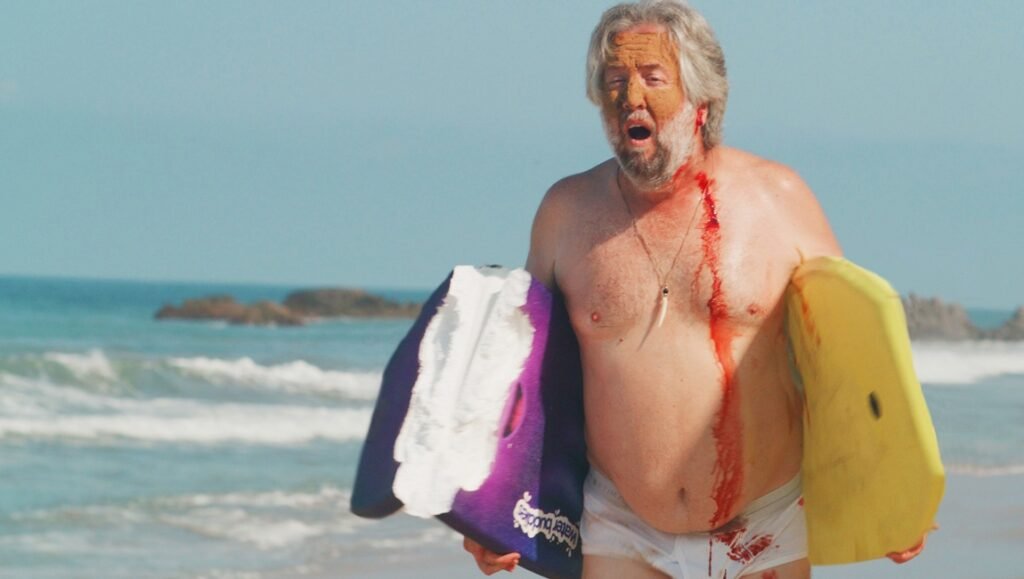
Toby (Steve Little) is the caretaker of a beachside hotel on the coast of Sayunita, a fictional town in Mexico, where he lives and does minor repairs for guests. We are introduced to Toby’s contentment with his unluxurious life. He enters the ocean with his bodyboard, chats with his friends while wearing flip-flops, an unbuttoned beach shirt exposing his sizable abdomen, and baggy below-the-knee shorts. At the end of the day, he is content watching the sunset while smoking weed and masturbating alone in his single-room bungalow. Toby is happy being Toby. In the eyes of the Meltons, newly arrived guests, Toby is nothing more than just another loser. Paul Melton (Dylan Baker) is a self-help author who built a career teaching that happiness and purpose are antagonistic and that a truly successful man must be strong to leave his mark on the world, ready to take flight. Michelle (Bojana Novakovic), his daughter, is responsible for managing him and running his social media.
Karpovsky abruptly shifts from the sunny style and slapstick tone he uses to establish Toby early in the film into a graver register. The soundtrack also becomes heavier, creating contrast in the father-daughter relationship. Toby seeks advice from his friends to treat testicular pain from scrotal trauma caused by his bodyboard, while the camera focuses on his cream-covered hand applying it inside his wet shorts. We cut to Paul emptying a bottle of vodka after being forced to record a sequence of countless stories for the speaking tour promoting his latest book, Leave a Mark. Paul faces the sunset with a somber expression and contemplates the sea at length, while the camera frames him from behind, showing his aging neck and crooked posture. He gets up from the ground, and the camera follows him as he walks into the sea.
For nearly the whole film, Little plays Toby as a man who seems to have some difficulty understanding his social situation. His speech is slurred, projecting his voice from the back of his throat as if he were hiding a potato in his mouth, which operates as a shortcut to establishing an exaggerated naïveté that might produce some degree of sympathy and humor. And in his behavior, Toby reinforces adolescent behaviors in a white-haired man, spending a great deal of time describing a bodyboard with a hole for male genitalia, believing this will revolutionize the world, without realizing that the other characters receive everything he says as nonsense. The resulting energy is that of a man easily manipulated by well-crafted rhetoric or a woman’s beauty — which indeed happens throughout the plot.
Riptides lets subtleties be washed away by the tide: in the very first dialogue between the characters, Toby is already confronted with the statement that his life has no meaning. From that point on, the script forces the character to become a voracious consumer of Melton’s bitter life philosophy, without sufficiently developing the transition from the initial shock to obsessive adoption. An exchange of two or three sentences is enough for him to start devouring his audiobook. In this way, Riptides is quite cruel to its protagonist. The script agrees with Paul, because even before he arrives at the hotel, Toby is already presented as an object of mockery simply for being a harmless idiot satisfied with his own life. And by characterizing the quiet caretaker’s contentment as the result of his naïveté, the film weakens its critique of Melton’s self-help model.
This sharp contrast between the characters also has the effect of making it seem as though the actors are in different films, even while sharing the same screen time. Little plays it like a Dumb and Dumber remake; his performance pushed toward comedy even in moments when his character is frustrated or mistreated. When they threaten to steal Toby’s boards, he defends himself like a child, terrified, holding onto one of them almost defenseless, before clumsily running away clad only in his underwear. His pain becomes yet another occasion for mockery, as the film shows no interest in portraying Toby’s humanity or complexity in the face of humiliation. Novakovic, meanwhile, feels like she is in a family thriller, serious and concerned, as she attempts to conceal the charade of her father’s empty life, trying to maintain the rigor and morality of a life deeply marked by depression. Inevitably, whenever these performances, marked by contrasting voices and facial expressions, collide, the film’s tone suffers the whiplash of collision as well.
Perhaps to make up for these deficits, Riptides takes pains to add more dynamism by constructing certain narrative passages or character flashbacks using visual devices. The most interesting, by far, is the integration of recognizable social media elements. Karpovsky’s film introduces characters through their Instagram profiles and uses stories and posts as a narrative device embedded in the photos of a feed, a choice that is both organic and logical, since a large part of the script’s argument rests on the ambivalence between the life lived and the life preached by social media figures. We see an eschatological scene of the character narrating how he scared away a restaurant’s famous clientele through an influencer’s disapproving stories, while simultaneously drawing the owner’s wrath upon himself. Despite the bizarre content of the narration, the entire scene is effectively energized by the switching of phone screens.
Other visual strategies, however, are less successful. In the film’s few scenes of violence, its blood has a distinctly artificial look and texture, and follows implausible trajectories given the angles of the blows struck. Perhaps a minor gripe to pick, but it has (unintentional) comic consequences and creates a strange distancing effect in the viewer. Elsewhere, the film’s dream sequences likewise land with less impact than intended, using a hazy filter that seeks to evoke the dreamlike, but ultimately ending up repetitive, even when replayed in slow motion during frenzied fantasies where the character revels in the glory of his completely stupid project. In this way, Riptides insists on showing everything we already know about its protagonist, reinforcing the idea that his ambition and self-image are as empty as his actions. Toby shifts from contentment to obsession, but the film’s visual design does nothing but double down on what has already been made over-explicit through its unsubtle character development. In the end, we are left only to observe the death of contentment without any accompanying grief, all dramatic weight becoming merely another detail in the caricature of a subject who was established as ridiculous right from the start. — GUILHERME QUIREZA
Also Playing at New/Next
The Arrow At Rest At Every Instant of Its Flight
Theodore Schaefer’s sophomore feature announces itself right from the jump, with a free-flowing camera flying, crashing, and zooming through modern New York City as if it were the Paris streets of Breathless and Elevator to the Gallows. And like Jean-Luc Godard and Louis Malle’s debuts, The Arrow at Rest at Every Instant of its Flight makes its black-and-white images burst with energy through a combination of a frenetic editing style and rollicking jazz soundtrack. This technical trifecta of Alex Huggins’ contrasty 16mm cinematography, Zach Clark’s raucous editing, and Scott Lane’s playful compositions (there are a couple repeated notes that feel like the music is about to dive into a riff on “Take Five”) come together to make Arrow a film of pure exuberance.
Just as playful as the style is Schaefer’s loose narrative, where three seemingly unconnected stories — each starring Gus Birney as an apparently different character — weave around each other, threaded by bookends of an old woman with a suitcase (Constance Shulman, Birney’s real-life mother) constantly having fleeting sightings of her exact doppelganger. The first story sees Birney as Violet, who works at an arcade that is apparently only frequented by the elderly, and fills her time by trying to come up with small-time, quick cash crimes and cons with her coworker Em (Jack Haven).
25 minutes into Arrow, Birney reappears as Sinopia, a mysterious socialite working through her relationships. If Arrow wasn’t already formally fluid enough, this middle section is where it starts to drop any of its rules, and shows the movie as able to transform into anything it wants in an instant. In particular, there is a great sequence here going up and down and up and down in an elevator, where the film takes another sudden swing at its diegesis as the absurdity starts to set in. It is also a scene of one of the film’s many great minor roles, where Gus’ cousin Albert Birney (the Baltimore-based filmmaker behind OBEX) plays the increasingly frustrated elevator operator whom Sinopia refers to as “Sisyphus.”
Around every corner of the film is another trick up Schaefer’s sleeve, something which the movie even winks at when Gus Birney appears in the final chapter as Jade, a hustler looking to cheat her way through a big poker game run by Flush Derringer (Babak Tafti) — a name that, when it’s first spoken, makes one realize there is a Pynchonian air to Arrow, with the about-town oddities in particular calling to mind V. What makes Arrow such a joy to watch, though, isn’t necessarily the literal content of its stories, but how much vitality it has in every instant. This is held together by how exciting Birney is to watch as she stretches her acting chops in every direction, and it’s no wonder that in the moments when Schaefer slows down and gets serious, it’s always because the acting on screen becomes more exciting than anything the camera can do.
Suffice it to say, The Arrow at Rest at Every Instant of its Flight is a rip-roaring delight, a movie that lets itself have nothing but fun across its 81 minutes. While it’s never a safe thing to presume, Arrow is a film where you can feel the team behind it having so much fun making it (which no doubt is enhanced by the familial cast — Gus’ father, Reed Birney, also shows up in a minor role), and amongst a sea of same-y indies, Schaefer’s throwback style is totally fresh. — ALEX LEI
It Goes That Quick
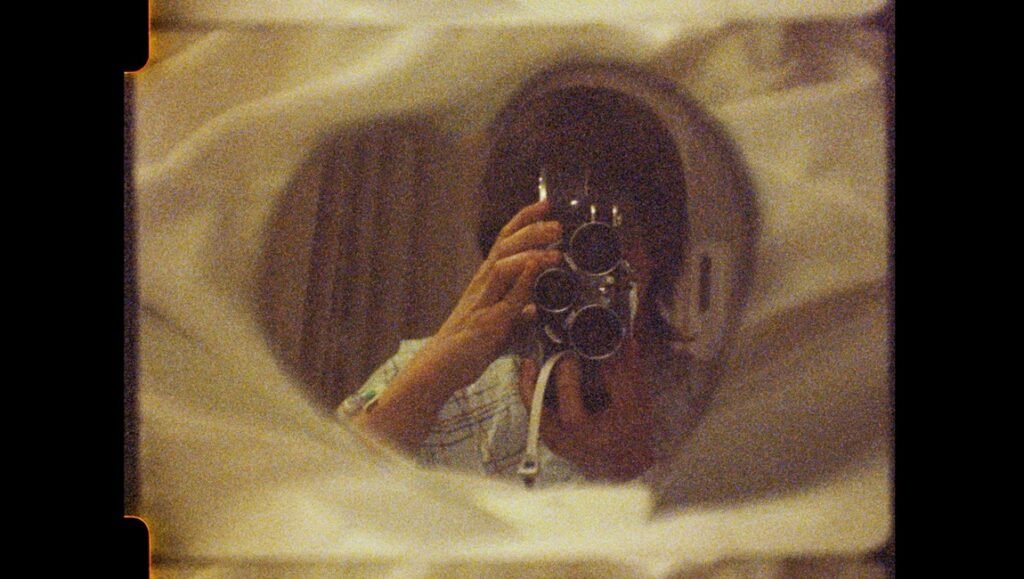
Moving at the speed of its title, Ashley Connor and Joe Stankus’ It Goes That Quick, which premiered at MoMI’s First Look last spring, is a beautiful love letter to the married filmmakers’ respective families. Though it’s crafted from footage the couple (Connor behind the lens, Stankus responsible for sound and editing) shot with their relatives over eight years, juxtaposed with home movies from their youth, the film isn’t a straightforward work of nonfiction but rather a sort of Seinfeldian doc.
Opening with the Leonard Cohen line, “If you are lucky you will grow old and live a life of errands,” It Goes That Quick is about nothing and everything. By casting their relatives in short scenarios — and often inserting themselves into the proceedings to give direction, roll sound, and call action and cut — based on their everyday lives and mundane activities, a multigenerational portrait emerges that’s equal parts comical and profound. One memorable scene, set to a warm piano waltz, involves Stankus’ mother, Andrea, who’s in need of a ride to work after her car breaks down. Running late for a meeting, she reaches out to her elderly father, Fred, to come pick her up. This in turn leads Fred to ask Andrea’s mom, Joan, if she wants to go with him. She does, but she’ll need a few minutes to get ready and then disappears up the stairs. The minutes grow ever longer as Joan dresses, puts on lipstick and perfume, and fixes her hair. All the while Fred calls out to ask if she’s ready yet (at one point adding, “I think she’s got a time limit”).
Eventually, they manage to get out the door and on the road, where Joan mentions for the second time that she needs to stop by the dollar store. They bicker over how to set up the buffet table for the Passover Seder. The quarreling continues once Andrea joins them and adds her two cents about the living room setup and serving gravy. She also wouldn’t mind swinging by that place where Fred gets a daily free bagel as a perk. Meanwhile, Connor’s uncle Michael, a commercial airline pilot, is in a hurry to get home from the airport, having just gotten in after being delayed for a day in Seattle due to the weather. On the long drive back, he calls his husband Ed to let him know he’s eagerly on his way and will ring him once he nears the Wendy’s.
After checking in when he reaches the fast food joint and asking if he needs anything from the store (“I do not,” Ed replies in sing-song fashion), Michael then pulls in to a plant nursery. On the phone with a friend, he laments being stuck on the job for an extra day. “All I want to do is be home. I want to be a hermit housewife in the Poconos.” As he starts browsing price tags on foliage, he also reveals that Ed is still struggling with a death in the family from the year before and that, “I think I want to plant something. I think it’ll make him feel better.” When Michael eventually arrives at their large house in the woods, the couple greet each other with a hug and a kiss — and then spend an inordinate amount of time trying to determine the perfect spot for an impulsively bought tree. They also have cocktails.
And while all this shtick might seem inconsequential and silly, it likewise reveals relationships between longtime husbands, and husbands and wives, and parents and children in a way that gets at their very essence. Indeed, over the course of filming two mothers, two fathers, two grandparents, and three uncles, the ups and downs of life are truthfully captured even as they’re staged. There’s a wedding, a birth, the progression of an illness, and deaths both expected and not. So by the end of the film’s 70-minute runtime, we’re left in a state of wholly unexpected wonderment, wondering how on earth it all went by so fast. — LAUREN WISSOT
Comments are closed.