
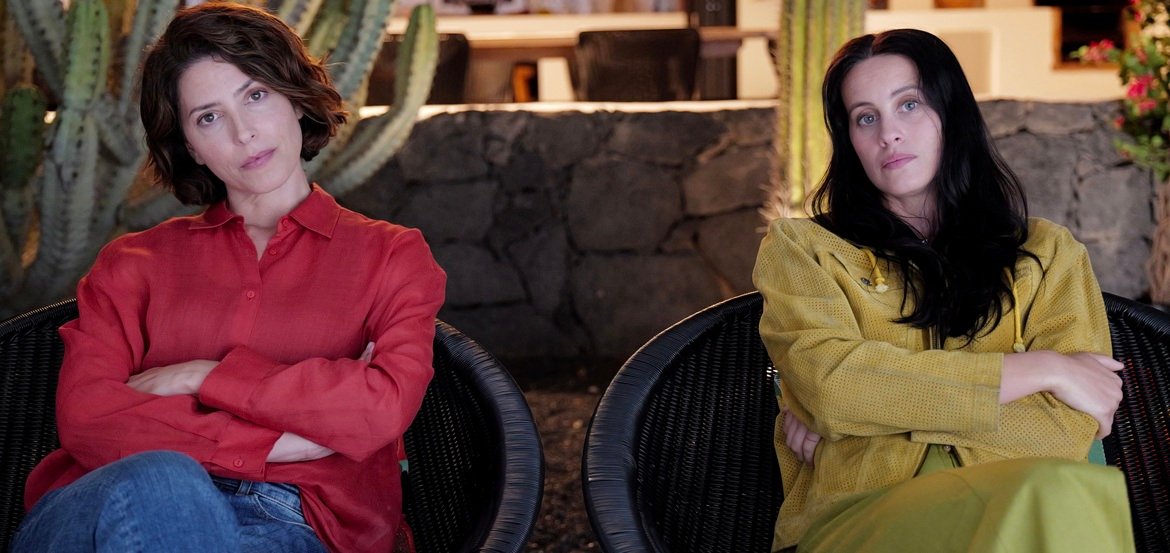
All of a Sudden
The post-Drive My Car films of Ryûsuke Hamaguchi have built a case for the director as the most acclaimed contemporary filmmaker in the world. Even more than his Japanese colleagues, like Kiyoshi Kurosawa or Sho Miyake, who have been educated or critically appreciated by the influential critic Shiguéhiko Hasumi, Hamaguchi seems able to pivot his approachable style toward societal disasters that somehow never spell the total end of the world, and the way filmmaking can fill that void of meaning. While comparisons to Rivette are now more scarce in his career, a generous reading would suggest his theatrical interests can be similarly keyed as rehearsals for navigating a world of conspiracies. He is unafraid, at the very least, to make films that address our current moment, or at least a version of that “moment” that corresponds to the potential space afforded at Cannes or the fall festivals.
The incursion of resource extraction and development in Evil Does Not Exist is, in a less harrowing but perhaps even more disquieting way, brought forth in his new film, which sets the fading memory and physical ability of French seniors with dementia next to the highly regimented, boundary-porous labor performed by the administration and nursing staff at an elderly care facility. Hamaguchi is, once again, using a large canvas to detail a continuum of emotional devastation that is punctuated by dramatic interventions via dialogue and theatrical performance. All of a Sudden is both very easy to take in — it is a picturesque and patient time at the movies — and a work stretched to a breaking point. This is a film about how medical patients and workers alike are exploited for financial gain, and what this does to one’s capacity for thought in work and life; it is also a film that showcases Hamaguchi’s ability to slip into the mode of the French tradition of quality without missing a beat. In some respects, it is a return to the core dynamic of Drive My Car, an expansion of its ethos, and an endpoint stylistically and structurally that seems impossible to push further.
Familiarity is one of the driving forces of meaning in the film. Marie-Lou (Virginie Efira) is the director of a nursing home. She meets Mari (Tao Okamoto), a theatre director. Hamaguchi has based their long, searching dialogues on an epistolary non-fiction text between two similar women; however, their professions have been brought more in line with his interests. In the book, they are an anthropologist and a philosopher; here those professions have been shuffled into their backstories. Similar names, shared languages, and an echoed tolerance for late-hours inquiry and safely restorative intimacy link them together and, in the film’s final act, emanate outward into the nursing home staff, at least those who have seen Mari’s play or have a similar personality to Marie-Lou.
Hamaguchi faces a challenge as Marie-Lou and Mari spend more time together. The principle of possibly his greatest film, Happy Hour, is that its four protagonists each demand a full account of their social life. In order to accommodate their work and family, along with the overlapping instances where the quartet’s interpersonal worlds connect, the film is over five hours long. Something similar occurs in All of a Sudden, but once one of the characters reveals a terminal cancer diagnosis, the film is set on a trajectory that can only end in cathartic understanding. This strict and classically constructed path through all the mysterious and hard-to-assimilate details that Marie-Lou and Mari exchange is also, notably, cluttered with halting introductions to tertiary characters.
In a sequence that brings the film to a spectacular standstill, Mari presents to Marie-Lou her understanding of global capitalist resource-extraction as a way of understanding her own ability to practice art, and even to connect (or not) with Mari as a friend. It’s the culmination of an extremely extended sequence, one that relies on Hamaguchi’s trademark ability to sustain high-attention dialogues between characters. These scenarios in his films often hold no particular promise of highly charged events, yet they retain a privileged narrative position, such that one could say that Hamaguchi’s way of conceiving character in these moments installs these characters as directors of potential drama. (Here, of course, this idea is explicit by nature of job titles.)
So what happens when Hamaguchi must re-introduce this duo to the wider world? If capitalism’s ability to leech social bonds into merely social appearances is now an activated piece of knowledge for these self-aware characters, how will we see their future interactions play out? This private dialogue is interrupted by the sudden appearance of Djibril, a nurse who works under Marie-Lou. Not only is this comic timing a way of alienating Djibril from joining in the scene, it points to a tendency elsewhere in the film, to only halfway develop character traits for the facility’s workers. Despite some appearances, the film does not truly care about Sophie, an experienced and more skeptical nurse who opposes Marie-Lou’s managerial approach, or Adidja, a nurse who, like Marie-Lou, decides to room at the facility, blurring the lines of any work-life balance. The film seems to absolutely assume the perspective of Marie-Lou to the extent that it proliferates the organization’s mandated exercises in which staff members are made to introduce themselves and their personality traits via quirky or heartfelt interviews.
This dynamic also correlates to Hamaguchi’s adaptation strategy. At the film’s outset, Marie-Lou is near burnout due to underfunding and low staff buy-in to a new training initiative, while Mari works hard to ensure her theatrical production remains only a single actor with a minimal set. After their rejuvenating first meeting, Marie-Lou’s workplace successfully hits new benchmarks, and no one has anything other than the highest praise for Mari’s play. We are a far distance from the theatrical critique scene from Asako I & II. The ideas here — about the presentation of disability and human frailty — are not in need of any fierce counter-examples, but the film does become rather lacking in elements that would position Marie-Lou and Mari within a larger world. Not only can we see this shape as a simplicity of design, but a self-reflexive attitude, wherein Hamaguchi has aligned his movie’s societal suggestions with what his characters possess in terms of intellectual resources. The director and the administrator agree on pretty much everything.
Hamaguchi’s control over reality as a writer and director is proven, after three-plus hours, once again to be a complete triumph — he now makes it look extremely easy. But most of us will have seen enough films that gesture toward a capitalist critique — or in this case, a few strongly articulated misgivings about capitalism — to know that the more streamlined and cathartic a narrative, the less room for consideration remains for the audience. As in the case of the progressive schools, libraries, and city halls of Wiseman’s later films (to which the town hall meeting in Hamaguchi’s Evil Does Not Exist has been compared), we can certainly know after an extended running time what they look like, and the language used to describe them. But unlike Wiseman’s investigations, Hamaguchi’s latest is not so much connected to a monumental shift. The film acts instead as an uncompromised conversation, one with an endpoint that sweeps away troubling ambiguities. — CHRIS MELLO

Bitter Christmas
“Cinema has something premonitory about it,” says Elsa (Bárbara Lennie), the cult director-turned-adman at the center of Bitter Christmas. It’s a statement director Pedro Almodóvar could have made himself — if it weren’t so myopic. For Almodóvar, cinema reaches not only toward the future, but in every direction: temporal, quotidian, and fantastical. The titanic Spanish auteur has woven five decades of melodrama through highs and lows, psychosexual ecstasy and pedestrian chastity, the metatextual and the metaphysical. Now, at 77 and with his legacy as one of international cinema’s greats firmly secured, Almodóvar continues a filmic journey inward. Bitter Christmas is a Matryoshkian autofiction intent on taking no prisoners (not least Almodóvar himself) in the pursuit of truth in film — entities indistinguishable to the director, despite what the world around him might insist.
It’s 2004, and neither Elsa’s career in advertising nor her lapsed time as a critical darling are helped by her debilitating migraines. It runs in the family: these day-ruining headaches triggered by thunderstorms and midflight cabin pressure. Fortunately, Elsa doesn’t have to weather them alone. She’s shacked up with Bonifacio (Patrick Criado), a firefighter by day and stripper by night whose love descended into Elsa’s life like a monolith, eternal and unshakable. Before we can learn much more about Elsa, though, she’s revealed as a feint. Elsa is in fact a fabrication of Raúl (Leonardo Sbaraglia), a late-career director in 2026 Madrid whose peppered locks and beard look conspicuously like Almodóvar’s own. Bitter Christmas trades its time across the 22-year lacuna between Raúl and the cipher he finds in Elsa. As life changes for Raúl and his coterie, so it does for Elsa and her supporting cast, each nesting doll racing asymptotically toward the surface of Almodóvar’s own life outside the silver screen.
A metafictional film-within-a-film is hardly new territory, especially for Almodóvar. His late period may have begun somewhere between Volver and I’m So Excited, but it was ratified with 2019’s Pain and Glory. A deliberate pivot from the prismatic splendor of Almodóvar’s greater canon, Pain and Glory is a decidedly sober piece of (semi)biography, a semantic digestion of the director’s late mother and a career in the rearview. It was packaged and seemingly intended as a sort of swan song, a predated Fablemans for the arthouse set. Instead, Pain and Glory spilled an autofictional inkwell across the next half-decade of Almodóvar’s output. He continues to plumb his relationship with all things maternal in Parallel Mothers; he furthers his own anxieties about the beyond with The Room Next Door. But Bitter Christmas emerges as Almodóvar’s most explicit work of autofiction yet. Its series of self-referential knots is a flagrant admission of technique and denial of guilt: toward his loved ones, his work, and his audience.
Bitter Christmas’ nested story (Elsa’s) is as resplendent as any Almodóvar fan has come to expect. By now, his melodrama is effortless to the degree that it exists outside genre. The trials Elsa bears — her migraines, the news of her mother’s death on the set of an underwear ad — are not exercises in hyperbole so much as disruptions given their due and seismic attention. Bárbara Lennie, now a codified member of Almodóvar’s cohort after returning from The Skin I Live In, fits snugly into this heightened schema, ticking like the Doomsday Clock as she regains her artistic voice and threatens to upend her own, fictional life with a new script. Returning too is Almodóvar’s indelible, primary palette: few filmmakers have made reds, blues, and yellows so vital and vibrant. Bitter Christmas is as visually arresting as anything at the zenith of Almodóvar’s work. It’s an assured confirmation that the director hasn’t lost an ounce of his zeal for the sensory, even as his later texts circle an increasingly morbid drain.
What’s more tenuous is Elsa’s tether to Raúl and its inevitable line back to Almodóvar himself. If Pain and Glory exists as a confessional for the director, a peek behind the curtain that once obscured his own life’s influence on his oeuvre, then Bitter Christmas is a manifesto. Raúl’s life falls like rain-swollen leaves into the life he constructs for Elsa. That means the events of those in his periphery — the death of his assistant’s friend’s child, for example — will materialize in a screenplay he knows that assistant will read. Raúl endures the ensuing chaos, the hurt feelings, the accusations of betrayal, but doggedly winds further into his mission: the line between lived and cinematic reality has blurred into oblivion, and while Raúl is happy to make penance for the damage wrought by his work, he shows no inclination to pivot. Bitter Christmas builds a house between the borders of admission and redemption; its bullheaded apologia comes pre-fortified against its fallout.
It’s a surprisingly Catholic dogma for an artist well-known for his flamboyant glee in the sacrilegious. Bitter Christmas’ metafiction folds enough layers into its own architecture to extend past the script, past Raúl/Almodóvar’s problematic methodology, to consider even how the movie will be pitched: should it be shortened to an hour and shipped to Netflix? Could it be compared to the later, minor works of Fellini and Bergman? It’s a deliberately exhausting discourse, a calculated provocation with obfuscated math. Bitter Christmas invests so heavily in self-reference that, in other hands, it might read as hostile toward its audience. Under Almodóvar’s purview, it’s something closer to ambivalence. Whether you’re watching or not, he’ll be typing away, immortalizing the grief and broken hearts and wet dreams and secret perversions of everyone he knows into cinema. — ANDREW REICHEL
The Remotes
“Is there even a suspect? Is there even a crime?” These words spoken by Detective Mijares (Alchris Galura) are as good a summation as you’re likely to find of The Remotes, the sprawling and bizarre new film from Filipino director John Torres. Expanding on his highly experimental approach, seen in previous films such as Toro Toro Teros (2006) and Lukas the Strange (2013), Torres has produced one of his most ambitious films, a 150-minute mood piece that sustains a tense techno-noir atmosphere without ever settling down into a linear plot. The Remotes can be, well, frustratingly remote at first, as the viewer struggles to understand exactly what is happening and why. But gradually we let go of this need to know, and if you can simply succumb to its pervasive mood of oneiric menace, the film begins to wind itself around you.
In short, this is a film about confusion, about the shifting nature of what it even means to be a human being in an uncertain world. With its sleek surfaces and permanent-midnight color palette, The Remotes can be seen as a distant cousin to Blade Runner. The aforementioned detective is trying to get to the bottom of a series of increasingly violent and random automobile and motorcycle crashes. But as Mijares becomes increasingly mired in the secrets of this dreamlike version of Metro Manila, he becomes compromised. At least that’s how we’d understand it in the typical language of film noir. In fact, he may simply be discovering that letting his identity be absorbed by unseen forces is an altogether more satisfactory outcome than trying to solve the puzzle. It seems Torres is inviting us to do likewise.
Here’s what we know. There appears to be a connection between the fatal crashes and a new phone app that is shared among users like a secret handshake; or, better yet, a virus. This app invites the user to relinquish his or her control over their own body. In essence, the app “drives” the user, sending them in directions and onto tasks that exceed the individual will. Mijares begins to suspect that two sisters, Eva (Julia Richards) and Gill (Gabby Padilla), may be at the center of this mystery. Both sisters work in fields that involve turning themselves into digital content. Gill records the voice for a GPS system, while Eva records real estate walkthrough videos. And both seem to be involved in a driving safety school that resembles a cult. While the sisters are still mourning the recent death of their mother, Mijares is still grappling with the death of his wife Marie, from “natural causes” that begin to seem less and less natural.
Torres’s sonic and visual language is entirely unique but not without precedent. In certain moments, The Remotes seems to touch on the urban alienation and vaguely supernatural atmosphere of Apichatpong Weerasethakul, Tsai Ming-liang, Kiyoshi Kurosawa, and later Hou Hsiao-hsien. But the closest kinship is clearly with Chinese director Bi Gan, as Torres is far more concerned with communicating modern life as a kind of all-consuming pressure or affect that exceeds language’s ability to articulate it. Characters’ trajectories shift and mutate, people seem to switch identities, and it is difficult to see how we get from one place to the next. In the world of The Remotes, the general state of being is a combination of grief and amnesia. Ghosts do not walk among the characters, in the manner of Weerasethakul, but the hovering oppression of previous generations impedes motion and personal choice.
The main aspect of The Remotes that will thrill some viewers will leave others deeply frustrated. The film thwarts ordinary meaning-making, and it seems to invite some sort of allegorical interpretation. Torres never specifies what this loss of free will represents, but the film is capacious enough to accommodate many different readings. Its use of GPS as a guiding metaphor can perhaps be understood as a statement on how we have given up free will in order to be “driven” by technology. People in this film behave like non-player characters, waiting for instructions from the unseen player. Critic and Remotes fan Sam Bordojan has suggested that the steady accumulation of dead bodies, a situation to which almost everyone but Mijares has become numb, could be seen as a metaphor for the Duterte era, with its rampant extrajudicial killings. Both interpretations seem entirely plausible.
But above all, The Remotes is a formal experiment that enacts its own premises. If you try to occupy the driver’s seat, this film will take you places you probably didn’t want to go. If you give yourself over to its rhythms and just ride with it, you still may not reach your desired destination. But you won’t for a minute doubt that you’ve gone to a place you’ve never seen before. — TYLER THIER
Comments are closed.