
In This Dispatch
The Day She Returns
Every time a Hong Sang-soo film plays at a film festival, one can assume someone in the audience is encountering the prolific filmmaker for the first time. An artist with a legion of devotees, Hong is often written about by completists (or the nearly) who are properly attuned to the master’s formal rigidity, structural games, and ever-evolving experiments. But the initial impression of a newcomer will likely be that whatever film in front of them is simply lifelike, that the mundane situations are recognizable to anyone, and that the characters seem to go on beyond the confines of the movie which is only a glimpse into their days. That this ordinariness persists alongside Hong’s rigor is worthy of celebration. The Day She Returns is another film in this mold, one where the lives of the characters on screen expand beyond the strong margins Hong applies.
But the films are also lifelike in that, once one has seen a handful, they can start to blur together like one’s own memories, especially as they star a recurring troupe of actors in similar situations. Taxonomy is therefore useful. In reviewing this year’s Nowhere to Lay My Eyes, Lawrence Garcia sets out by sorting the filmography between films “where the structural play with narrative is upfront and unmissable, explicitly marked with title cards or numbers” and those where that structure is hidden. He places The Day She Returns into that first category — the first image after the title card is the numeral 1 — and we can go further to sort the film into a few more simple descriptive categories. The film is in black-and-white; it is one of the director’s films that principally concerns women, the men in the film remaining mostly unseen; and it is another Hong Sang-soo film about characters involved in filmmaking.
The film is split into five chapters, and there are hardly twice that number of camera setups. In the first three sections, Bae Jeongsu (Song Seon-mi), an actress who has recently returned from retirement, sits in a restaurant and allows herself to be interviewed by three young women, ostensibly about her new independent film. Each interviewer, however, seems more interested in facts surrounding Jeongsu’s personal life and celebrity than in her movie, the second interviewer going so far as to admit she knows little about cinema and didn’t appreciate it. They all seem destined to file dull puff pieces. By filming each of these interviews in the same static two-shot, Hong communicates the exhausting repetition of a press day from the artist’s perspective, where a meager few hours of the actress’ time seem longer, especially as each interviewer returns to the questions of the last and her answers, while different each time, also begin to seem canned.
Once in each meeting Hong will cut in to a close-up before characteristically zooming out to the original framing. The implied ellipsis and Hong’s limited framing call attention to the unknown beyond the frame. The director of Jeongsu’s film, for example, recurs throughout the film but always offscreen, his voice ending each interview. And then, of course, there’s the matter of Jeongsu’s personal life, the subject of the bulk of these interviews but one that is still mostly circumvented. She speaks in generalities about her daughter and her divorce, an event that we can infer precipitated her return to the cinema, if not for financial reasons then at least for personal fulfillment. All three interviewers push her on her divorce — search “Hong Sang-soo divorce” and read this inclusion as you will — but she resists divulging out of fairness to her ex. Like most Hong characters, she drinks, not so much now as she used to, but her playful insistence that she and her interviewer order a beer in each segment points toward something more than just a casual tendency to drink.
Then, in the final sections, Hong’s structure further reveals itself. In her evening acting class, Jeongsu is tasked with writing a script based on the day’s events and performing it with a classmate. The reenactment draws upon material from all three interviews but embellishes — or fills in elliptical gaps — to provide new information and insight. Jeongsu’s response to the banal question — “any advice for young people?” — that ended each interview is particularly expanded, like a better, more detailed answer to the question, obviously advice she’d like to have given her younger self, has only come to her now that the moment has passed. She has to refer to her own script several times to recall her own lines.
The added layer of abstraction gives Song a showcase to play her character differently, displaying a variability between the natural performance she gives in the film’s first half and the performed naturalism of the acting exercise. Jeongsu’s performance is like her projected real self from earlier, only with the addition of mannered gestures that suggest an actorly realism. What Hong accomplishes with this last section is externalizing a process by which a combination of experience and internal thought becomes a work. Jeongsu misrepresents her reality not out of malice or shame, but out of a desire to know herself better and make acting a transformative practice. We only know artists through what they tell us, either via interviews or, more tellingly, their art, but they exist beyond these brief glimpses. Even the minor characters in a Hong film feel the same way. The Day She Returns ends in transit to another destination. There’s a world beyond its walls. — CHRIS MELLO
Tender Loving Care
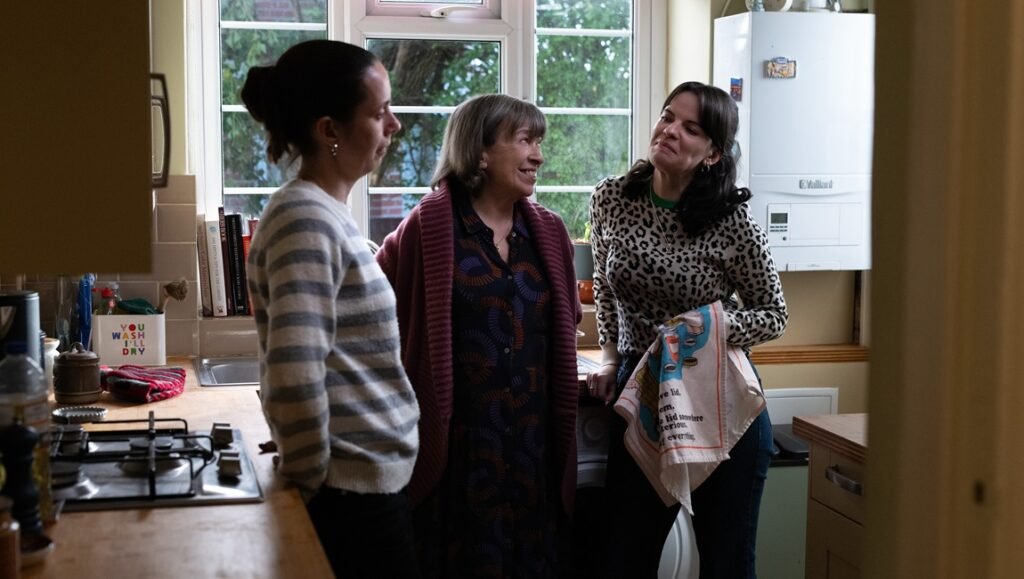
It is perhaps inevitable that a higher number of films are going to be focused on the difficulties of aging as birth rates decline and the world’s population generally starts skewing older, and Mike Leigh’s self-conscious finale Tender Loving Care is one of the leading transmissions from someone who is currently undergoing it. As is often the case for Leigh, the protagonist of the film is frequently just part of a community portrait, and the director begins with a bait-and-switch: it’s technically the story of late-30s committed child protection social worker Amy (Kate O’Flynn), but we open on her closest friend and roommate Rosie (Alice Bailey Johnson), an elderly services worker, dealing with a homeless man named George (Alan Williams) who has become incoherent after a recent heart attack. Rosie is functionally a sister to Amy and is lending her a place to stay after a recent bad breakup, but only Amy’s parents are in the picture, and she’s not inclined to give them more than the bare minimum of information about why it came to an end. Birdie (Marion Bailey) wants grandkids, and Geoff (Paul Jesson) just wants Amy to be happy, but the four are ultimately content to simply spend time together and enjoy bantering about the highs and lows of the past times they’ve shared. It’s easy enough to gloss over the tough issues of the present day when it’s just the two women’s unhappy romantic lives (Rosie is dating a firefighter whom she finds attractive and not much else), but aging is unavoidable, and it’s about to land on the family doorstep.
Side characters who only make a single appearance tend to be the skeleton keys to Mike Leigh films, and Tender Loving Care has quite a few thanks to Amy and Rosie’s profession, alongside Birdie/Geoff’s own bonds: an alcoholic mother who’s lost custody of her children and can’t understand that Amy wants to help, an increasingly paranoid and belligerent old woman who thinks her neighbors are leaving dog feces on her doorstep, and a friend of the family who recently lost her husband and is suffering intense regret about how she ruined her relationship with her son, who didn’t come to the funeral. The central foursome provides plenty of affection to them and to each other, but you’d never come away with the sense that this is enough to compensate. (The fact that Amy and Rosie’s own bonding tends to involve drinking entire bottles of white wine together and goofing off is both an uncannily accurate portrait of white middle-class women’s friendships, and a sign that they’re only marginally better at coping than the average person.) Leigh’s own anger about how Margaret Thatcher began torching the United Kingdom’s social net is expressed very explicitly by Birdie and Geoff in one scene, but it’s the point where Geoff begins having clear signs of cognitive decline of his own that spells out Mike Leigh’s fears for the future even more clearly: if Geoff didn’t have the affection of the title from so many people to keep him in relative comfort, he’d be no better off than the clearly less fortunate.
Tender Loving Care lends itself fairly easily to being compared with Mike Leigh’s sole other 2020s contribution to cinema in Hard Truths (2024), with both coming after Peterloo’s undeservedly disastrous run in 2018 made the prospect of financing Leigh’s typical pre-filming actor’s workshops much less appealing to most studios. Both are small and contemporary productions, and both found the director’s recent struggles with the autoimmune condition myositis playing a role in both the subject matter (Hard Truth’s central woman who seems to be perpetually in pain) and in the form. Hard Truths was the final Mike Leigh film shot by Dick Pope and Tender Loving Care looks to be the only Mike Leigh film shot by Lucy Bristow, but neither one makes much of an impression visually — the job gets done, but there’s a slight sterility to the lighting and the blocking is only as memorable as how the lines are performed. The scoring by Gary Yershon also possesses a certain eccentricity in both titles, with Tender Loving Care’s curious score being performed almost entirely on the marimba. Much more interesting is how Leigh is still finding new ways to demonstrate the different ways that British people communicate with one another. Some of the final scenes of Tender Loving Care are particularly instructive in this regard: after a bittersweet sing-a-long that suggests Leigh’s departed peer Terence Davies if he had made films for the present day, we quietly turn away from the family to return to George for the first time since the start of the film. He’s sitting outside in the cold, and says nothing as people pass him by, but he stares and stares. Mike Leigh’s final message through cinema is both indecipherable and clear as day. — ANDREW REICHEL
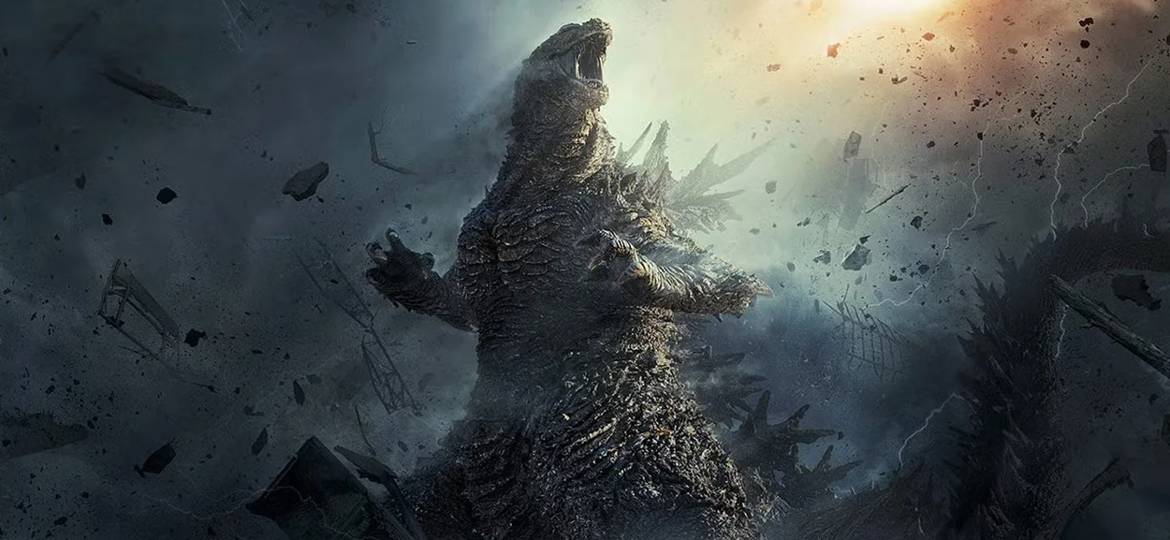
Godzilla Minus Zero
Shin Godzilla exists in a class of its own, nearly experimental in its focus on political red tape in the face of a developing catastrophe, and a creature design that is downright terrifying. Taking that film out of the equation here, Takashi Yamazaki’s Godzilla Minus One (2023) proved a refreshing, exhilarating antidote to the anemic Hollywood reboots that began with Gareth Edwards’ installment in 2014, and have since devolved into unadulterated CGI slop. If AI hasn’t been used in that franchise already, it’s only a matter of time.
Yamazaki’s follow-up, Godzilla Minus Zero — set two years after the events of the first film — cranks up the voltage (quite literally) by introducing tangible mass carnage — between 800 and 2,000 deaths per individual attack — in the form of a frightening, ever-imposing Ghodirah. The three-headed, skin-shedding, rapidly-evolving, gold-electricity-beaming behemoth far outshines Godzilla in his own movie, which is arguably the film’s greatest strength. More latent, but genuinely provocative, is its underlying theme of reckoning with nuclear devastation and foreign intervention.
Godzilla as an IP has maybe lost some of its novelty as an allegory for the atomic bomb in recent decades, especially once Western studios really leveraged it and stripped it of its teeth. But that doesn’t change its fundamentally Japanese impetus; as J. Hoberman puts it, “Godzilla transformed the trauma of the war into fun… [in] a daring attempt to fashion a terrible poetry from the mind-melting horror of atomic warfare.” That idea of terrible poetry is one that resonates in Yamazaki’s sequel, in which bursts of goofy, melodramatic antics are often spliced with disarmingly bold and potently political choices.
The most enduring example of this tonal dance can be seen in Professor Murakami, a character who bounces between absurdly stoic and deeply emotionally disturbed. He is continually haunted by imagery of piles of scorched bodies amid the wreckage of Hiroshima. As a survivor and as a government scientist who now assists with the effort to suppress Ghodirah’s onslaught and must also deal with geopolitical interference from American forces, he harbors a quiet but roiling vengeance toward the U.S. In a particularly unforgettable sequence during the film’s final act, we find Murakami disgruntled in his lab, surrounded by scientific ephemera that store plentiful data on Godzilla’s abilities and potential for weaponization. A whiplash of editing captures the professor at multiple angles as he cracks a maniacal rictus across his face and fantasizes about New York City being leveled by Godzilla.
It would be remiss to ignore in these moments the visual parallels to 9/11. Godzilla begins with the Statue of Liberty, crushing the totem to dust, before setting its sights on Lower Manhattan. Perhaps strategically absent is One World Trade, but the sentiment is there nevertheless — slo-mo shots of pedestrians burned alive in real time, skyscrapers detonated, and the monster’s enveloping blue energy beam slicing right through the cityscape. This is what revenge would look like for the acute, irreversible decision to drop A-bombs on Hiroshima and Nagasaki. Godzilla weaponized against the United States, no longer wreaking havoc or causing further atomic aftermath for the already traumatized island nation. Off to foreign shores.
This sequence is striking aesthetically and politically, offering an uneasy conclusion to the buildup of Murakami’s ongoing flashbacks throughout the narrative. He catches himself for thinking so violently, and is berated by fellow colleagues for wanting to weaponize Godzilla in the first place, but in the end this fleeting fantasy sequence is pivotal when it becomes clear who the true villain of the story is. Spoiler alert: it’s not Ghodirah, it’s not Godzilla, and it’s not the Japanese scientists and officials.
To focus only on the film’s political contours, however, would be a mistake and would overlook most of its other thrilling details. There are the tactile textures of its CGI, which sell its genre trappings and work in slick tandem with the film’s subtly slapstick sense of humor. There are the actors’ performances, which strike a nice balance between soapy and earnest, and are neatly of a piece with the film’s postwar narrative arc. There’s the fact that Yamazaki disrupts expectations and effectively builds momentum by steering clear of big action set pieces; essentially, there’s just one in the first quarter and another in the last. Everything else, then, is human folly, strategy, empathy, and bureaucracy. And so, the stage being thus set, when Godzilla Minus Zero’s large-scale kaiju battles arrive, they are one helluva good time. Terrible poetry, indeed. — TYLER THIER
Comments are closed.