
In This Dispatch
Paper Tiger
For the past decade, James Gray has been talked about in cinephile circles as the last great American (neo-)classist, the only auteur effectively continuing to make mature narrative cinema with the formal precision and operatic scope of a Coppola, Lumet, or Michael Mann. He works within many of the big genres of yesteryear, when Hollywood still made films for adults: crime films, melodramas, colonial epics, big-idea sci-fi, and coming-of-age stories. His frames are always precise, beautiful, immaculately lit, yet never showy or self-conscious. He can mount an action scene like few others today, makes tidy work of familial conflicts, and knows how to create richly textured visions of our shared history, all semi-invisibly without ever showing himself showing or exuding an ounce of self-consciousness. He is a nostalgic director, in a sense, aspiring to a type of cinema which no longer feels possible in American culture, yet he’s also one who has never worked in the post-modern nostalgia modes of pastiche, irony, and self-referentiality.
Beyond rich traditions of film form, his narratives also often evoke the troubled emotional violence of Greek tragedy. Almost all of his films are about families torn apart, brothers working against one another, fathers abandoning sons, mothers suffering in their constrained domestic sphere. There’s a clear moral sense to his characters, and they almost always evince the will to do the right thing even if they run in the wrong circles. Even with the best intentions, fate and the larger contours of a world marching in step with Darwinian capitalism turn them against one another as self-preservation drags them toward moral and personal calamity. That this is often firmly rooted in a sharp sense of American immigrant history and the machinations of modern power structures is what makes Gray not just compelling, but an increasingly essential voice in contemporary cinema.
His latest, Paper Tiger, seemingly picks up where his last, Armageddon Time (2022), left off: the outer boroughs of New York City during the 1980s, where a seemingly perfect nuclear family finds themselves in deep shit for no good reason of their own. The dad, Irwin (Miles Teller), is a bookish engineer, content with his middle-class life yet eagerly taken in by his brother Gary’s (Adam Driver) idea for a quick $10,000. The city is trying to clean up the Gowanus Canal (a Superfund site still to this day), and Gary sees a chance to pick up some of the contractor money for environmental assessments. While starting as a small-scale portrait of industrial waste and the ineffective bureaucracy built around pollution standards, the film quickly grows into a panoramic vision of the immorality of Reagan-era power struggles. Irwin — nebbish, awkward, and a little clueless — innocuously pokes his nose where he shouldn’t one night, ticking off the mob-backed Russian contractors who have hired him and Gary. While threatening Irwin and his family, what they really want is Gary, an ex-cop with influential connections who refuses to become corrupt.
As a genre craftsman, Gray is economical and precise, spending more time on the construction of ambience than violent spectacle. On a beat-by-beat level, scenes unfold steadily and unhurriedly, with ample breathing room given to moments of pure character and scene-setting. Reuniting with cinematographer Joaquin Baca-Asay (The Yards, We Own the Night) and shooting on film, Paper Tiger is gorgeously textured, rich in its urban street scenes and bathed in beautiful neo-noirish greens, yellows, and reds in its nighttime scenes and interiors. Every shadowy close-up or well-timed camera move is at once incredibly precise, completely stunning, and gracefully understated — never sacrificing absorption and emotional consistency for spectacle.
With performances, Gray is one of the few remaining directors who can engender classical naturalism steeped in a method-like ability to capture micro-nuances of expression. Driver, who often leans into stolid, monk-like reserve, gives one of his nerviest performances as Gary, a man whose endless confidence and constant joking are mere wallpaper, slowly peeling away as we become more and more privy to how aware he is of how much is at stake and how quickly everything can unravel. When Gary is confronted by his former police-officer partners about his Russian connections, a whole unseen well of fragility and anxiety is glimpsed in pauses and small shifts in his gaze. Scarlett Johansson, meanwhile, has some of the film’s most startling close-ups as Irwin’s wife, Hester, whose fragile solidity corners her suffering into an almost exclusively private affair that lives in a world of its own. At moments she goes full Meryl Streep, with constant method-like ticks — a quivering lip alongside perpetually busy hands — but in other moments, such as when she’s in a doctor’s office after a cancer test, it’s a marvel to see her transform into pure suffocated interiority, self-doubt, and disbelief with micro-maneuvers of voice and eyes.
Beyond the operatic and socio-political dimensions of the film, one of the most compelling readings of Paper Tiger lies on an autobiographical level — James Gray’s father, Irwin, was an electronic parts salesman caught up in a Queens municipal corruption scandal in the early 1990s while Gray’s mother was suffering from terminal cancer. From this angle, the film is rife with Oedipal tensions, a power struggle for the contrasting generational visions of the American dream. The skeezy Russian immigrants — Gray’s grandfather was one himself — offer an atavistic idea of strong-man crony capitalism where the most savage takes all, while the Pearls offer something of the middle-class assimilationist dream, where playing by the book and working hard are supposed to offer clear paths to a simple, easy life. That Paper Tiger finds that this dream takes sacrifice and that moral purity is barely an option are both evidence of the film’s leftist leanings and signs of its inability to offer a unique exegesis on contemporary America’s ills.
The film’s almost Lynchian vision of a suburbanite society whose tranquil surface is just a band-aid to its savage underbelly is compelling for its efforts to crack below that surface, to take us into the belly of post-industrial globalist misery in the same way Dickens and Marx did for industrial capitalism, yet it’s also dated, too beholden to 20th-century ideas of corruption. Today’s greed and savagery are not below the surface — they are almost all that we have in public political life. To posit a moral world betrayed by its immoral shadow is to indulge a useless nostalgia mode of political action, one that reifies the idea that capitalism could function justly if only its savage (and, in Paper Tiger’s case, Slavic) side could be destroyed. This doesn’t, however, lessen the film’s aesthetic and dramatic impact, but merely functions to dampen its vitality. Like most filmmakers, Gray is a better craftsman and artist than political polemicist. Vastly more important than Paper Tiger’s socio-economic commentary, however, is its belief in a certain sense of spiritual suffering inherited from classical tragedy. It’s a movie that understands the connections between mothers and fathers and brothers and sons, and the emotional sacrifices we make for one another. It’s a beautiful work, one that lives up to its opening Aeschylus quote and achieves a level of accomplishment and scale very few American films have been capable of this decade. — JOSHUA BOGATIN

The Man I Love
“My father said you got to swallow your feelings.” Jimmy Page, the fictional actor at the center of Ira Sachs’ new film The Man I Love, makes this remark in character as a hardened chanteuse in a play he is rehearsing, but he may as well be speaking about himself. Played by Rami Malek with elusive charisma that slowly fades into ragged vulnerability, Jimmy is a star of the downtown experimental theatre scene in 1980s New York City whose work and life are threatened by the encroaching symptoms of AIDS-related illnesses. Sachs stringently resists the standard narrative beats of AIDS dramas designed to elicit cathartic emotional outpourings. Rather, Sachs trains his focus on Jimmy’s pursuit of pleasure to stave off suffering, and the anxieties and resentments his hedonism provokes in those close to him. Sachs’ disciplined approach resists cliché to such an extent that AIDS is never explicitly mentioned; the syndrome hovers about the film like a specter while Jimmy and his loved ones try to focus on their daily affairs. The characters of The Man I Love spend their days swallowing their feelings out of necessity; their buried pains prove all the more agonizing when they, inevitably, burst forth unbidden.
Sachs opens The Man I Love with Jimmy returning to his shared apartment with his partner Dennis (Tom Sturridge) after a stint in the hospital. Jimmy is in good spirits and relatively good health, and while he settles back into his domestic routine with Dennis — who acts more as a full-time caretaker than an equal partner — he also is intrigued by his new downstairs neighbor, Vincent (Luther Ford). Vincent is a charming twentysomething who has just moved to New York, and he is as compelled by Jimmy’s mystique as Jimmy is by Vincent’s youthful good looks. At the same time as he embarks on a love affair with Vincent, Jimmy’s professional life continues apace with a starring role in his theatre company’s new play, though he is frustrated by his uncharacteristic inability to remember his lines. Jimmy ignores the signs of his own declining health and the concerns of his loved ones, instead continually enjoying his life’s joys: love, sex, theatre, musical performances, dinner parties, dancing.
Sachs uses a minimalistic approach to propel the relatively sparse plot and develop his characters. In the place of traditional narrative development, Sachs uses much of the film’s runtime to luxuriate in episodes of social, artistic, and erotic pleasure. A representative example is a homecoming party for Jimmy early in the film that culminates in the guests singing folk songs and show tunes one-by-one, with all in attendance aglow in the joy of collective music-making. Sachs also spends extended time in rehearsals with Jimmy’s eclectic theatre company, in bed with Jimmy and Luther in post-coital relaxation, and at a club where shirtless men dance close to pulsating bass.
If Jimmy steeps himself in pleasure, and Sachs cues the viewer to follow, then Dennis acts as a counterweight, constantly reminding both Jimmy and the viewer of the brutal reality of Jimmy’s illness. Sturridge gives a melancholy, beleaguered performance; in his weary face, one sees his unconditional love for Jimmy and his resentment toward Jimmy’s lack of acknowledgment for his steadfast caregiving. It is telling that one of the film’s most substantial scenes of dialogue is a tense exchange between Dennis and Luther, which culminates in Dennis pinning Luther against a wall in anger for what he sees as his carelessness in having sex with Jimmy. The scene succinctly represents the characters’ narrative functions: pain-stricken experience and youthful ignorance. Neither is equipped to handle the cognitive dissonance of Jimmy’s simultaneous ravaging illness and continuing life.
Malek is tasked with embodying this dissonance, which goes some way toward explaining his idiosyncratic performance. His acting style is highly gestural and laden with behavioral tics, a twitchy physicality that stands in contrast to the mumbly baritone he speaks in. The performance, at first, is absorbing yet distancing, with a display of surface-level technique that does not provide access to deeper intimacy. Something breaks in Jimmy’s presentation, though, when he performs, and Malek’s performance engages on a more visceral level in turn. In the dinner party scene, Malek is sweetly intimate when Jimmy joins his sister Brenda (Rebecca Hall, as luminous as she was in Sachs’ last film Peter Hujar’s Day) in a rendition of “How Are Things in Glocca Morra?,” and he delivers a languorously romantic performance of George and Ira Gershwin’s torch song “The Man I Love” at a bar. Behind the psychological safety of the fourth wall, Sachs suggests, Jimmy can express his innermost emotions honestly; the implication is that if he did so in his regular life, he may fall apart.
The pinnacle of Malek’s performance — and arguably of the film as a whole — is when Jimmy sings Melanie’s “Look What They’ve Done To My Song, Ma” at an anniversary party for his parents, accompanying himself on the guitar. A jaunty tune with lyrics that suggest the destruction and exploitation of the human spirit, Malek’s performance escalates in intensity until his voice becomes a ragged, desperate howl, the song a lament for his violently circumscribed future: “Look what they done to my brain / Well they picked it like a chicken bone / And I think I’m half insane, ma.” The discontinuity between the genteel family event and the abject pain Malek emanates is jarring; the depths of betrayal at the hands of his own body (and, implicitly, a negligent government) are almost too much to bear. Look what they’ve done to his song.
The film’s formal qualities track with Jimmy’s slow decompensation: Director of photography Josée Deshaies’ warm, color-drenched frames grow sterile and detached, and editor Affonso Gonçalves’ precise, time-jumping cuts intensify in consequence as Jimmy’s life diminishes. AIDS does not deliver catharsis, reconciliation, or revelation in The Man I Love, as a more conventional film might suggest to give its viewer a sense of emotional fulfillment. Here, as in life, the disease only lays waste to lives that were once fully and vibrantly lived. Yet Sachs’ film is not nihilistic or resigned to the desolation left in the wake of the AIDS pandemic. Indeed, it is significant that the film centers on a character so devoted to holding on to what he can in life for as long as he can, and equally so that the film’s final frames show men dancing together, an expression of defiant freedom.
Formally challenging and narratively sparse as it can be, The Man I Love proves to be a significant work of queer cinema that finds insights both confrontational and tender by looking back to a long-gone but treasured subculture. Sachs’ film is at once an elegy to a lost generation of queer artists, represented in the compelling form of Jimmy Page, and a paean to life’s immortal joys. — ROBERT STINNER
Life of Jorge Luis Borges
In his rather humbly titled “Autobiographical Notes” that appeared in the New Yorker in 1970, Jorge Luis Borges recounts the day in 1935 when, from her deathbed, his paternal grandmother Frances Haslam — “a respectable English lady” from the West Midlands — told her “Georgie” and the gathered family: “‘I am only an old woman dying very, very slowly. There is nothing remarkable or interesting about this.’” Grandma “Fanny,” Borges notes, then went on apologizing “for taking so long to die.” This may be as good an entry point as any into the life of Argentine writer Jorge Francisco Isidoro Luis Borges, and, one hopes, even more so into the Life of Jorge Luis Borges, the experimental documentary by El Pampero Cine co-founder and filmmaker Mariano Llinás, who prepends his exhaustingly inexhaustive portrait with a line from Jean de La Fontaine: Défendez-vous par la grandeur — “Defend yourself with grandeur.” What in itself may read as a Flaubertian imperative turns, within the logic of the fable “Death and the Dying Man,” into its near opposite, La Fontaine’s memento mori: La mort ravit tout sans pudeur — “death seizes everyone without shame.”
It — or “she,” as the French dubs the Grim Reaper — does indeed. And it is death that allows people to look at another person’s life and tell it how they see it. If one understands the biographizing practice thus, there is no issue with the terse international title of Llinás’ biography of Borges: Life of Jorge Luis Borges, for every life exists solely as a story and, as such, begs questions about its narrator. And if there is one charge to which Llinás, throughout the film’s more than five-hour-long runtime, never lays himself open, it is the obfuscation of his own narrative subjectivity. Far from it, his skittish and mischief-infused voiceover remains dominant throughout, the chaotic zeal of its performance perceptible even to non-hispanophone ears. It is a kind of filmmaking that follows traces, sometimes mere intuitions; a filmmaking that turns things upside down. Toward the very end, we see Llinás’ hand write down the same sentences that his voice uttered only moments before, thus turning the screenplay — that element that is typically expelled from the mise-en-scène — into a play of the screen, not for it.
Before, about midway through the film, Llinás had already met us sitting at his office desk, interrupting our full-screen experience of car-riding through La Pampa, the image of which suddenly reduced to a small window on his editing monitor. If there was any sense of liveness to the previous scene, it quickly dissipates once it reveals itself as footage shot who-knows-how-far-prior to this moment. Similarly, Llinás at one point reports about a message he just received, but as we see him taking quite some time to scroll up the WhatsApp chat, we realize the unreliability of his assemblage. In yet another instance, when replaying one of his voice memos, he kicks it up to double speed. So much do temporality and locality get juggled around in Llinás’ narration that we inevitably lose track of — well, the tracks.
But see, speaking of “tracks” may already hint at a misunderstanding, for Llinás’ project, not unlike that of the narrator named “Borges” in Borges’ famous short story “The Aleph,” strives for the experience of simultaneity where earthly constraints, the limits of language, enforce sequentiality. The fictional Borges of that tale, much to his chagrin, must come to accept that one of his most annoying adversaries is not the madman he took him for; that so-called “Alephs,” worlds at large that can be experienced in impossible limitless lucidity, do exist. Yet, the problems they naturally pose to a man of letters are those of representation: “What my eyes beheld was simultaneous, but what I shall now write down will be successive, because language is successive.” It is a problem well-known to Llinás, though he, with every fiber of his being, seems set on resisting the formal rules of narrative cinema, i.e., of ac-counting and re-counting.
In 2024, not so long after the Institute for Studies on Latin American Art in New York had commissioned Llinás to make a film project about the vast collection the Institute had recently acquired, Senses of Cinema published an excerpt of a still unpublished book by the film scholar Hernán Sassi under the headline “Mariano Llinás in the Footsteps of Borges.” In this excerpt, Sassi argues that Borges’ literary legacy lives on much more in the films of the New Argentine Cinema than in the national literature of the nascent 21st century. Who better than Llinás then, one may ask, to attempt the impossible and compress the infinite worlds of Borges into one — if particularly long — motion picture.
As is to be expected when giving artists quasi-free rein, the project, initially to be centered on the world’s largest private Borges collection, quickly outgrew its premise. Somewhere in between travelogue, reenactment, investigative journalism, and essay, between YouTube and Venice’s Sala Casinò, where it premiered out of competition, this “biography” remains to the end unidentifiable. And those few scenes that do approximate the conventional are offhandedly mocked by the filmmaker himself, who in one scene laments the necessity of including one particularly boring episode of the journey. As if to make up for it, Llinás, in other moments, squeezes in a sequence here and there for its mere unusualness. A random place he happens upon is captured solely for the reason that it otherwise would be “unlikely ever to appear in cinema.”
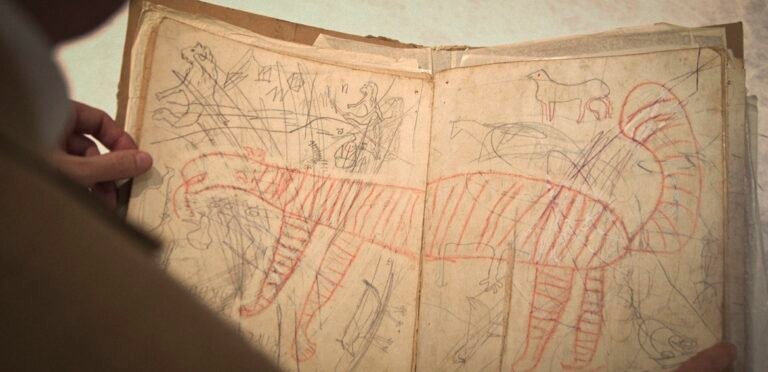
On this journey, Llinás is regularly accompanied by Ernesto Montequín, director of the UNESCO-Villa Ocampo Documentation Centre outside of Buenos Aires and the film’s Borges expertise incarnate. Montequín, with his solemn airs, makes for a most natural target of Llinás’ trolling, yet nevertheless proves one of the emotional pillars of the story; a necessary protagonist — “the star when no one ever asked him” — who quickly ascends to MVP status. He is the Sherlock to his — Llinás’ — Watson, the filmmaker quips. And indeed, Montequín, in the role of the skillful investigator, right away appears to solve an enduring mystery that leads the film into explorative terrains: the infantile yet somewhat precocious tiger drawings that, for decades, had been misattributed to feline admirer Borges. Signed none too subtly in the name of Adolfo Bioy Casares, the writer of The Invention of Morel and Borges’ lifelong friend — who, mind you, had not yet been born in Borges’ boyhood — these drawings make one wonder why, throughout several decades and numerous editions, they were recurrently reproduced under Borges’ name. While the remaining film has no fund of similarly revelatory “magnitude,” the diario de Montequín, as Llinás dubs it, subsequently becomes one of the film’s irregularly regular segments. During a particularly poignant moment in it, we encounter a notebook dated to the 1950s, whose script makes a sudden shift: it marks the moment when Borges lost his eyesight and began dictating — for a long time to his mother, later to other collaborators.
If Montequín is the implied hero of the story, Norman Thomas di Giovanni — one of Borges’ English translators, and likely the most significant, who passed in 2017 — becomes the villain of Llinás’ narrative; albeit, for the most part, a villain in absentia. Ever and anon, meanwhile, the audience is reminded of the ongoing production process: at one point, we see the director play the very tones on a xylophone that underscore the scene. Going even further, Llinás and his DP Agustín Mendilaharzu — known for his work on Trenque Lauquen and the monumental La Flor, to mention just the household names — spend an extended scene resisting their own camera that cannot seem to get right the jade-green color tone of the cover page of the 68th issue of Sur, the magazine that first published Borges’ canonical story “Tlön, Uqbar, Orbis Tertius” in 1940. The function of this scene — its refreshing playfulness aside — is clear: reminding us that whatever we see is rendered through a lens, and sometimes a quite literal one.
It is in this sense that one should understand Llinás’ imposition of the villain role upon di Giovanni, with whom Borges between 1967 and 1972 went on an innovative and rather ingenious spree to carry over many of his hitherto untranslated stories into English. Publicly, Borges would later come to call these English variants better than his originals, though in private — at least according to Bioy Casares and his 1600-page biography Borges — the famed writer was much less enthused by di Giovanni and their co-authored translations. It is not so much a complaint as an observation that this episode, among so many other side trails, did not find entry into Llinás’ film. At any rate, it appears obvious that di Giovanni, like no one else, got under Llinás’ skin. In omitting this chapter of Borges’ life, which, granted, is of much more interest to the anglophone ear, Llinás makes use of the biographer’s perhaps most powerful device and nearly erases di Giovanni’s presence, save for the latter’s misogynist dig at Borges’ first wife Elsa Astete Millán.
The other reason why this dispute does not feature in greater detail is, of course, that to find a fiend in a biographical tale of Borges, one need look no further than Borges, the man of mirrors himself. As an attempt at “a biography, not a homage,” Llinás initially describes the coordinates of his endeavors. Consequently, he does not spare us the many interviews toward the end of his life that see his reactionary turn that outright demolishes his cultural legacy. Interviews featuring racist slurs and denigrations of Indigenous people are well documented, as is his public siding with Augusto Pinochet after the Chilean’s coup d’état in 1973. The latter episode, Llinás suggests, likely cost Borges the Nobel Prize — a matter that is perhaps belabored a touch too long, and too strongly. All the more powerful is the manner in which Llinás effects a transition toward Borges’ political regression. Together with El Pampero Cine stalwart Laura Paredes, Llinás reenacts a legendary interview in which poor Borges was asked to opine on tennis star and multiple Grand Slam champion Guillermo Vilas. The verve with which Llinás imitates the assertive journalist and Paredes returns Borges’ irritated dictum is deeply infectious. And yet, it is the script’s change for another, more politically centered interview — in the course of which Paredes’ Borges posits his revolting worldviews — that reveals the subversive potential of the reenactment format and its mechanics of identification and differentiation.
Decades before, in February 1921, Borges and his coevals Jacobo Sureda, Fortunio Bonanova, and Juan Alomar had published the Manifiesto Ultraísta in the Mallorquin magazine Baleares. Central to their postulation was the fundamental distinction between the “passive aesthetic of mirrors and the active aesthetic of prisms.” Given the millennia-old concepts of mimesis and poiesis, there was no particular novelty to such juxtaposition. And yet, it seems quite obvious that the ultraístas’ striving for a prismatic form that “uses the world as its own instrument, and creates—beyond any spatial and temporal prison—its own personal vision” deeply resonates with Llinás.
Toward the film’s very end — it is the year 2024 — Montequín learns that Edgardo Cozarinsky, the legendary Argentine filmmaker and novelist, has died. Upon Llinás’ suggestion, Montequín, who devoted much of his career to the study of Cozarinsky’s work and is the universal heir and literary executor of the filmmaker’s estate, presents a eulogy in commemoration of his kindred spirit. But only a few words into the speech which Montequín reads aloud with habitual solemnity, Llinás intervenes through voiceover, wondering aloud about the person behind Montequín, this man he earlier dubbed the “star” of his film. What under different circumstances might well be taken for indelicacy reveals itself to be a twofold movement that commemorates the dead without forgetting those who commemorate them. For it is the latter who keep them alive. Is it then a cliché to note that this film is as much a film about Llinás as it is about Borges? Quite possibly, but all the better for it. — PATRICK FEY
Comments are closed.