
Ink
“Fleet Flick From Fleet Street!” That could be the Sun headline for Danny Boyle’s boisterous adaptation of James Graham’s 2017 play about the transformation of the stodgy British newspaper into a tabloid sensation. Tabloid Thrills! Fast-Paced Action! Eye-Popping Pictures! These elements, present in pretty much any Boyle film (Trainspotting! Slumdog Millionaire! 28 Days Later!), find a perfect fit in Ink. Set in a vividly detailed late-1960s London, the film recreates the lightning-in-a-bottle moment in 1969 when two outsiders in the newspaper world, Australian ex-pat publisher Rupert Murdoch and rogue editor Larry Lamb, teamed up to create a lively daily paper that broke boundaries and, along with its American counterpart The New York Post, catered to a working-class readership to help shape and stoke the contemporary British and American conservative movements.
Ink opened on stage in London in 2017, barely a year after Brexit, and on Broadway in 2019, deep into the presidency of a real-estate tycoon whose rise was hypercharged by his masterful control of the tabloids (Trump’s affair with Marla Maples gave The Post one of its legendary headlines, “Best Sex I Ever Had”). New York Times theater critic Ben Brantley wrote in 2019 that the play “foretells the age of populist media in which we now live and squirm.” Ink seemed then, as it does even more during Trump 2.0, to speak to the current moment.
Like the big, flashy stage productions that preceded it, Boyle’s film is a mechanical wonder. It draws stylistically from the pulsing, percussive rhythms of the heavy metal machinery, like clanging typewriters and rumbling printing presses, that filled the pre-digital newspaper offices of yore. With its abundance of sharply tailored, stylish clothing, Boyle’s Ink is a celebration of Savile Row as much as of Fleet Street. And propelled by its banger needle drops and thrumming score by Daniel Pemberton, it’s as visceral as the hard-copy tabloid papers sold by the millions in newsstands’ heyday.
Guy Pearce plays Murdoch as a keenly ambitious, tightly wound businessman torn between the rectitude and propriety that comes with a desire to fit in and be part of the club, and the mercilessness of a spurned suitor who wants to crush his competition. But Ink’s pulsing heart is actually the ruthless, resourceful editor Larry Lamb, whom Murdoch hires to reinvent The Sun. Lamb’s relentless drive, and ultimately his hubris, are thrillingly embodied by Jack O’Connell, who oozes charm as he rounds up his samurai staff of reporters with Toshiro Mifune-like focus. O’Connell first made his mark as a manic teen delinquent in the British TV drama Skins (2009-10), and Angelina Jolie deserves credit for giving him his first leading film role in Unbroken (2014). Building on the sinuous charm of his Irish-American vampire in Sinners (2025) and cult-like gang leader in this year’s 28 Years Later: The Bone Temple, Ink should function to propel him to major stardom.
It is irresistible fun to watch Lamb and his band of misfits brainstorm the Sun toward its punchy new identity: snappy headlines, horoscopes, page-two weather reports, a women’s section with a keen focus on sex (including a serialization of The Sensuous Woman), and a steady flow of shocking crime stories. Standing out among Lamb’s dream team is Jules Davis (Claire Foy), who makes the most out of a somewhat conflicted role as Lamb’s mistress and the paper’s spokesperson for women’s independence. In a film that draws on the fast-talking brio of classic newspaper films like His Girl Friday (1940), Davis is a somewhat subservient version of Hildy Johnson.
Boyle also understands that for the film to work, it must walk a tightrope. One can’t help but root for the Sun’s scrappy staff and celebrate the paper’s soaring circulation. Charismatic as they are, however, Lamb and Murdoch are antiheroes whose legacies and success are built on questionable ethics and a coarsening of public discourse. All the President’s Men this is not. The film’s ominous final section focuses on two troubling episodes in the Sun’s history. First, there is the kidnapping of Muriel McKay, who was mistaken by the perpetrators as Murdoch’s wife but was, in fact, the wife of a top Sun editor. By cashing in on the case’s sordid personal details, one has to wonder what harm the paper also contributed. And second is the introduction of the “Page Three Girls,” a vulgar attempt by Lamb to test both the censors and Murdoch’s own sense of propriety through photographs of topless women.
A too-tidy montage at the end of Ink rushes to connect The Sun’s reckless, attention-grabbing strategies to the pernicious fake populism of Fox News and the click-bait frenzy of today’s entire social media environment. But as we watch the circulation numbers for The Sun soar, there’s also no denying that just under Ink’s rollicking surface is a sober understanding of the way that populist media grew to become a behemoth that ultimately serves the interests of the wealthy. — DAVID SCHWARTZ
Mr. Nelson, Did You Kill People?
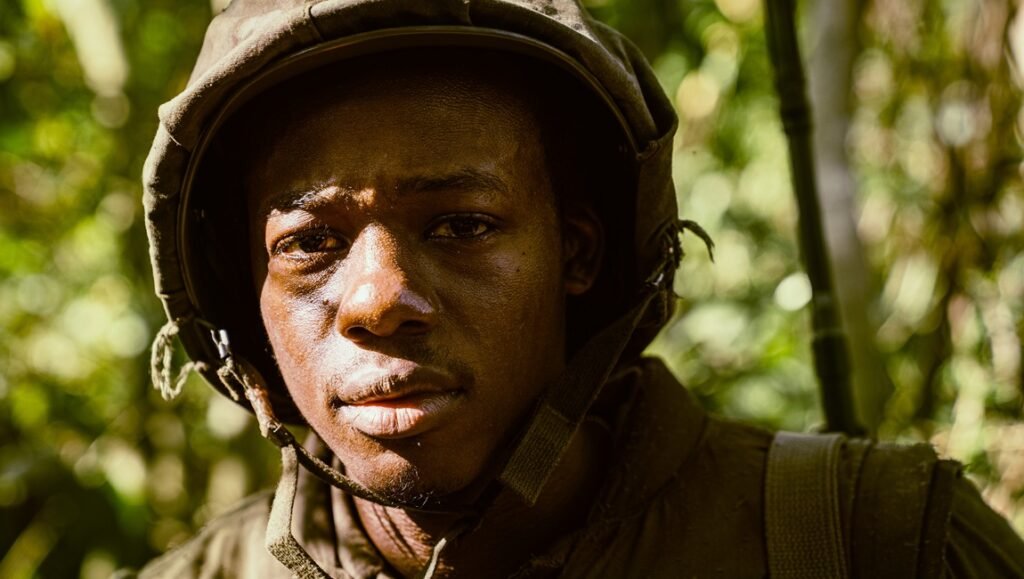
The title of Shinya Tsukamoto’s latest foray into historical war drama comes from a question asked by a child to a Vietnam War veteran. Allen Nelson (Mark Merphy), suffering from PTSD and currently living in an abandoned building, has been invited to speak to a classroom of fourth graders about his experiences in the Marines. He describes to the kids his experience of life in the forest (hot, crawling with insects) and the reality that not everyone makes it home, but until this girl bluntly asks, “Did you kill people?” he elides his own actions. That he killed enemy combatants is a given, an expected and accepted possibility of warfare, but coming to grips with the atrocities he committed in Vietnam will take up the rest of both Allen’s life and Tsukamoto’s overlong film.
Years later, Allen’s (now played by Rodney Hicks) material conditions have improved drastically: he is married with a young stepson and is employed, but his PTSD persists. Unable to sleep peacefully, his medication ineffective, Allen seeks the help of Dr. Daniels (Geoffrey Rush), who pushes Allen to bring his old memories to the surface. Tsukamoto’s script, his second in English, awkwardly takes the most literal approach to the material. This manifests in Daniels, as he tries to unravel the psychological dimensions of his patient, simply asking “Why did you kill people?” ad nauseam at the conclusion of all their sessions across many years.
For a while, Allen’s answer is simplistic, avoidant, and unchanging. It was war; what was he supposed to do? The flashbacks Tsukamoto employs, however, tell a story of cold-blooded murder and massacre, no matter how much Allen insists on the heat of combat fueling his decisions. Mr. Nelson Did You Kill People?’s approach to war is protest by extremity, befitting its director’s roots in an aggressive, discordant horror aesthetic. War is realized as a gory, unpleasant affair, filmed with shaky cam intensity and focusing on the most repugnant encounters. Allen’s unit — made up predominantly of other Black soldiers, a fact which Tsukamoto only engages with in passing — becomes increasingly ruthless, and while they are initially fighting for their lives, soon enough they are using their hunt for the Viet Cong as an excuse for slaughtering entire villages. Much of what we see here is pedestrian in the context of the many other movies about the conflict, but a handful of images are so repellent that they threaten to stick in the viewer’s mind.
But it’s not all therapy. By the time Dr. Daniels reaches a breakthrough with Allen, a whole hour of Mr. Nelson remains. Tsukamoto’s effective war scenes in the rearview, the rest of the movie focuses on Allen’s domestic life, his work toward inner peace, and the stumbling blocks of various triggers, most notably an incident in which his teenage stepson brings home a Marine recruitment pamphlet from school. On the rare occasion that the film depicts a panic attack, the Tsukamoto who made Tetsuo: The Iron Man shows up with a few visual sequences that disorient and render familiar settings unrecognizable. But largely, the film’s second half looks terrible, with the plain digital filmmaking landing well below par for even bad television, even if the expanded space of the film’s domestic drama gives Hicks the room for a nuanced, powerful performance that almost overcomes the deficiencies of the thudding script and lifeless direction.
Yet for however much Mr. Nelson, Did You Kill People? is a repetitive slog, a symptom of the late style’s dark side, it remains an effective and intelligent work about the lingering effects of war, thanks primarily to the insistent agitation of Tsukamoto’s stronger instincts and Hicks’ gravitas at its center. At the end of the film, as Allen embarks on a long speaking tour throughout Japan, the movie denies the simple healing framework a more facile psychological study might take. Allen has taken steps toward a healthier reckoning with his past, yes, but old wounds remain open, with redemption and forgiveness left lingering appropriately, painfully out of reach. — CHRIS MELLO
Djinn Wedding
How to escape from the bottom of the barrel? In Ferit Karahan’s Djinn Wedding, a family in desperation moves into an abandoned house in rural Anatolia. A white horse lingers nearby, meteors fly through the sky, and the kids see evidence of dinosaurs in the fields beyond. A curse befalls them, two parents and four children apparently doomed to a life of misfortune. In this way, Djinn Wedding is a somewhat dour, pessimistic movie, save for a last-minute implied stab at hope for the aforementioned escape, though it’s not a film lacking in insight or intelligence.
Those who saw Karahan’s 2021 international breakthrough feature, Brother’s Keeper, won’t be surprised to discover that, but where that movie was taut and piercing, Djinn Wedding is loose and sloppy. Karahan casts his net too wide here, following several characters over three time periods; the jumps in perspective and period stymie emotional and thematic development. Holding it together is only the exploration of misery, the hardship that accompanies each and every family member through life in their own, uniquely punishing way. But without a clear catalyst or purpose, the gloominess quickly begins to feel gratuitous, and the haste with which promising storylines are abandoned holds emotional connection at a resolute reserve.
The first of the movie’s three chapters concerns the inception of the family’s woes, as illness brings tragedy and self-destructive vices are passed through the generations. The second takes place some 10 or 15 years later at the wedding of Deniz, the only daughter in the clan. Here, Karahan begins fleshing out these characters, and his talent for so doing reaps rewards — he’s particularly good at orchestrating a confluence of multiple internal conflicts and stances within both individuals and groups, and there are a few tense encounters that fizzle with the ambiguity and uncertainty of where they might lead. But, alas, they don’t really lead anywhere, as this chapter concludes with another tragedy, one glib and implausible, before chapter three leaps ahead a couple of decades. Here, the family’s fortunes are at their lowest, though a new generation offers the possibility of change.
All that this would require, Karahan suggests, is to dismiss the validity of the curse. One of the movie’s most persuasive qualities is its assertion that those most doomed to despair are those who invest in that doom, be it poverty, loneliness, or dogmatic spiritual adherence. Two scenes, mirroring one another, in the local imam’s car reveal a distrust for conventional authority that’s familiar from Brother’s Keeper; the imam is Djinn Wedding’s most keenly observed character. Karahan draws everyone, from the family members to the supporting parts, as powerless in some manner or another — and often several — their lives instead dictated by tradition, religion, money, the past, superstition, or their elders. Those who eventually claim power do so of their own accord, and must do so alone.
Most alone is Ceren, the eldest son, whose roguish, black sheep quality is oddly cliché for a movie that otherwise deals in more nuanced personalities. The focus on him forces a judgemental, faux-objective stance — as one man against the world, he has some substance, but as one man against the real people around him, with their real problems, he’s too insipid to inspire positive identification. This is one of Djinn Wedding’s most persistent problems — it’s hard to feel sorry for such sorry souls, and, by the time you do, Karahan has already moved his perspective elsewhere.
That restlessness is why this movie ultimately doesn’t work, and this fault is easy to diagnose due to the fact that Karahan’s better instincts are entirely observable. His sharp, unfussy compositional sense (there’s one long tracking pan that feels manufactured, but it’s an outlier), his canny blend of verisimilitude and dramatic urgency, his understanding of character and of how various distinct characters interact — all are present. They’re just scattered, nuggets of cinematic diamonds in a sea of misguided impulses. Karahan’s not quite at the bottom of the barrel himself, but, with his next feature, he could do with an escape of his own. — PADAÍ Ó MAOLCHALANN
The Ultra Runner
The dovetailing of a post-Free Solo film landscape with the advent of a mass production, streaming-focused documentary apparatus — exacerbated by the home-viewing requirements and trends of early Covid — has resulted in the homogenization of what was once one of cinema’s most adventurous forms (and quite literally when it comes to adventure docs). Even looking beyond the milquetoast, ready-made genre templates that have been stamped, approved, and nigh-mandated for true crime and nature documentaries that hit streaming platforms with the regularity of the well-fibered, there is a scarcity of quality nonfiction cinema accessible to viewers. This is due both to top-down profitability decisions operating in an ouroboros feedback loop tandem with consumers and to the industry’s writ large capitulation to our digital era’s preference for sensationalism, subsumed into the presentation and construction of even the most ostensibly serious-minded material. It’s depressing enough that Trump the Redux has ushered in a wave of overearnest but deceptively lightweight documentaries — ones that function only to reinforce the status quo by keeping attention trained on systemically-engineered cultural ills, allowing a neoliberal audience to gorge themselves on their own decency, all from the comfort of their sofas and sectionals. But now we are forced to suffer a form that has abandoned its roots in the avant-garde in favor of all the visual panache of a Zoom call; it’s to the point that your average documentary can only be dubiously regarded as a visual medium anymore.
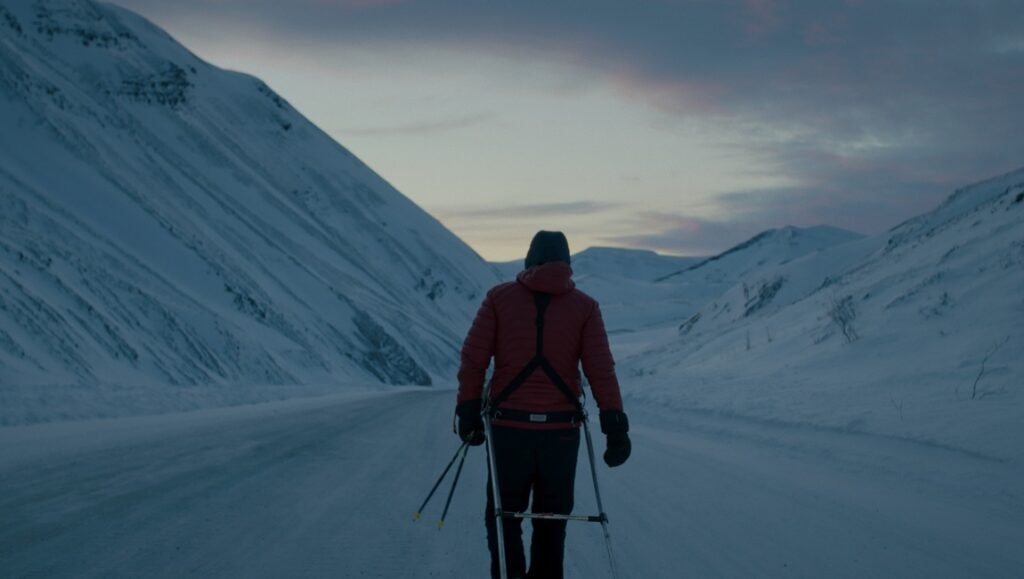
And so, whatever prefab designs engender their creation, there is at least a concrete visualism to nature docs — and all tendrils of subgenre that umbrella term implies — that passes a baseline sniff test for cinematic form. One particular branch in the realm, growing in popularity in the wake of the aforementioned Free Solo, is the one that aims to paint psychological portraiture of the cortisol-depleted, highlighting those individuals inclined to testing human limits on the extreme surfaces and facades of the natural world. It’s a film flavor no less indebted to our taste for the sensational and still very much amenable to the favored talking head format of conveyor-belt cinema, but one which also allows kinetic, even experimental, formalism, intentional compositions, and insight from the minds of those who we can usually safely suspect might also find fault with the kind of mass media consumption documentaries now too often reflect. Into this tradition comes Mila Aung-Thwin’s The Ultra Runner, which purports to detail twinned past-and present narratives: of ultramarathoner Tiberiu Uşeriu and his participation in 2017’s 6633 Arctic Ultra, a punishing 380-mile footrace through subzero Yukon territory; and re-enactments of the athlete’s childhood in Romania, which was plagued by familial disruption and abuse, resulting in a decade-long prison sentence earlier in this life.
That innate drama to The Ultra Runner’s narrative offers a compelling enough setup for a documentary of this sort, and there is a fitting austerity to the film’s depiction of an endeavor so grueling on both mind and body; to inject undue fanfare and tension into the presentation of a race so brutal that it sometimes fields fewer than 15 participants would cultivate a fatal dissonance here. Similarly, the material world that is captured during this race is far from the grandiosity of spacebound mountaintops or the dark depths of an alien ocean world, instead consisting mostly of windswept snowy highways and passerby longhaulers. Indeed, the best footage to be found is decidedly humble, as when a disembodied voice from behind the camera, falling into the athlete’s pace, fails to elicit any response from Uşeriu, who is presumably locked into the kind of psychological empyrean necessary to accomplish such a feat. It’s tough to imagine a tougher mystery to solve than that of a man who can achieve something like this, and simply observing the act establishes a fascinating record.
Unfortunately, The Ultra Runner’s other half, detailing Uşeriu’s difficult life journey as a companion piece to that of the race’s difficulty, doesn’t get much more complex than that conceptual contrast. It’s a shame, too, because in the film’s gentler moments the endurance athlete offers fascinating glimpses into a complex person worthy of an expanded canvas. Instead, Aung-Thwin keeps things as blandly inspirational as possible — to the point of highlighting Uşeriu’s present-day motivational-speaking work multiple times — flattening psychological nuance into easily digestible eat-pray-love gruel absent any real interrogation. The director employs the same biopic template as fiction films, falling prey to the pattern of reducing life to a montage of the biggest dramatic beats, which has the effect of lending everything the sheen of the manufactured. And none of this is helped by Aung-Thwin’s formal approach to his re-enactments of the past, which possess a halcyon, sun-dappled visual quality and a self-conscious sheen of melancholic yesteryear. Not only does this leave one half of the film to feel in direct conflict with the other, but it distractingly emphasizes the self-conscious artifice of the narrative’s structure, leaving it to exist at an awkward nexus of fairy tale impressionism and realist tragedy. That’s not to deny the genuine vein of moving humanism that runs throughout the film, but to observe that much in the way that motivational speaking becomes a bumper-sticker testament to real human experience, The Ultra Runner opts to employ platitude and narrative convenience at the expense of a less pat, more honest reflection of life. — LUKE GORHAM
Also Playing
Soumsoum, The Night of Stars
Chadian director Mahamat-Saleh Haroun has staked out a strong, consistent ethic across his career. His films champion the cause of the outcast, the foreigner, the troublesome figure whose very being disrupts the habits of tradition. This perspective has no doubt been informed by his own straddling of distinct cultures, as an African Muslim filmmaker trained and educated in France. But Haroun’s films are never staged as simple confrontations between old and new ways. Instead, he identifies prejudice and misogyny as trans-cultural phenomena, and his films often explore the ways in which tribal or religious rituals are distorted and mobilized in order to justify bigotries that were already in place.
There is an element of simplicity to Haroun’s narratives, and sometimes they can seem anti-dramatic, as if the point were merely to direct our attention to some problem in the social fabric. But Soumsoum, the Night of the Stars demonstrates the reasons why Haroun’s concerns are evergreen. This is a film about the scapegoat, an anthropological structure that is neither traditional nor modern, but has mutated over time to serve the needs of those in power. In this case, the members of a Muslim community vilify Aya (Achouackh Abakar Souleymane) because of a series of deaths during childbirth. Rather than examine the material conditions that contribute to maternal mortality — ones that any NGO would happily identify — the village has decided that Aya is a demon and must be shunned. They even go so far as to withhold medicine from her, which hastens her death.
Soumsoum is a story told from the point of view of 17-year-old Kellou (Maïmouna Miawama), an independently minded girl who is herself viewed askance by the villagers. Her mother died during a childbirth overseen by Aya, and various people casually claim that this is a sign that Kellou herself is cursed, “born in blood.” She is not permitted to be with the Baba (Christ Assidjim Mbaihornom), the boy she loves, and the fact that her father, Garba (Ériq Ebouaney), is an immigrant only adds to her marginality. When Kellou befriends Aya, who becomes a surrogate mother to her, the lines are firmly established. Kellou has gone against the tribe, and she must be either reined in or banished.
Haroun’s early films reflected an unadorned realism that, while skillful, was essentially functional. Over the years, he has perfected his craft, and although Soumsoum is not as conceptually rich as 2021’s Lingui, the Sacred Bonds or his underrated, Paris-set 2017 film A Season in France, the new film is perhaps his most vivid. There is an undercurrent of animism in Soumsoum, one which becomes thematically pertinent but is evident stylistically in Haroun’s detailed attention to the Chadian landscape, especially the network of caverns on the outskirts of the village. This may also be Haroun’s first film to employ special effects, as one particular rock formation unexpectedly comes to life.
It’s evident that Haroun is trying to simultaneously decry superstition and articulate the value of ancient forms of spirituality, ones that are sometimes perceived as being at odds with Islamic practice. Soumsoum cannot achieve this balance in an entirely satisfactory way. Kellou is presented as a young feminist whose identity bristles against patriarchal tradition. But then we learn that she has visions, and her access to the supernatural connects her to a suppressed matrilineal magic. Haroun wants to thread a tricky needle, respecting Islam, Western rationalism, and ancient African tribal wisdom, but sometimes these discourses simply clash. Soumsoum, like Haroun’s other films, wants to find a way to forge them all into a progressive humanism that respects the old ways but offers freedom to the individual. It’s a noble ideal to be sure, but it’s a task Soumsoum, unsurprisingly, cannot accomplish. — MICHAEL SICINSKI
The Final Act
“Medical assistance in dying,” or MAID in Canada, is the country’s assisted suicide legal framework. The framework is now a decade old, and its use has been relatively normalized. (This writer, for instance, knew someone who chose to die this way, and this is not in itself an unusual level of awareness across the country.) For director Sophie Deraspe, coming off back-to-back narrative features that took TIFF’s Best Canadian Film prize, the subject has perhaps been on her mind since as far back as 2009’s Vital Signs, in which a character joins the staff of a palliative care department. By all accounts, she is a director with an unusual level of research-based insight and prestige to lend the topic.
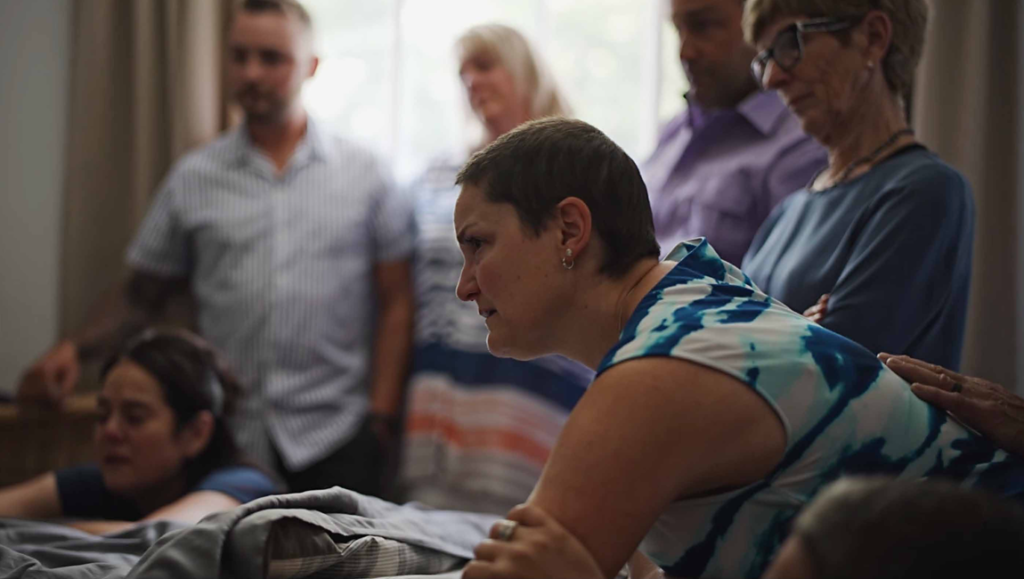
Yet The Final Act most assuredly does not follow in the tradition of sensitively rendered reflections of mortality in nonfiction cinema, as in Frederick Wiseman’s Near Death, Michael Roemer’s Dying, or Allan King’s Dying at Grace. Unlike those films, we do not gain deeply intimate access to particular people. Instead, Deraspe adopts an oral history approach, in which a cross-section of people all variously echo similar ideas underpinning their reasons for choosing MAID, and their intentions in choosing to have their final days filmed. But while Deraspe is evidently a natural interviewer, what becomes immediately clear is that her film is sloppily constructed, ignores the tension inherent in the topic, and, at the risk of harshly criticizing a film that contains many moments of vulnerable confession, rather dubious in its conclusions.
After opening with a Camus quote and letting social psychologist Sheldon Solomon set up the film’s philosophical premise — that MAID represents a new paradigm of living and dying that has never before existed in human history — the film assumes an almost faux-naive approach, with choirboys that stare into the camera lens and a range of interview segments that studiously avoid the most critical aspects of MAID policy that are currently in the process of being enacted, debated, and delayed in Canada. This is a film about assisted suicide that never once uses the word disability (though visible disability does appear), and completely elides discussion of mental illness.
The social impact of MAID has already, in highly publicized cases, become a pressurized aspect of living with disability in Canada; a common criticism of the framework is that assisted suicide is such an efficient process that it all but eliminates the tricky, nuanced, near-impossible conversations that provide the basis of Wiseman’s film about what it means to suffer or die or prolong life when pain is by its nature self-reported. Instead of this protracted refinement of language and treatment, MAID might be said to displace pressure from the public healthcare system onto its most vulnerable members. The expansion of MAID in Canada to include people who, rather than having a “reasonably foreseeable” death, are simply diagnosed with a mental illness that has no permanent cure, is currently delayed from 2023 until at least 2027 because of how this legal intervention could impact human rights.
While none of these controversies — or, one might say, questions inherent to the topic — are raised in the film, this context reveals the limitation of Deraspe’s human-interest approach. MAID is essentially a means by which one’s rights are potentially empowered regarding one’s own suffering. This is the way most of the subjects articulate their decision. They do not want to suffer, and they do not want their loved ones to suffer by witnessing the deterioration of their body and mind. There is something tragically inadequate about this line of thinking, however. As we hear its repetition, there is no question that this mantra is the truth of their experience, but this fear of fear is implicitly contradicted in the brief moments when we see that their deaths, of course, in no way prevent long-term grief and trauma for each patient’s surviving family members and friends. People exercise their autonomy, but any supposed radical change — and the reach of its meaning — can never be truly named or investigated. It’s a new legal process, a new variation on a ritual. So what does it mean for MAID to create justifiable scenarios that, even in a best-case use, produce unintended effects? This is the ultimate limitation of the reportage mode of streeters and oral histories; if Deraspe has anything to say about what her in-the-field empathy has collated, we never hear it, as she prefers to keep her film in a sentimentalized and easily digestible frame.
In effect, then, The Final Act is an advertisement for what might be termed “standard use” under the MAID framework. Each person dies at home or in a care facility surrounded by loved ones. It happens that all of Deraspe’s main subjects have extended families and friend networks, which lend their final moments, cross-cut near the end of the film in a way that is perhaps egregious, a sense of spectacle. 15 years ago, a movie called How to Die in Oregon won the Sundance jury prize for best documentary. It was an unabashed advocacy doc (with its own share of flaws) at a time when legislation around the right to assisted suicide was rare in North America. To make this kind of film now in Canada is timely, and also slightly absurd in its slant. One of the repeated conclusions in The Final Act is that there should be no shame, and less reluctance, and far more familiarity, when it comes to talking about death. But the film cannot conceive of an actual public that might do this talking; it contains itself to the suspect banality of a few well-cast model cases. — MICHAEL SCOULAR
Phoolan
It’s hard to talk about Richie Mehta’s Phoolan without first talking about Bandit Queen and Arundhati Roy. In 1994 in India, writer Arundhati Roy was invited to the screening of Bandit Queen. Directed by Shekhar Kapur and written by Mala Sen (adapting her own biographical book, India’s Bandit Queen: The True Story of Phoolan Devi), the film made a claim to absolute truth as it painted a picture of Phoolan Devi, a bandit turned politician. The real-life Phoolan Devi gained notoriety for being a part of a gang that would rob higher-caste villages, and for punishing her rapists and evading capture by authorities; people of lower castes praised her because she boldly stood up against caste-based and gender-based violence. Devi was charged in absentia in the early-’80s for the Behmai massacre, wherein 20 high-caste men were allegedly shot and killed by her gang under her command. She claimed she wasn’t there, but was nevertheless hunted by the police until her surrender in 1983. She served 10 years in prison for the massacre; upon her release, she became a politician. She was assassinated in 2001 at the age of 38.
Kapur’s film spun the myth that much of Devi’s bandit career was in response to being raped by various men into an unassailable claim of truth, visually depicting her as the murderer during the Behmai massacre. Roy’s complaint against the film was that it put Devi’s life at risk because it passed “judgments that ought to be passed in Courts of Law.” As “Bandit Queen claims nothing less than ‘Truth’” and as it depicts the woman as the active murderer, it also and primarily depicts her as the perpetual victim of rape, with every one of her actions being a reaction to violence. The film is difficult to watch because every few minutes Devi is being raped by one man or another. Indeed, Phoolan Devi herself claimed that the film was misleading and subsequently took the film to court. Roy writes in Mother Mary Comes to Me that her issue with Bandit Queen isn’t one about freedom of speech so much as it is about consent: Kapur’s film, in its belabored depictions of Devi’s rapes, a woman still alive at the time of the film’s release, violates the woman all over again, but also preemptively works to evade criticism by virtue of its claims of “truth.”
Mehta’s Phoolan, in comparison and perhaps in reaction to Roy’s and others’ responses in the ‘90s to Bandit Queen, makes no claims toward truth. In fact, Mehta’s film almost defensively reins in its stride and claims fiction from its outset. There is a fearsomeness about this film, an unwillingness to offend that saps the story about a very vibrant and opinionated and rebellious person of its sting, leaving it feeling as though it doesn’t stand for anything. Where Kapur’s film incensed, Mehta’s feels forgettable. Phoolan takes place over the course of a 48-hour siege on a village in the Chambal region of India, immediately after the Behmai massacre. Devi and a handful of her comrades are hiding within the village as the police swarm the small area. At every turn, Devi outsmarts the heavily armed police, and as she works to get away, she recalls the years and days leading up to the siege. In snippets, we receive her story: how she went from a child standing up for her family to a young adult standing up for herself and other women.
Mehta and co-writer Anu Singh work off of Devi’s 1996 autobiography I, Phoolan Devi: The Autobiography of India’s Bandit Queen, and yet the film opens with a hefty disclaimer: “While the film is inspired from true events, characters, life stories and events have been fictionalised and dramatized creatively,” the disclaimer begins. It’s all well enough, until the disclaimer says that no dialogue, characters, or scenes in the film are “intended to offend the sentiments of any individual, caste, community, country, ethnicity, race, or religion, or to denigrate any institution, location, political party, or person living or dead.” And that the film’s makers have “the highest regard and utmost respect for the government authorities and law enforcement agencies including the police department.” It’s an intentional disclaimer that defangs Devi’s story — the story of a woman who was incendiary, offensive to many people, many men — and does itself a disservice. That’s not to say that disclaimers are in and of themselves a problem, but this particular one, in this particular film, feels odd, feels both sidesist, feels fearful, rendering a film about a renegade person underwhelming and milquetoast.
While Kapur’s film was cruel, Mehta’s film simply doesn’t feel strong enough to carry Devi’s story, which is a shame because it does succeed in making her feel like a fully-formed human rather than only an eternal victim. In having a disclaimer that positions the film as not intending to offend anyone, it extricates Devi’s story from society, ossifying it as if in a snow globe, rendering it as divorced from space and time, from any bearing in reality. While Kapur’s film hewed to truth as an ideal, Mehta’s film hews to very little at all — to both truth and fiction, to meaning and meaninglessness. In this way, a story that ought to embolden, that ought to incite passions, becomes something lackluster in Mehta’s hands. Phoolan Devi was a rebel, a renegade; she was bombastic and vivid and strong; she was offensive to tradition and custom; she was not palatable. And yet in Phoolan, her story becomes one not constructed with the explicit aim of not offending, carried in the same breath as a respect for government authorities, law enforcement agencies, and the police department, institutions that sanctioned and carried out a hysterectomy on Devi without her consent. These institutions wanted her blood, but are in Mehta’s film coddled. Phoolan Devi would be disappointed, to say the least, and so too should viewers. — ALISHA MUGHAL
Wavelengths: Anoushahpour/Aljafari
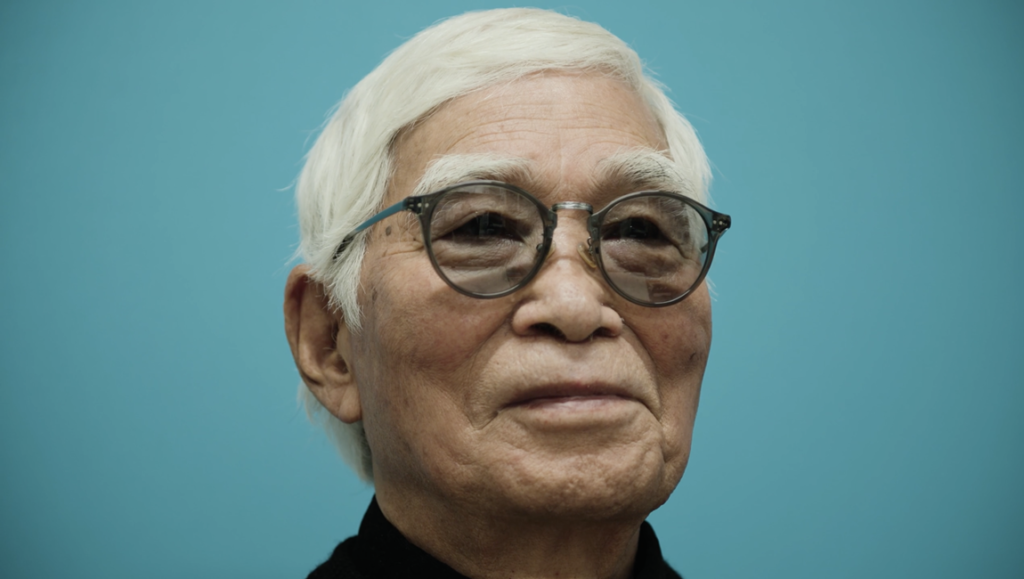
A committed revolutionary who doesn’t see his filmmaking practice as something separate from his revolutionary aims, Masao Adachi has consistently stuck to his guns under utmost duress, refusing even to let what was declared a national tragedy (the assassination of Shinzo Abe) remain unexhumed. Naturally, his revolutionary ideology has a price to pay, and in this case, it resulted in multiple prison sentences abroad for his militant support for Palestinian liberation (a film even sprang from his travels, Red Arm/PFLP – Declaration of World War, co-directed by Pinku film maverick Koji Wakamatsu), and, following his deportation, the withdrawal of his passport by the Japanese government. Flung from one bureaucratic department to another, Adachi’s ordeal in retrieving his passport has only been met with 17 denials. A natural tendency for any filmmaker would be to foreground this struggle, laying out the historical context while rousing their audience through Adachi’s dogged defiance. But for Palestinian filmmaker Kamal Aljafari, such struggles with displacement and dissent are all too familiar. Therefore, he and his collaborators (the project was jointly conceived with Adachi, filmmaker Neo Sora, Ikuyo Shida, Makiko Nishigaito, and Hideo Shida) shift the focus of the film to the seemingly innocuous act of Adachi taking a passport photo himself, baiting both Adachi’s supporters and detractors into expecting an overtly radical revolt based on Adachi’s reputation, while turning their attention to kitsch, both communist and capitalist.
Masao Adachi Takes a Passport Photo indeed shows us the very action of its title, but without a frontal shot of Adachi. Aljafari films him primarily from the back and side, giving us the occasional glimpse of parts of Adachi’s facial profile. The “full picture” of Adachi’s face is only seen in the passport photo, the very denial of that document simultaneously freeing Adachi from the disciplinarian confines of the passport frame while tethering him to Japan. The picture and its accompanying labels (“communist,” “anarchist”) are all that make a dissident, so every “normal” action is imputed to disruptive, revolutionary intent. So Aljafari accordingly doles out parodic communistic kitsch — Che Guevara cigarettes, passport photos framed through garish red filters that recall Warhol’s pop art — for governments who can only conceive of left ideologies in terms of their accouterments and larger-than-life figures. Aljafari spends even more time with the studio owner, a kindly old lady who has some difficulties with the copying machine, than with Adachi, offering the capitalistic kitsch strewn across the photo studio — reality shows playing on the TV, souvenirs, photos of attractive locations across the world as advertisements — as an apt counterpoint, reframing the entire (governmental) discourse on ideology and normalcy through commercial objects. Though he doesn’t cover too much new ground in this regard, the contrasts and Adachi’s tongue-in-cheek retorts are delightfully engaging.
***
Parastoo Anoushahpour’s Peacocks Come With the Clouds also homes in on a mystique — a mystique of a minority community and the mystique of the Western world through their lens. Ostensibly intended to be a documentary on the embroidery in Kurdish villages located on the borders of Iran and Turkmenistan, Peacocks Come With the Clouds is instead an evocation of a strange, surreal mood, a mood wrought by Iranian propaganda and, perhaps, the current war and incessant American attacks. Shrill industrial noises from factories almost induce the villages into a daze, a daze that can’t be dispelled by either getting too close through disorienting handheld footage or zooming out too far through landscape shots teeming with clouds functioning as harbingers of things to come. The title possibly alludes to the mating dances of peacocks as a prelude to the rain, a motif that lines the intricate embroidery the villages are famous for, but as a villager remarks, even the peacock might have been brought by the Russians. Conspiracy wafts through the air, and even the seemingly innocent children are corrupted by it. These children become our entry point into this world of embroidery, with Anoushahpour focusing on children’s workshops while simultaneously depicting their surrounding neighborhoods. By centering the children’s perspective, she attempts to channel the spirit of Kiarostami, subjecting the entire embroidering process and its histories to critique through the lens of a confused generation.
However, her knack for conjuring eerie, extraterrestrial moods overwhelms the agency and art of the villagers, which she rather tackily underlines through sci-fi staged plays of aliens by the children. (Who would have thought that the connective tissue of these two films is actually… kitsch?) The embroidery is more often than not reduced to a prop, one that serves to enhance the film’s moods, almost as if the art form itself is in a state of crisis. Perhaps this is the point Anoushanpour wishes to make at this particularly fragile juncture in Iranian and Kurdish history, but this also robs the villagers of their culture and specificities, making them mere pawns in the hands of larger historical and political forces. The art form isn’t given its due, nor is there a sustained critique of it, so all that remains is its death knell, which regrettably makes this film an act of cynicism rather than one of resistance. — ANAND SUDHA
Comments are closed.