
Wild Horse Nine
Two depressed guys, a remote location, and loads of shit hitting the fan. Martin McDonagh doesn’t need much more to make sophisticated black comedies that handsomely straddle the line between populist banger and purist art film. Ever since the Irish playwright turned to cinema as his primary artistic avenue with 2008’s masterful debut In Bruges, his adherence to that formula has been a reliable gauge of the quality of an oeuvre that still amounts to only five features. With the middling Tarantino-esque mosaic satire of Seven Psychopaths (2012), he bit off more than he could chew. And while the follow-up, Three Billboards Outside Ebbing, Missouri (2017), fared much better at the box office, and at the Academy Awards where it was in the running for seven statuettes, its blunt engagement bait around the political hot topics of the day made the dour Frances McDormand saga age like milk.
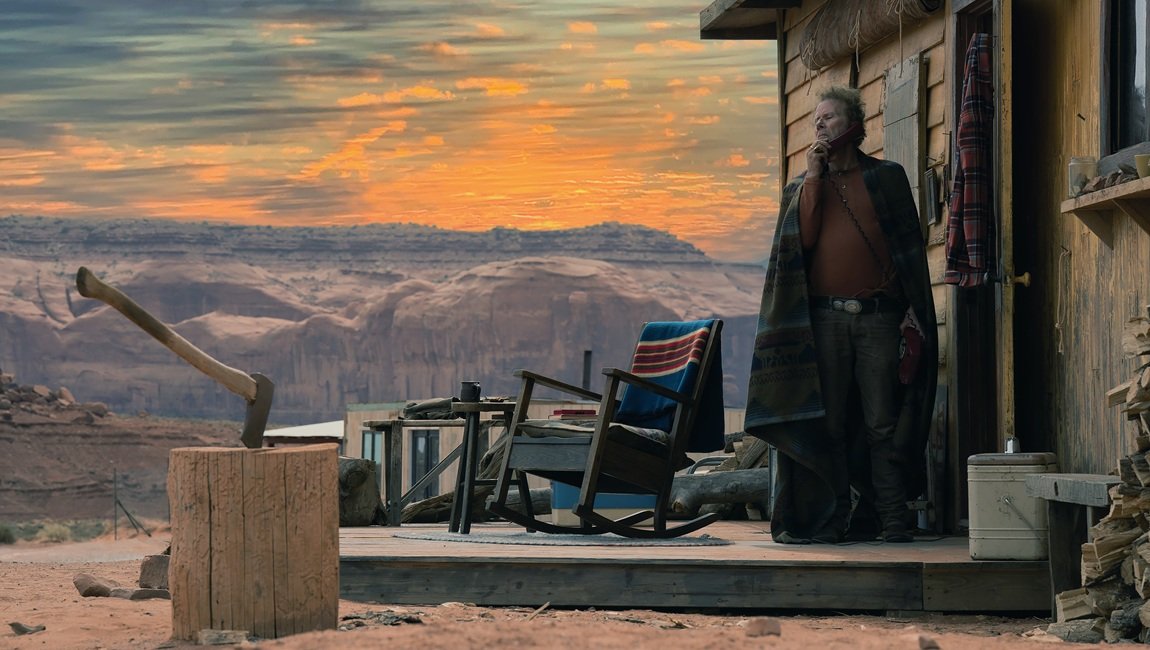
That’s a fate hardly imaginable for Wild Horse Nine, a back-to-basics star vehicle that landed John Malkovich the Volpi Cup for Best Actor in Venice just before its Canadian premiere at TIFF. The 1970s CIA caper, primarily set on Rapa Nui, better known as the mythically charged Easter Island of Chile, is arguably McDonagh’s best film to date, and most certainly an award-worthy career high for Malkovich. With remarkable comedic dexterity and emotional profundity, he crawls into the skin of Chris, an aging CIA agent on the verge of retirement, if not for late-stage cancer getting there first. Keen to die on his own terms, he drags his espionage protégé Lee (Sam Rockwell) to the island of the “big heads” for a somewhat somber, somewhat sweet suicide pact. As far removed as possible from any politics the Americans might interfere with, this is the place where Chris wants his skull obliterated by his most trusted CIA buddy.
McDonagh sets up a perfect serve here for a series of smashes: the most incredible jokes of his comedic oeuvre, mostly at the expense of the myriad political victims of America’s relentless interventionist politics. For instance: Chris wants a shot to the head just as much as he likes joking about that fateful 1963 day in Dallas, Texas, on which someone turned JFK’s skull into a bloody pulp. The sardonic agent also loves to riff about the impending coup d’état that is soon to oust Chile’s socialist president Salvador Allende and install the regime of General Augusto Pinochet. Patrice Lumumba catches some strays too in McDonagh’s prickly screenplay, all while the less lethal gags strike with equal impact. The objectively evil man is so infectious a jokester that accredited guests at Venice proudly donned merch bearing one of the film’s many quotable lines: “good luck with democracy and all that.”
The hardest-hitting joke, though, is emblematic of how much comedy gold McDonagh can mine from even the most banal back and forth. Chris posits the hard-to-refute thesis that the quality of cheese in a country is directly related to its acceptance of gays. The Netherlands, with all its queer pride, offers your Goudas and Leerdammers, while the icy uniformity of Russia has no such delectable cheeses to speak of. Like Colin Farrell and Brendan Gleeson’s miserable hitmen killing time in the sleepy Belgian town of Bruges, or the same pair falling out on the Irish island of The Banshees of Inisherin (2022), Malkovich and Rockwell gleefully chew the scenery of Rapa Nui, turning a place where nothing ever really happens into an arena of exciting cerebral sparring, and ultimately into a metaphorical site where America’s evil foreign policies come to die.
Never pretending to be a great visual cineaste, McDonagh and his trusted cinematographer Ben Davis do know how to extend their edgy comedy onto a visual plane. The title takes its name from the wild horses roaming the island, elegantly caught as impartial bystanders while Chris wrestles with his conscience and tries to put his insane career into a revealing memoir that the CIA would rather never see the light of day. The best visual joke is another JFK throwback, with a passing airplane lined up so that it seems to pierce one of the stupid big heads — as Chris so fondly calls them, much to the ire of Rapa Nui’s inhabitants. This mastery of the visual register also stays in place when the shit really hits the fan, and Steve Buscemi arrives as the strung-out head of the CIA’s Chile station. As if lifted directly from the Coen brothers’ best films, he delivers a couple of pitch-perfect lines of his own, all while escalating the plot to a dizzying degree.
But even as a geopolitical storm is brewing, McDonagh never lets the emotional core of his modest masterpiece out of sight. He is the master of the depressive male bromance for a reason, and Malkovich’s late-turn reckoning with all the ills he has inflicted on this planet is the most poignant crystallization of themes that have concerned the Irish director all the way back to his very first film. Rarely do you see a work that so gleefully bursts through political bubbles, only to finger-paint with the bloody remains scattered across the floor. — ANDRES HERRERA
Ha-Chan, Shake Your Booty!
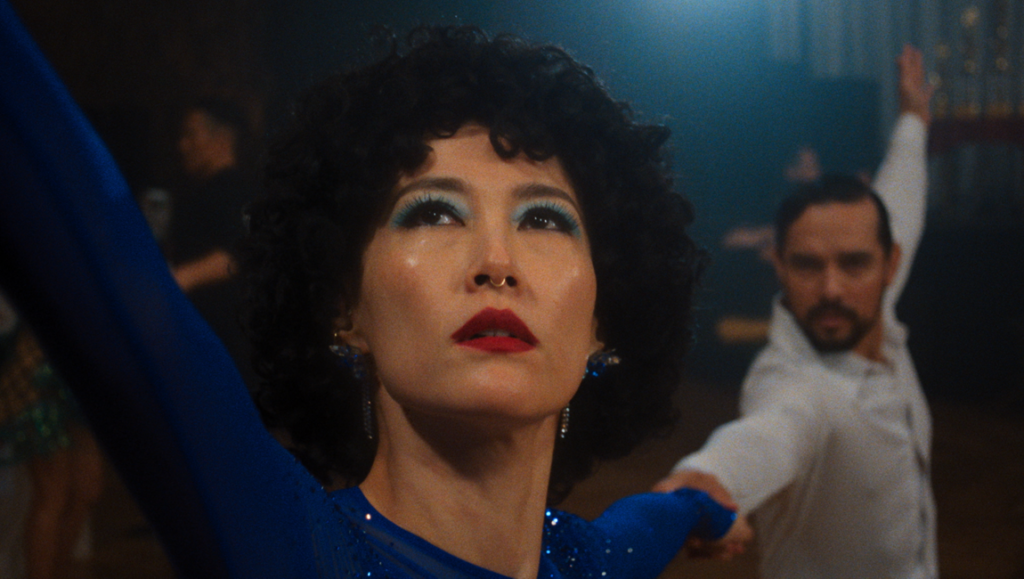
In Ha-Chan, Shake Your Booty!, grief bums around like a third wheel. It is needy, morose, fickle; the sort of guest that says they’re not hungry and then becomes sullen when everyone else’s food arrives. That’s inconvenient for the formerly jubilant Haru (Rinko Kikuchi), a Japanese salsa dancer who only stops moving when her husband, Luis (Alejandro Edda), passes tragically from a heart attack. But Ha-Chan is as averse to drudgery as its title suggests. Director Josef Kubota Wladyka answers the call to grief with psychedelically dilated eyes, finding as many punchlines, pratfalls, and pockets of rhythm in death as he might in life.
We first meet Haru as dawn floods her modern and immaculately curated home. She chews her breakfast with mischief curling at her lips; she grooves past posters of Punch-Drunk Love and All That Jazz toward her record player like a mountain lion on a lazy day. When she finds her prey in the backyard — her sweet Luis — he answers the call with a playful shake of his own hips. It’s the sort of near-silent, masterfully economical introduction that bares two full lives within a few script pages. They finish breakfast while they review footage of their own dancing, trading compliments and loving barbs in English, Spanish, and Japanese. If there was ever friction between Haru and Luis, it’s long since smoothed; if they’re sweating their upcoming competition, they’re not showing it today.
Ha-Chan operates with a vivacious cadence that merely shudders, not stalls, when it approaches its central tragedy. A (literally) ascendant performance at the Tokyo Dance Classic ends in literal heartbreak, and Luis spends his final moments alive clutching his chest on the dance floor. But grief is not a sullen affair in Wladyka’s purview. Haru’s sisters, the conservative Yuki (Yoh Yoshida) and the wild-eyed New York transplant Hiromi (YOU), swoop in to shepherd Haru through her sadness and stretch the cartoonish poles of sisterly affection and agita. If their Tom-and-Jerry cabaret weren’t enough to lighten the mood, Haru’s grief is quickly personified: a giant, chibi-style raven manifests in her home, as adorable as it is foreboding.
It’s an unsubtle metaphor that fits snugly within Ha-Chan’s portrait of broad strokes and primary colors. The movie is divided into six chapters, each with winking titles (“Oh Fuck, Fedir,” reads the fourth installment), each repeated twice in bright neon: first in English’s Roman characters, again with Japanese Kanji, both shouted in alternating baritones and shrieks. Wladyka’s palate is uncut indulgence. Ha-Chan’s score makes room for two needle-drops from The Cranberries; characters crunch and slurp and smack their food in ecstasy. Even the film’s most harrowing moment is an in-joke: home alone for the first time since Luis’ death, Haru waltzes with his framed picture in an unmistakable allusion to the drunken grief of Leland Palmer. It might be exhausting if it wasn’t so successfully funny.
On the page, Wladyka’s allergy to subtext is a riskier gambit. His players are operatic in their mission to tell before they can show, and the film cha-cha’s its way past every opportunity for nuance. But that inclination toward bold, brash text is deliberate. Ha-Chan militaristically pursues the less familiar fringes of grief, in which it can transcend its onus of woe to exist as an entity of vitality, of excitement, even of love — qualities that demand to be shouted. Eventually, Hiromi and Yuki convince Haru to draw back her curtains and dance again. She starts taking classes under the comically hunky Fedir (Alberto Guerra), a former Dancing with the Stars contestant with a notoriously open marriage — and, like Luis, a Mexican immigrant cutting a life as a dancer in Tokyo. Haru’s grief keeps her tethered to the ghost of Luis’ love, but Fedir’s bohemia poses an interesting question: what if that grief could open their relationship to a third?
Ha-Chan is a dance movie, one that marries its rhythms and cadences to the popping hips and sliding shoes of a waxed parquet. In a stroke of bitter irony, though, the movie’s dance sequences slip into its least successful moments. Cinematographer Daniel Satinoff’s lush, gauzy frames never seem to step in sync with Haru as she glides and snaps with her partners. Perhaps it’s a consequence of comparison. Ha-Chan performs characteristically explicit homage to the pillars of the genre — Dirty Dancing, Grease, Footloose — but never quite captures the art with the same panache. It’s an unfortunate failure made all the more tragic for the movie’s otherwise stalwart adherence to the bliss of the dance floor’s absolution.
Josef Kubota Wladyka is the son of a Japanese mother and a Polish father, and Ha-Chan is dedicated to the former, who remains an active ballroom dancer into her 80s today. For all its insistence on abandoning subtlety, Ha-Chan is most successfully nuanced and mature in its position as a by-product of multiculturalism. Wladyka is no stranger to the unexpected rifts that emerge through wedded cultures — say, the proper way to bury a lost son, a lost husband — and even through his dogmatic frivolity, he remains tonally nimble enough to pay these moments their due respect.
As Haru, Kikuchi earns equal esteem as an international star. No stranger to global productions herself (Kikuchi is one of only two Japanese actresses to be nominated for an Oscar), she shimmies seamlessly through Ha-Chan’s trilingual script and commands dexterous control over the movie’s maniacally giddy reckoning with grief. Like Ha-Chan itself, Haru exhibits little distinction between the passions of puppy love and the bowel-gripping panic of fresh grief. They are both deliriously painful, brutally ecstatic reminders of what it’s like to be alive, gushing from a vein with a rhythm good enough to get your feet moving. — CHRISTIAN CRAIG
Also Playing
The World Before
Love buds during summer on an idyllic Korean island. At least, it does for Jin (Sim Su-bin), a 17-year-old girl native to the island. Her childhood friend Dujae (Kim Eo-jin) comes back to the island after moving to Seoul. His mom, however, doesn’t show, and her absence frustrates his grief. He spends the summer occupying her empty house like a ghost, but his presence has the effect of intensifying the heat of summer for Jin.
The World Before is the third feature from director Yoon Dan-bi, and it reflects a legible continuation of her growing filmography. Best known for her first narrative film, 2019’s Moving On, which is also set during the perpetually evaporating summer season, Yoon then directed a documentary portrait of actor Lee Je-hoon (Time to Hunt), Another Record: Into the Daydream, a film where memories and dreams collide much as they do in her latest.
Jin’s infatuation with Dujae is largely symbolic of her own negotiation of self. The sparks start after a conversation with her friends, who put the two childhood acquaintances on the spot with the question all children dread: “Do you like each other?” She smiles at the idea the question conjures, imagining a near-future of them coupled in young love. But he shoots it down. “Don’t be ridiculous,” he starts, collapsing her smile. “She and I would go to the beach and run around with our clothes off,” pushing the past to the forefront. She yearns for the future; he grieves the past.
The summer Yoon conjured in The World Before is on quiet guard, with the warm light of the sun to provide her characters comfort. And it’s a world easy to fall in love in: Lee Seong-eun’s camera gracefully dances around the teenagers with its own intimate character, while the film’s sonic texture is one scored more by silence than by Lee Min-hwi’s subtle compositions. When the music is perceptible, her score carefully moves as if to make judgment. Take, for instance, a flirty shared bike scene where Jin tries to sit on Dujae’s handlebars, but they struggle to make it work and crash before even setting off; she ends up on the back of the bike, holding onto his waist so as not to fall, and Lee’s ethereal score transports us as if into a fairy tale.
The World Before centers both female desire and female heartbreak. Unrequited or unevenly requited love on film often flows in the other direction, but here it is a woman whose feelings go unreturned. This emphasis extends to Lee Seong-eun’s female gaze-reflective depiction of sensuality, where hands, lips, and reactions take precedence over exposed skin and voyeurism. A scene of Jin approaching the obfuscated shower door, where Dujae (not knowing Jin is even in the home, and thus non-consenting) stands completely in the nude, seems to make a point in rejecting patriarchal voyeurism with a sharp edit, one which moves Jin from standing outside the door’s privacy glass to sitting on the floor, waiting for him to finish.
Present Jin’s attraction to present Dujae is a dynamic born from a combination of post-puberty desire, the time they enjoy together, and the comfort of their intertwined pasts. The world is small on the island, and so too are Jin’s romantic prospects. She doesn’t like the thought of him being with other women, but these interactions always come with the additional baggage of “other girls… in Seoul.” If Seoul shares some relationship to the future, where students leave for college and lost lovers hide, the island holds onto the past. Front doors stay open to the whole community through the day, and everyone still knows everyone. This is even told through the geographic positions of their houses on the island: Dujae stays at the top of the hill; she lives downhill. Perhaps a play on the title, The World Before appears set in the present, though there is a resistance to depicting screen technology. Bored characters read; they don’t doomscroll; Dujae finds his dead grandma’s diaries and reads them noisily as she entrusts her disappointment with married life on the island to the pages of her journal. He may enjoy spending time with Jin, but his past — symbolized by the island and his grandma’s memories — holds him hostage.
The only assured truth about summer is that it always comes to an end. The love wasn’t entirely unrequited, and Dujae’s departure for the mainland via boat demonstrates this in images alone. There is no final screaming declaration, nor any grand romantic gestures; those would be alien artifacts in The World Before. Instead, as Jin sets her gaze on the departing boat as it cuts through the sea, Dujae, from the back of the vessel and on the far left of the frame, as if trailing the camera’s gaze, looks back to the island. They look past each other — Jin to the right, Dujae to the left — as if their looks alone might connect a timeline between them: past and future. — JOSHUA POLANSKI
Edward Said: Between Worlds
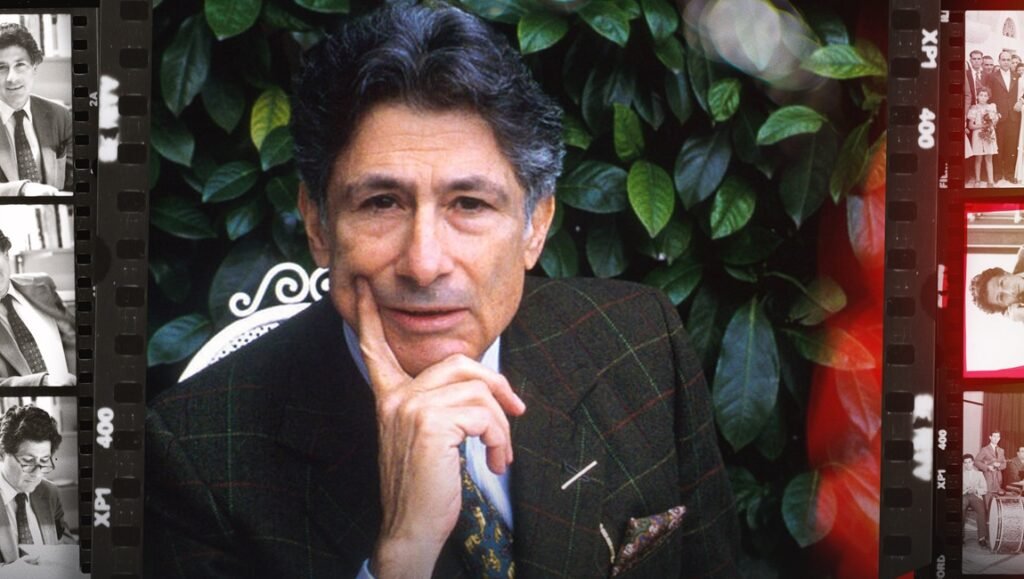
As a certain theory of Baudrillardian post-intellectualism would have it, we now live in what could be referred to as an “anti” age — an era so replete with meaning that the notions of meaning are negated entirely. If this is to be considered true, then Edward Said could be regarded as a definitive figurehead of the “pro” age — pro-intellectualism, pro-curiosity, pro-human spirit — in his seemingly inexorable inquiry toward life’s conditions. Said was many things: a prolific academic, scholar, critic, political activist, and champion of human rights, most expressly Palestinian rights. Anyone familiar with Said’s work would contend that he was obstreperously committed to his side of an ailing battle for a people’s right to exist. And while perhaps best known for his rigorous and incisive Orientalism — and a number of other considerable academic texts — it would seem that Said’s later memoir, Out of Place, was the threshold from which Maiken Baird’s new documentary, Edward Said: Between Worlds, arose.
And like most memoirs, both filmic and literary, Baird’s film begins with Said reminiscing on his childhood in Jerusalem, long before his eventual immigration to the U.S. These early moments are as roseate as they are elegiac, with Said contextualizing through interview voiceover a collection of his father’s Super 8 home videos before delving into childhood loneliness and his father’s disdain for leisure. Later, after the film treks further into adulthood, Said details an argument with a U.S. official regarding his passport, which named his place of birth as Jerusalem, Israel, instead of Jerusalem, Palestine (the official later agreed to name his place of birth simply as “Jerusalem,” omitting a nation altogether). As Said had learned, to be Palestinian was to be wrongfully ostracized, and his persistent sense of lifelong otherness followed suit. To use his own words, “My sense of exile really has been lifelong. I’ve always felt myself to be out of place.” Edward Said: Between Worlds arrives at a number of pointed ideas throughout its runtime, but perhaps none more critical than the primordial connection between geopolitical exile and personal alterity.
Thus, the driving factor of Baird’s film becomes Said attempting to reconcile this notion of a figurative and literal homelessness. When viewing Edward Said: Between Worlds, the first impulse is to describe the various actualities onscreen as being of the present moment as opposed to referring to them as a thing of the past. It goes without saying that Said’s musings on Middle Eastern conflicts were especially prophetic, and Baird rightfully treats them as such. Regrettably, the political and humanist perils which fueled Said’s struggle for his people’s freedom — and ultimately his central mission as a person and academic — persevere today. So the central question of Between Worlds becomes not one of a singular man, but of the manner in which his advocacy echoes into the broader contemporary malaise. In this regard, Baird’s documentary takes on a twofold structure in that it situates the personal tribulations of an egalitarian voice within the conflict which he sought to rectify. Or, in far simpler terms, through Said, Between Worlds reminds us that the fight for change is ongoing, and we mustn’t forget the tragedies of history.
In this sense, despite the fact that Said died over two decades ago following a battle with leukemia, Baird’s film grants him the new life he so justly deserves. Naturally, this is evident in the rather straightforward manner in which Between Worlds relays information to the audience. Though, the formal qualities of the film are immaterial, especially because Baird understands that her film is chiefly one of discourse as opposed to images. To harken back to the aforementioned point of Baudrillard and the aftermath of his teachings, the notion of a discourse-driven cinema is becoming for a subject such as Said, who dealt in words and intellect rather than images. And if an ideology which speaks to the un-meaning of images is valid in any capacity, then perhaps discourse is the most appropriate route. As Edward Said: Between Worlds asserts, the avenue through which social change is triggered begins with a discourse between two opposing ideologies. As with Said’s own Orientalism, only then will change occur, and with it, synthesis. — JOSEPH DIMACCHIA
Also Playing
We Are Born Good
Hong Kong cinema is dying, or at least so says the BBC (https://www.youtube.com/watch?v=IQd3BiwYM1E). But keen observers will note that Hong Kong cinema, like cinema itself, has always been dying. The latest crisis may be more serious than most, and certainly things look bad compared to the industry’s peak in the early 1990s, but narratives of decline tend to overlook the fact that vibrant and exciting works are emerging from Hong Kong every year, and that an industry that’s reinvented itself through a half dozen crises over the past 60 years is in the process of doing so once again. There are fewer films made in Hong Kong these days, but nowhere else in the world would a young filmmaker imagine their debut feature as the Netflix series Beef meets Hamaguchi Ryusuke’s Drive My Car. That’s exactly what Yeung Leung Chuen has done with We Are Born Good.
Chung Suet-ying (star of Norris Wong’s The Lyricist Wannabe) plays an aspiring actress who is forced to stay late at her job at a clothing store and almost misses an audition. She makes it and ultimately gets the part, but exhausted from a long day, she orders some takeout on the way home, only to find that her Singapore fried noodles have been replaced by beef chow fun, and she doesn’t eat beef. She walks back to the now-closed restaurant and confronts the owner (Yeung Wai-lun), who apologizes but explains that he’s closed and can’t make her the proper food just then. She eventually leaves in anger and disgust, returning sometime later for revenge in the form of letting roaches loose in the store and flooding the bathroom.
From here, the prank war escalates — he puts her picture and phone number on sex websites, she graffitis his walls, etc. — while Yeung builds out the characters’ worlds. The restaurant owner is the black sheep of a successful family, having served time in jail, and his restaurant is funded by his younger brother, a doctor. The actress, meanwhile, is thinking about getting an apartment with her girlfriend, but is also developing a friendship with the writer (Kearen Pang) of the play she’s starring in, an older woman who has a romantically tragic past, one which intersects both with her play and with the young actress’s life.
The theatre scenes, the relationship between performance on stage and in life, as well as the fact that the writer is partially deaf, are all beats that owe an obvious debt to Hamaguchi’s hit. But Yeung doesn’t overplay the homage, instead offering balance via the more class-forward elements of the restaurant owner’s story, linking the aspiring actress and the ex-con as failures in the eyes of respectable, success-focused Hong Kong, people left behind by the city’s all-powerful strivers. Their prank war is the hook that links the two characters narratively, but its importance fades as the film instead becomes a character study, with those characters themselves becoming a stand-in for Hong Kong itself.
The Slobs vs. Snobs construction has a long history in Hong Kong cinema, with the slobs standing in for the polity itself. Whether as a colonial outpost, pawn of international negotiations, or special administrative region, Hong Kong has always been on the margins, the black sheep of empire, relentlessly committed to doing its own messy and improvisational thing despite the desires of the controlling powers that it simply clean itself up, follow instructions, and get a real job. The stresses of the 2020s pit the actress and the cook against each other, fighting a pointless war until they slowly realize the real enemy is not each other, but the rich and successful people who toy with their lives, manipulate them, and then blame and discard them when things go awry. There the perennial hope of solidarity lies, for our heroes, for Hong Kong, and for its cinema. — SEAN GILMAN
Marie Madeleine
The power wielded by Thierry Frémaux and the Cannes Film Festival is such that countries can become defined, for a decade or even longer, by the cinematic work of a single director. Gessica Généus, the first Haitian director to be selected for the festival since Raoul Peck in 1993, is an example of what this kind of selection can do for a career. Her debut, Freda (2021), played in the Un Certain Regard program, and caught the attention of Francis Ford Coppola, who lent the film an approving, effusive quote and an executive producer credit. With her follow-up, Marie Madeleine, which played in the nebulous Premiere section of Cannes’ 2026 edition, Généus has pursued one of the directions of her first film, taking as her subject not characters or formal questions but a portrait of a nation, symbolized this time by conflicts along religious and nationalist lines.
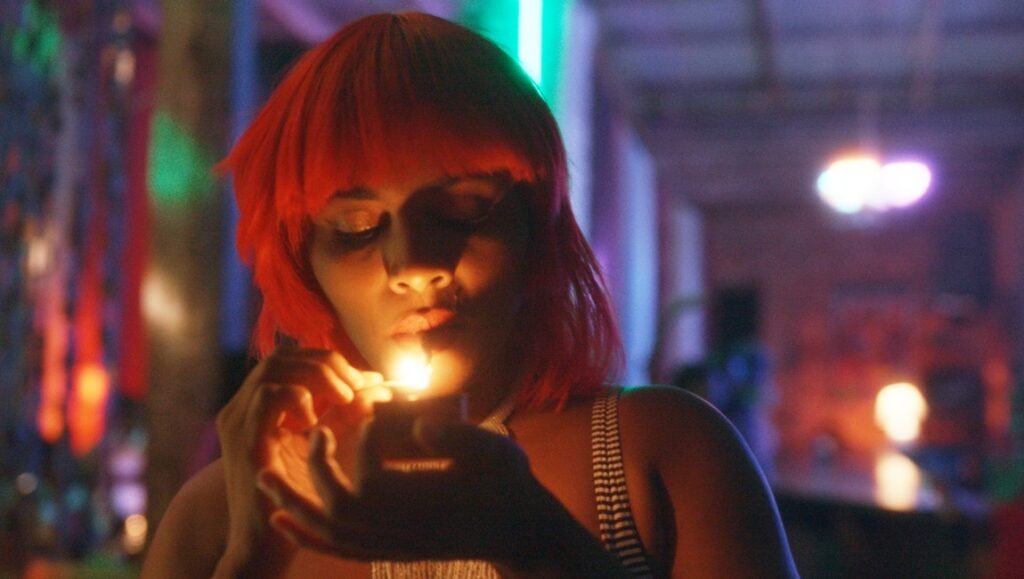
Despite, or perhaps because of this scope, Marie Madeleine is extremely contained. On a single street, a brothel sits across from a new church ministry effort. Ideology is ever-present and explicitly determines the shape of daily life, from speech to fashion, and there is a sense of urgency in how this energy might be forcibly directed. Généus plays the title character, a sex worker. Her name, she explains, is based on Haitian matrilineal history, rather than for its religious connotations, in order to defuse a line of questioning. Béonard Monteau, meanwhile, plays her across-the-street foil, the son of a preacher. While this is a highly symbolized and archetypal setup, Généus successfully draws out the feeling of how local activity is improvised, and how entrenched positions — on sex, gender, and propriety — clash in ways that rarely feel like a formal debate.
There is only so much bending of these guardrails possible, however. The film looks, for the most part, quite conventional, and its final act, which corners its characters — repressed and dogmatically targeted — does so in order to arrive at a cathartically tragic ending, one that feels familiar, not in its exact plotting, but in the idea that hate-crime violence must be rendered as an abrupt twist of fate. Généus clearly has talent as both a director and actor, but the demand that a filmmaker in a de facto sense represent their nation is a familiar story — especially at Cannes, where the film launched its festival run. Whether by intention or not, it pushes a filmmaker to allegorize their country’s particular contexts and, despite the Nina Simone quote that Marie Madeleine abruptly ends on, rarely allows for aesthetic or political freedom. — MICHAEL SCOULAR
Comments are closed.