
In This Dispatch
You Don’t Belong Here
A staid frostiness envelops the frames of Florin Şerban’s smoldering latest feature, whose clinching of the top prize at its Locarno premiere serves as an almost reactionary vindication of the haunted psychological portraitures that have, of late, seemingly gone out of fashion. In particular, as the auteurial specter of Radu Jude rears its playful hand across the canvas of contemporary Romanian cinema, punishing miserabilism no longer comports with arthouse sensibilities the way it used to, or at least its tropes are more readily deconstructed and demystified for the world to see. Yet Şerban’s return to international prominence (after 2010’s If I Want to Whistle, I Whistle) with You Don’t Belong Here is a less straightforward affair. Throughout the glacial course of its runtime, the film revisits the many checkpoints favored by its spiritual predecessors: the rot and stagnation of Romania’s post-communist society, the resurgence of a conservatism that never quite left, etc. But it does so by centering the action, so to speak, on the tepid aftermath of an event; post hoc, the crime is done, one can only dream.
Though our protagonist is not much of a dreamer, he has in place a set of ideals instilled since youth, ideals which he never sought to question or have others call into doubt. Marius (Adrian Văncică) is the chief of his local hospital, in the small town of Reșița, west of Bucharest. He oversees the staff, administers complex surgeries, and moves through life with a sense of purpose. His son, Ioan (Teodor Butănescu), does not. Shy of 18 and overweight with the pallid flush of a sedentary lifestyle, the boy bears a constant reminder to his father of his failed legacy. “Every crow thinks its chicks are swans,” muses Marius to his colleague and casual lover Dana (Cristina Richter), recollecting his own desire, at 18, to win the Nobel. The minutiae of his daily life neatly unfurls in You Don’t Belong Here, whose numerous interior and static shots gradually tease out the surgeon’s moral and mental world. Order is cleanly circumscribed throughout, like a scalpel unto skin; no one but Marius may occupy the center of things, whether in the conversations he has with his subordinates or in the subtle imposition of his way, his last word, everywhere he goes.
The quiet chauvinism of these passages takes hold insidiously, without the overt fashioning of the film to foreground its thematic weight. When Marius’ high-school friend, the police inspector Silviu (Alexandru Conovaru), comes to visit, it is a numbingly uneasy encounter belied by mutual joviality. A Gypsy man has died, bludgeoned to death by unknown assailants, and his son is seeking both justice and the assurance from the hospital not to perform an autopsy on the deceased. To do so would be to further desecrate him, and while Marius awaits the many developments surrounding this murder case, his own reflections lead him deeper down a cesspool of misanthropy. As the plotlines of father and son inevitably converge in a third act of fierce despair, Şerban effectively sucks out the air to relish an atmosphere of tense foreboding that accentuates the various instantiations and manifestations of a larger masculinity in crisis. The young man has, for his naïveté and inexperience, committed a heinous crime; the older man, trudging along his self-imposed path of duty, is awoken, somewhat, to the senselessness of it all.
Where a more clichéd hand would clamor to couch the film’s ostensible central event — a racist attack by neo-fascist thugs on immigrant property and persons alike — in sensational, luridly outraged terms, Şerban excavates his national anxieties less as convenient talking points and more as a means to process the generational anomie that, unmoved and unsullied, easily reduces its citizens to husks of their ideals. The clinical gaze of the camera recalls the works of his countrymen; Cristi Puiu, in particular, has evinced a style of holding shots past the natural span of action and attention, and so too does You Don’t Belong Here gesture to the earlier oeuvre of Cristian Mungiu. Deceptive in its lethargic appearance and slow-burning in its rumbling interiority, the film effectively serves as an antithesis to Mungiu’s Fjord, a highly bombastic yet unenthused rally against “wokeness” that itself harbors a perverse instinct to expound and exploit its version of miscarried justice. From its somber tunes (opening with Mahler laid over the unassuming town environs) to its voyeuristic long shots (the province of DoP Liviu Mărghidan’s calculated coldness), it speaks not just of a nation’s violent and reactionary xenophobia, but crucially of a fundamental rupture and displacement between its image and its people. — MORRIS YANG
Nobody’s Violence
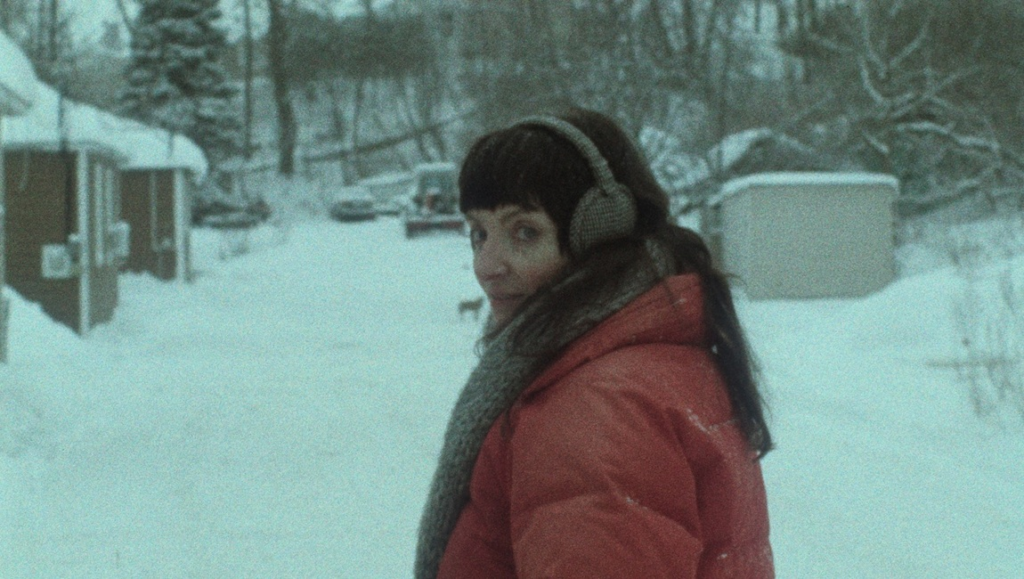
A woman of unknown origin and, for a time, unknown purpose, Mira (Larissa Corriveau) observes. For some, her observation is distant, silently watching the people around her living their lives; her own life, sleeping in her car with only her pet dog for company, seems little worth observing. But Denis Côté observes; as for others, Mira’s observation is intimate, as she watches them living their final moments. Supplying these people with a lethal powder mixed into a glass of water, she facilitates an act of irreversible violence that is also, it seems, an act of necessary mercy. Neither devil nor angel (of death), Mira is also less a person than a part of a process. Stoic and terse, her observant eye, mirrored in Côté’s, is entirely non-judgemental.
Nobody’s Violence is the latest of Côté’s signature portrayals of the far-flung fringes of society in his native Canada, a land so sparsely populated that these fringes seem more like remote enclaves, mini societies of their own. He’s hardly tempted to justify nor contextualize the peculiarities of his characters, though the generosity he shows them — that non-judgemental eye — grounds their actions in a humanity that’s easily identifiable. Mira’s actions are obscure, initially, then curious, and eventually clear — Côté’s decision to reveal the nature of her work only gradually is enriching in its embrace of any and all perspectives on it. Varying, even conflicting interpretations are encouraged.
As Nobody’s Violence departs from its early episodic scheme, and divulges some narrative context for why Mira is doing what she’s doing, it loses some of this richness. That’s not to say that it becomes didactic, but rather that it becomes indulgent — Mira travels to the remote home of her employer, Ludo (Philippe Rebbot), a volatile man who regards all in his orbit as his subjects in some manner or other. He’s hosting a dinner party-cum-business retreat for his underground assisted suicide operation, and Côté turns his attention away from Mira and toward Ludo and his colorful guests. One wonders if Mira takes these people seriously, or if Côté does, but he certainly lavishes an inordinate amount of time on their revelling and scheming, and the middle section of the movie is flaccid and aimless as a result.
There are important details within this section, though, as hints to Mira’s past, and her wishes for a future, raise poignant questions when set alongside the decisions of her clients earlier in the movie. They’ve chosen to end their lives, for whatever reason (though its validity is never in doubt), a choice that Mira evidently has the power to make too, since it’s her weapon they all end up wielding. Côté asks not just what we live for, but what memories, what pain are each of us capable — or incapable — of living with? And is Mira’s near-perpetual reserve a response to her own troubles, or a defense against succumbing to the temptation to partake of the powder she so routinely dispenses to others?
Yet while these questions may linger, Côté’s treatment of them doesn’t, as he resists developing them, instead opting for contrivance to close out his story, and close off the interpretive ambiguity that had been so appealing. There’s a distinct unease between his chilly, almost passive style and the drama and theatricality of Nobody’s Violence’s final sequences. Earlier, other instances of unease had held more formal and stylistic interest, as in that between observation and manipulation (a jarring zoom out is particularly memorable), or that between mundanity and the finality, even barbarity of death — Mira’s bike ride with the man who’s wife wouldn’t even permit him to witness her death is extremely moving, paradoxically so in its total withholding of emotion. But when emotion finally does erupt, it feels out of place in a movie that’s always conveyed more through doing less. It’s a confused, self-sabotaging movie, as rich in profundity as it is determined to undercut it. — PADAÍ Ó MAOLCHALANN
Roma Elastica
A purveyor of artifice and decadence, the films of Bertrand Mandico are at their most interesting on the purely visual plane. He fills his frames with cluttered mise-en-scène, gargoyle-esque character actors, and abstract lighting designs that call back to the erotic energy of ’70s and ’80s exploitation flicks. They feel interminably evocative of a better era in arthouse cinema, when Fassbinder and Fellini were at their most erratic and inscrutable, making dense dream-like panoramas of freakish ’70s types fighting and screwing one another into hysterical historionics a la Satyricon, Roma, World on A Wire, or Querelle. Unfortunately, he’s just a little too buttoned-up to really lapse into any true poetics of perversion, and his perfectly designed worlds end up being closer to Wes Anderson at his most affected rather than any true old school arthouse or genre master. They’re Bataillian doll houses, filled with a semblance of transgression that is too plastic to ever carry any real charge.
His latest, Roma Elastica, is about a famous French actress, Eddie (Marion Cotillard), visiting Rome in 1982 to shoot a science fiction film that is described as “if Antonioni made Escape From New York,” with references to Mario Bava and Lucio Fulci thrown in for good measure. Retreading much of the same ground as Fellini’s medium-length film Toby Dammit, Roma Elastica is largely a semi-psychedelic portrait of Eddie’s encounters with various actors, producers, teenage bikers, perverts, and artists in Rome. Accompanied by her make-up artist, assistant, body guard, and best friend, Valentina (Noemie Merlant), Eddie begins to psychologically unravel from the pressures of the film and a growing drug addiction thanks to a group of leather-clad, Fassbinder-looking punks staying in the apartment next door to her.
The film starts from a place of absolute weirdness — one of the film’s first conversations has Valentina tell Eddie of how she once carried a turd around in her handbag because she felt bad leaving it in the luxurious bathroom she was using — but fails to meaningfully build in shock value or campy transgression. It’s a monotonous journey with each neat new trick coming across as just one more gimmick rather than genuinely creative ideas. It’s a shame because there are a handful of sequences that do effectively dazzle the viewer — a black-and-white sci-fi sequence at one point, a love scene where both characters suddenly find themselves growing janus-like doppelganger faces on the back of their heads at another point — but they all feel listless, almost phoned-in, lacking true poetic or emotional value. Even the film’s visual style, which feels genuinely and lusciously bizarre with its neon blue and silver color schemes and gauzy, smokey mise-en-scène, very quickly becomes rote. The glitzy dolly shots Mandico favors, meanwhile, which glde across almost every scene, gracefully ogling the opulent, expressionistic sets, are ultimately just one more sign of the film’s emptiness, gestures of hollow technical prowess.
The film’s most essential flaw is its lack of dramatic development which might force any meaningful tension onto these pretty surfaces. The film is instead content to leave Eddie as a clear type, the diva tired of being a diva, and gives very little nuance or depth to her emotional exhaustion. Each scene finds her floating near the same level of affectless confusion, even as the demands of the film production and her drug addiction are ostensibly wearing her down further. Cotillard adds little to the underwritten role, playing the same stiff note of weary bitchiness over and over again without any of the charm one would expect her character to exude. The supporting characters all also fail to inspire, consistently skirting the grotesque, yet too often coming across more like fashion models playing punk than genuine creatures of the subversive.
Like a piece of elastic, the film feels defined by a stretchy consistency, able to generate a world that feels expansive at times, yet always ends up snapping back into the same artificial shape. Unfortunately, genre cinema — and most vital pieces of cinema — needs the ability to break, to fall apart, and to risk stepping outside of pre-conceived forms. For all his oddball irreverence, Mandico is too beholden to a certain stylistic sub-nostalgia mode to take any genuine risks. Less a genuine reworking of form, Roma Elastica a cheap tchotchke: it can remind us of better eras, but it fails to either transport us there or inspire anything new. — JOSHUA BOGATIN
Hearing
It’s fairly easy for an artist to commit themselves to a concept, less easy for them to do it justice through their art. Lê Bảo’s exploration of the human senses — initiated with two shorts, Scent and Taste, in the 2010s, then followed by the features Taste (2021) and now Hearing — has bountiful conceptual promise, but how to elaborate on these themes, both broad and specific, in an audiovisual medium? Taste was a striking but stagnant semi-exploration of its title, but Hearing is a significant step forward for Lê. Looser than its predecessor stylistically, and with substantially more purpose and momentum, it makes more sophisticated use of Lê’s fabulous sensorial craft, even if it ultimately proves still a little too ambitious for him to control.
Ninh (Quốc Tuấn) installs decibel meters in homes and businesses, devices that blast blue-purple light when the noise reaches a level deemed unacceptable by his clients — bars, discos, graveyards, even one private residence where a woman has seemingly demanded near silence from her husband. Ninh is mostly estranged from his ex-wife, and seeks to repair the broken bond between his parents now that his mother has fallen ill. He works in silent spaces, and exists in them too, the personal relationships around him having ruptured and left him lonely and somewhat resentful. But whether or not he can work his way out of this rut is beyond his control.
It’s also rather beyond Lê’s concern. Much of Hearing is comprised of sequences of minimal narrative relevance (including a series of sequences toward the end of a most enigmatic nature), while the plot fragmentation and ellipses obfuscate clarity. A lack of dialogue would further aggravate were it not for the function it serves: Lê focuses the viewer’s own hearing not on what his characters say, but on what they do and on where they do it. Action and environment are more influential to Ninh and to others than their individual intentions, and those who surrender to this deprivation of agency are the movie’s most contented figures. The devices he installs are designed to control and manipulate these environments, and the value they add to their recipients’ lives is questionable.
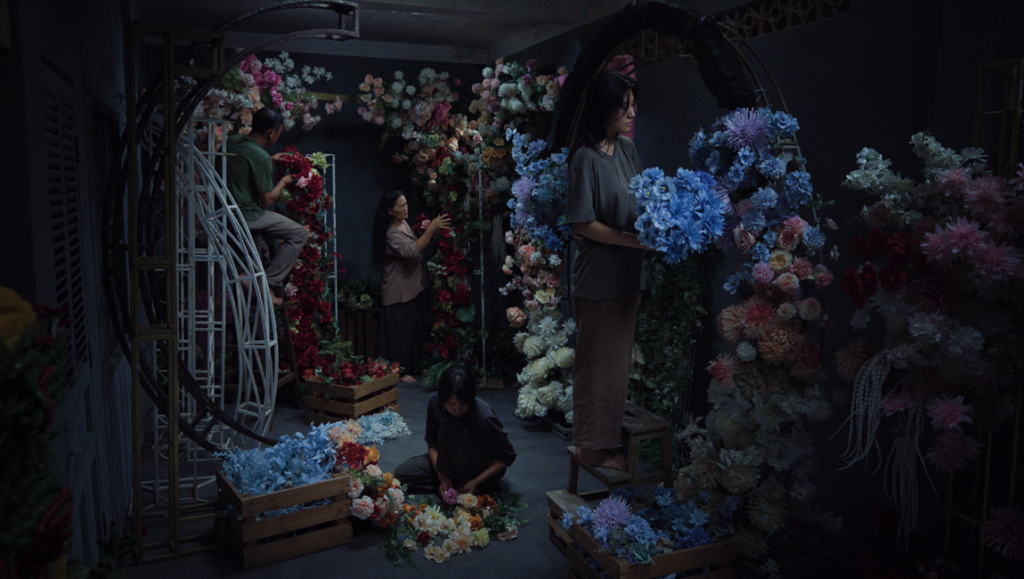
Until its final 15 minutes, where Lê indulges in some underdeveloped, mildly fantastical tangents, Hearing is too plain and literal to be mysterious, but it’s certainly cryptic. He asks a similar surrender of his characters as of his viewers — that we give in to the sensory pleasures this movie has to offer. And it has many: from curious sights (a boy stood inexplicably on one leg amid a magnificent floral arrangement above a rowdy bar) to strange encounters (a man delivers a eulogy for his tooth before wrenching it out with string; off camera, in keeping with the tranquility of the movie’s tone) and subtle flourishes (compositions in which characters seem to become almost invisible in their surroundings). It has a unique feel, meditative yet without the long takes commonly associated with slow cinema. Lê has an elegant perception of pace and composition relative to the on-screen action, slowing and simplifying as the action’s rhythm does, and intensifying with it too.
Yet the narrative imprecision of it all takes its toll, leaving one with a slight sense that Lê may intend only to show off his technical skill. The various diversions and asides hold little contextual value, as do the scenes concerning Ninh’s family members in his absence. It’s a beautiful movie, but one that fails to make a clear point for itself beyond said beauty. One may marvel at how Lê captures a mood of stillness and diligence in an opening scene in which most of the screen is filled with noise and movement, but scenes such as these, while impressive in isolation, have less lasting impact than they ought to. They isolate themselves, and Hearing feels fractured as a result.
But it’s wonderful nevertheless to see a filmmaker break free, even if only a little, from the conceptual confines they’ve imposed upon themselves — and particularly to do so with such stylistic sensitivity. He may not yet have his storytelling down, but Lê has made real improvements in this regard after Taste, and his appreciation for how to use his excellent eye and ear within a story has sharpened. This is a fine, rewarding movie, as beautifully put together as anything else this year. — PADAÍ Ó MAOLCHALANN
Small Talk
Small talk counts more critics than supporters. Pleasantries about families, careers, mutual acquaintances, or — if the conversation really gets dire — the weather, despite their obvious centrality to everyday life, are typically thought of as shallow and boring, if thought of at all. Director Mateo Ybarra is interested in those who take the opposing view. In his docu-fictional film that itself bears the title Small Talk, Ybarra plants the fictional Charlie (Hélène Bares) within an actual summer course at the Institut Villa Pierrefue, the last extant Swiss finishing school, perched on a hilltop overlooking Lake Geneva. Small talk is serious business at the pricy Institut, with instructors describing it as an “appetizer” to a main course of more substantive conversation, and teaching students how to subtly steer subjects away from controversial topics and prioritize appearing “interested” over being “interesting.” The principles of effective small talk correspond to other manners of etiquette: each lesson taught at the Institut, whether on table-setting or descending a staircase in heels, entails molding one’s behavior to a socially contingent structure of unwritten rules designed to elevate one’s status by ensuring the comfort of others. Ybarra effectively encases the actual practices of the Institut within a loose narrative frame, and in doing so enacts an ethnographic, productively ambivalent critique of an institution that prepares wealthy women to operate in spaces shaped by patriarchal capitalism.
The lines between documentary and fiction are blurred in Small Talk, but they are not impossible to parse. It is unclear the extent to which the conversations between Charlie and the other denizens of the Institut are scripted or improvisatory; based on the structured nature of the scenes that occur between Charlie and the film’s other subjects, though, it would seem that Ybarra has orchestrated these encounters, while presumably presenting the actual subjects’ viewpoints and personalities within these narrative frames. The courses and exams sync up precisely with how they are described by the Institut itself and in past journalistic accounts (most notably in a perceptive 2018 New Yorker article written by Alice Gregory), and the Institut’s history and current personnel also align neatly.
Ybarra, with the collaboration of writer-actor Bares and co-writers Louis Rebetez and Milan Alfonsi, deftly crafts Charlie as an audience surrogate. Charlie is a French woman who works in the fashion industry and aims to obtain a new job in Dubai, and in an effort to shape up her manners to suit her ambitions, pays the steep price (over €30,000) to attend the Institut. Charlie, portrayed with seamless naturalism by Bares, is as unpolished as she is ambitious. Amidst high-powered businesswomen and beneficiaries of familial wealth, Charlie’s flippant, mildly awkward personality sets her apart. She struggles to remember the correct placement of silverware, and she admits that officially verboten conversational topics — “love, politics, [and] money” — are her favorites to discuss. Ybarra, though, does not impose a narrative of ostracization on Charlie; rather, she is a mild fish-out-of-water who her instructors are keen to help and who her classmates take to quickly. Charlie’s narrative arc, then, follows how she wrestles with the stringent values and social codes embedded in the course of study, and how her behavior changes over the summer. By keeping Charlie’s character development largely internal, Ybarra frees up the actual instructors and students from fulfilling specific narrative roles as allies or antagonists, allowing them to present themselves on screen without explicit value judgments from behind the camera.
The instructors, including headmistress Viviane Neri, present the Institut as a place to obtain vital social knowledge, with importance placed on cross-cultural communication and women’s empowerment. Their emphasis on the social and business skills that they aim to impart comes across as defensive, given the image of finishing schools as outdated and anti-feminist — note a scene in which some students complain about friends and family dismissing the program as a training ground for “princesses” or “housewives.”
The program is indeed business-centric, and Ybarra depicts courses and lectures involving dressing for the workplace, leadership styles, and journalism — alongside tea-serving and party-hosting. Emphasized in every aspect of the coursework, though, is an extremely narrow presentation of womanhood: the students are cautioned against dressing in a “sexy” way or speaking in a pitch deemed either girlishly high or mannishly low. When Charlie receives private feedback from her instructors, they encourage her to “tone down” her personality, which one describes as “too much” and “fake.” This particular scene is slippery — since Charlie is a fictional character, it is unclear whether Ybarra scripted this feedback, or if the instructors delivered the feedback that they would have given to Charlie were she an actual student — but it does emphasize how rigid, yet unclear standards of behavior designed to appeal to men are given equal weight as more concrete codes of ethics. Ybarra also emphasizes the cloistered world of wealth that the school represents: one particularly out-of-touch lecture focuses on the issue of hiring household staff, and the lecturer encourages the students to run credit checks on potential hires as a means of screening against potential thieves.
The students are shown to have a variety of responses to the coursework. Some are devoted to the type of etiquette taught at the institute, and others were sent by their parents and are personally non-committal. A plurality describe pragmatic reasons for attending, such as working in roles that require entertaining colleagues from various cultures. The most fascinating conversation occurs between Charlie and a student who has made a series of clear-eyed calculations to obtain professional success as a woman. Prior to attending the Institut, she made a spreadsheet of qualities that she believes an “exquisite” woman should hold and hired a vocal coach to help craft a lower voice, with the aim of being taken seriously by male colleagues. She reports seeing herself as “playing the game,” but worries about the implications of an educational program that encourages women to be “reserved and quiet.” This monologue is remarkable both as a trenchant analysis and a self-justification, and it marks the most explicit acknowledgment of the double bind that the wealthy, ambitious women attending the program exist in.
For all its deeply embedded social critique, Small Talk is pleasant and breezy to watch. Director of photography Lucie Goldryng’s sun-saturated cinematography is idyllic and pictorially beautiful, and the students are depicted as having a natural, easy camaraderie. There are few significant conflicts, and Charlie is even given a happy ending — though Ybarra ably suggests how she has sublimated central aspects of her personality in order to fulfill the program’s objectives and reach her personal goals. In Ybarra’s canny, sneakily complex depiction, the Institut Villa Perfue acts as a microcosm of larger social dynamics. Within and outside its walls, no individual can be held personally responsible for the upholding of women’s subjugation by patriarchy and instrumentalization by capitalism, yet no individual lives innocently outside of these systems. — ROBERT STINNER

Magic Atlas
True objectivity is, practically speaking, virtually impossible when analyzing art. Each individual approaches each work of art, whether film, painting, music, literature, or so on, from a perspective informed by their own outlook and experiences. A song about heartbreak might be more meaningful to someone going through a breakup; a painting of religious transcendence might be more impactful to someone of deep spiritual faith; a book about revolutionary politics might be more convincing to someone with left-wing beliefs; etc. With some films, it’s better to watch them knowing as little as possible beforehand. With Sun Xun’s Magic Atlas, though, the opposite is the case.
There’s one extra-diegetic detail that it may help to know before watching Magic Atlas, though it’s one that’s eminently clear from the film itself: its production took a whole 10 years. If the artistry displayed here isn’t impressive enough on its own, the dedication it took to display it must be. Otherwise, this astonishing animated fantasia is almost aggressively obtuse in divulging much meaning behind its extraordinary imagery. Its contextual collage of political history, cosmic spirituality, and horror-fantasy might imbue it with a richness fully appreciable only to those better versed in these specifics than this writer — it’s like an untranslated text, decipherable by those who can speak it. But though its meaning may not be clear, its marvellous beauty certainly is.
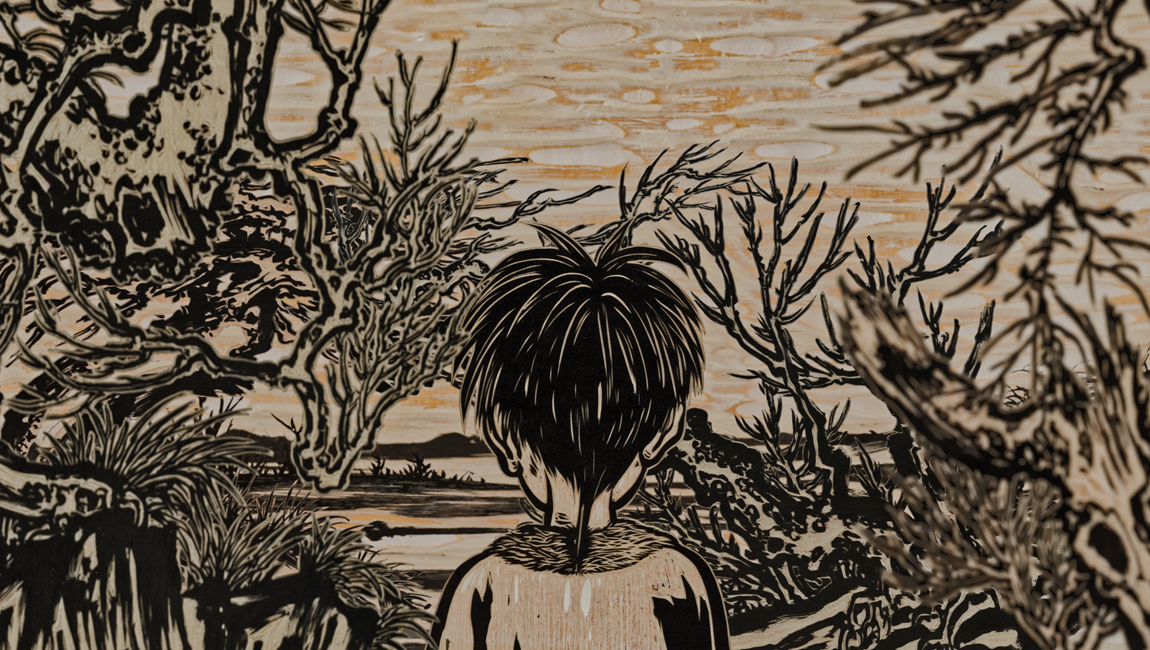
Sun tells his story with a logic-defying looseness that befits a film of such stylistic variety, though that doesn’t exactly make it any easier to follow. Essentially, the film concerns a young boy in the fictional empire of Luocha, where coal is king, the inhabitants are a mix of talking animals (including humans), and flight is a criminal offense. A magician arrives in the region, and is instantly imprisoned on the eve of a national festival, where the authorities have planned a terrible surprise for their subjects. Details of the plot are of some significance, though rarely much. Rather, they serve as vehicles for Sun’s artistic explorations, combining an array of media, most notably extensive wood carvings whose frequency and intricacy boggle the mind. By the film’s final stretch, almost all semblance of narrative has fallen away.
If Sun is trying to create a mood rather than tell a story, he’s surely succeeded. The abundance of visual information overloads, and the intoxicating mysticism of the last act baffles, but the world Sun has imagined into existence out of wood, paper, and pixels is vivid and compelling. His style is vibrant, with relentless detail generating transfixing chaos even in monotone wood, and every artistic choice feels informed by its thematic importance and its impact. There’s a sense of bleak austerity one moment, then lush wondrousness the next, then raucous humor the next, and references from Dalí to Itô. The opening functions like a tapestry, with the image moving rightward over warriors on horseback; black-and-white turns to sepia-and-white before turning to color, which becomes gradually more vibrant.
With such a wealth of ideas, from stylistic to thematic to narrative, it’s both a wonder Magic Atlas isn’t more engaging and no wonder. The film is simply so congested with material, and so opaque in elucidating upon it, that it’s potentially impossible to understand it all on one viewing. Whether it’s possible on repeat viewings or not will be a matter for those willing to endure the task, though what a thrilling task to witness such artistic excellence multiple times. And what an achievement too — early on, narration relates time, space, and existence to ink and woodcutting, with its temporal aspect seen in the time it takes to create and its physical aspect in being actual tangible matter, not just dots on a screen. You can see the time in Magic Atlas, all 10 years of it, and it’s quite evidently 10 years well spent. — PADAÍ Ó MAOLCHALANN
Comments are closed.