
In This Dispatch
Unholy Night
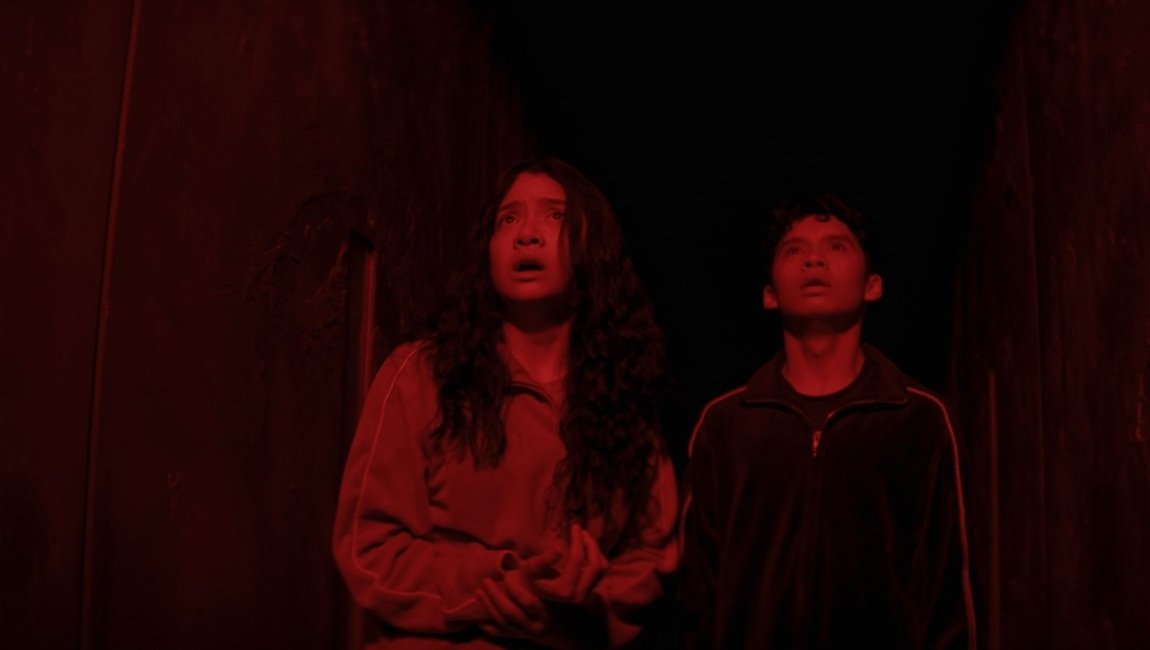
For introverts and the unaccomplished, the greatest threat looming over every family gathering isn’t the unlikely prospect of mass violence, but an all too conscious reckoning of one’s character and credentials as the treacle of seasonal goodwill conveniently comes to bear on one’s sense of self-worth. As Michael Gabriele’s riotous holiday horror would have you believe, this phenomenon is not unique to Asian households, where shame and propriety commingle under a greater generational hierarchy, but rampant across traditions. Commencing in media res amid the fanfare of an Italian Christmas sited in the wintry suburbs of Canada, Unholy Night splatters its festive proceedings with an introductory rampage that’s as brutal as it is brief, with Lucia, a young girl, as its sole survivor. Decades later and now a mother of three, Lucia (Toni Ellwand) once again gathers her adult kin around for their annual reunion; this time, an uninvited guest shuffles into her home, skulking around in the basement, before emerging to unleash bloody mayhem on the household.
That uninvited guest is grandma, or Nonna (Jacqueline Robbins), as Lucia’s children affectionately know her. The chief issue with this unexpected reunion is that Nonna has been dead and buried for years; her skin has turned a ghastly white, and her eyes are susceptible to glowing like red-hot embers when provoked. While the rest of her offspring fend themselves against her and hole up amidst rumors of a wider outbreak of the living dead, single and underachieving Gino (Marc Bendavid) heads out for some answers, and also to check in on his ex-girlfriend, Renee (Shailene Garnett), whose sudden appearance on his doorstep earlier raises more questions than it provides any semblance of closure. Cutting to and from the house and Gino as the latter tussles with more of the underworld’s ritornati (as they’re ominously termed), Unholy Night takes no small delight in unfurling its bloody homages to the likes of Evil Dead and Black Christmas while valiantly fighting to flesh out its thematic subtext. Yet the coherence it achieves with the bloody consistency of its kills is sorely lacking in both the method and madness of its virulent familial setup.
A largely diffident man, Gino — who lives with his parents and receives little credit for his profession as a paint specialist — pales in comparison with his forceful siblings, who naturally provide the foil for him to outsmart and outlast the group’s flaying showdown against their undead nemeses. But while Gabriele courts no little familiarity and nostalgia from viewers who no doubt would appreciate the finer tones of the quintessential dinner squabbles and dynamic jests particular to the immigrant Italian diaspora, his characters don’t quite possess the requisite depth to sustain and justify their prolonged presence throughout the film. (In most of the Evil Dead entries, psychological insight is rightfully jettisoned alongside physical integrity.) Throughout the prolonged nocturnal battering of bodies and emotions, little is really articulated by way of Nonna’s return, alongside that of her long-deceased amici, except that the zombified corpses here serve some kind of loose metaphor for ancestral vengeance best interpreted as arising from a broad disrespect for tradition and authority. Notably, the ritornati aren’t all brain-dead but mostly capable of rational thought, excluding the fits of rage that turn them into maniacal shredders of flesh. On that count, Unholy Night’s choice of the Christmas dramedy vehicle to augur the return of the repressed registers as a lamentable waste of its monstrous arsenal and a wholly undercooked swipe at sacrilege. — MORRIS YANG
Home Bodies
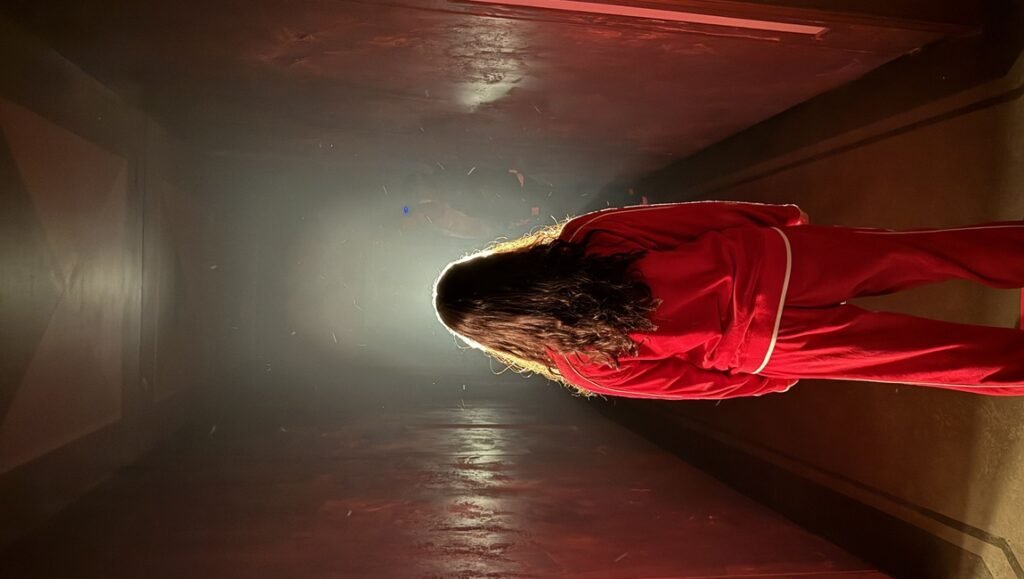
It’s all too easy to feel at home in Casey Walker’s Home Bodies. Red (Emma Ho) and Blue (Ian Ho) have lived all their days in a small but intricate home. They seem to both be around 14 years old. Aesthetically, the various rooms, each outfitted for a specific and essential purpose (the eating room, the TV room, the bedroom, the toilet room) looks as if it were stuck in the ‘50s. The appliances and decor are all retro-futuristic, but also decaying, browning from old age. But at the same time, the home is technologically advanced: cupboards re-stock themselves (evidenced by a mechanical whooshing), the microwave turns ingredients into meals, and the cellar disappears the bags of trash the siblings place into it, but only after they close the door and recite “garbage” three times.
They regularly visit “Papa,” a paternalistic disembodied being who resides behind a locked door. We and the siblings only ever hear his robotic voice, which is summoned after they ring a doorbell. They must kneel before the door every time they speak to Papa, who answers any questions the kids have, and also doles out advice and discipline. Their entire knowledge base — their language, moral lessons, hygiene — has been inculcated in them by Papa and by a show called “Barn,” a children’s puppet show that Red and Blue watch on VHS tapes that Papa provides them daily. Papa and the puppets in the show (a cow, chicken, and pig) are the only other beings the kids know.
Only a few moments into the film, it feels as though we, too, have spent all our lives in this little home with Red and Blue. They don’t have much purpose other than to move through the days, measuring time by the light that brightens or dims (marking days and nights) outside the translucent glass of their windows. They wake up, eat breakfast, watch “Barn,” eat lunch, play, watch more “Barn,” eat again, and then go to sleep. It’s incredibly ordered and comforting, at least to Blue, who relishes and thrives in the rigor. Red — it grows increasingly apparent in the first act, through her lazing around, her reluctance to wake up as swiftly as Blue does, through her dragging heels — is growing bored with their existence.
The siblings’ simple and predictable days are disturbed by the appearance of Pal (Ess Hödlmoser), an androgynous being about the same age as Red and Blue. Pal doesn’t speak and Papa tells the kids that they must treat Pal with the respect they have for each other. Red is elated, having found in Pal a new friend, while Blue rankles. The figure of Pal introduces in the lives of the two siblings ideas more grim than they are used to, and the film watches as Red and Blue deal with this newness and the growth it foists upon them. In service of this shift, the set design, pacing, and cinematography, along with the Ho siblings’ portrayals of Red and Blue, are so incredibly well done, are so well realized and cohesive (each aspect completing and complementing the other), that it’s tough not to forget yourself as you watch the film. And so when Pal does appear, one feels both Blue’s discomfort and Red’s elation with visceral force.
Home Bodies works incredibly well on its immediate level, telling a story at once simple, engrossing, and monumental. And it is this simplicity that allows the film to successfully and poignantly carry its bevy of ideological meanings. Most sci-fi stories often carry a single, hefty allegory, which reflects in broad strokes the complex world that the stories have built. In Home Bodies, the story, the world built, is fairly simple — that is, even as the small home that Red and Blue live in is intricate and has distinct rules and regulations, there isn’t much in the way of exposition for why things are the way that they are. In anchoring the story in such distinct and well-wrought characters, which are superbly embodied by the Ho siblings, characters who have little need for reasons behind why their world is the way that it is, the story is able to afford its simplicity. And it is this literal or narrative simplicity that enables and deftly supports the film’s analytical openness.
The story of Home Bodies can be an allegory for a coming-into adulthood, for psychological individuation; it can be an allegory for how our society is built on decaying systems; it can be a commentary on the surveillance state; it can even be read as a critique of religion and blind faith in stolid and ancient symbols and myths. The viewer is encouraged to identify with whichever sibling speaks to their soul; each is equally and stridently characterized, neither is pedestaled over the other. It is this strong foundation of story that supports ideological freedom. Each reading depends on the viewer, and this wealth of interpretations speaks to Walker’s admirable ability to, through a certain kind of narrative control that facilitates our psyche’s enmeshment in the story, give up analytical control. And so because we feel so at home within Home Bodies, we have a stake in the siblings’ fates, and then we feel impelled to find an allegory, to search for answers that might satisfy us.
Home Bodies is a confident film that is not afraid of unanswered questions, but rather encourages them. In its manner of carrying and developing Red and Blue, prodding them through Pal to ask existential questions, and in its respecting its characters to reach meaning for themselves, Home Bodies is triumphal. Because the thing is, the film does for us what it does for Red and Blue. The film itself feels like a lesson in emboldening us to read films for a meaning that speaks to us. At a time when so much art is terrified of open-endedness, takes pains to explain and over-analyze itself, Home Bodies, for how it opens itself up even as it remains so distinctly contained, so distinct in its identity, is a refreshing, renegade, and beautiful being. — ALISHA MUGHAL
Suzuki=Bakudan
Akira Nagai’s Suzuki=Bakudan is a police procedural in which nearly every consequential movement begins with a man sitting at a table. Tagosaku Suzuki (Jiro Sato), detained after drunkenly attacking a vending machine and an employee, claims that bombs will soon detonate around Tokyo. The first accurate prediction forces the police to reconsider everything coming out of his mouth. Even his jokes require attention. From there, the film cuts between the interrogation and officers pursuing clues across the city. Cinematographer Tetsuya Kondo’s handheld camera gives the room an unsettled texture, while editor Suguru Ninomiya turns Suzuki’s remarks into changes of location and pace. For roughly an hour, this arrangement works. The trouble is that Nagai continues cycling through it long after the viewer has learned its rhythms, leaving Sato to supply most of the remaining surprise.
The police decide who questions Suzuki and whether he can stand or leave. None of that prevents him from directing their attention. Kondo begins at conversational distances, then moves closer as the predictions acquire credibility. The camera picks out a finger lifted from the table, an abrasion, the corner of a smile. Small handheld tremors keep these inserts from looking clinical. Early on, each detail can change how Suzuki’s last sentence is understood. By the final third, similar close-ups have become routine coverage. The city may be under greater threat, but the camera is still returning to the same hands and injuries.
Suzuki initially looks like someone the institution can process and forget, an unidentified drunk attached to a minor offense. The equal sign in the international title describes the suspicion he creates once the first blast occurs: every part of him might now be evidence. His control depends on the police becoming afraid of interpreting him incorrectly, whether or not they can prove that he commands the bombs. A stray remark can send several officers out of the building while he remains in the same chair.
Sato keeps changing the temperature of the room. Suzuki often mumbles and seems pleased with himself. Occasionally he raises his voice, though volume is never a reliable measure of danger. Some of his ugliest statements arrive with exaggerated courtesy. A pause may suggest drunken distraction until his eyes settle on the interrogator and make the delay look planned. Sato can let the laughter disappear while leaving the smile in place; elsewhere, his mouth relaxes before the suspicion leaves his face. Nothing about the performance feels casually improvised, even when Suzuki appears to be inventing the conversation as he goes.
Yuki Yamada works in a broader register as Ruike. He plays the detective as a slightly anime-coded sad boy, announcing disillusionment through lowered eyes and a clenched jaw. When that restraint breaks, the response is sudden and large. Nagai repeatedly cuts to Ruike after Suzuki lands a provocation, using his face to underline that the exchange has changed. This makes the interrogation easy to follow, but it also limits Ruike’s intelligence to visible reaction. Sato sets the tone and Yamada confirms it. Ruike rarely appears to be thinking on a track the film has not already shown us.
Outside the station, Sairi Ito’s Koda and Ryota Bando’s Yabuki move through public spaces with considerably more freedom. Nagai keeps the searches geographically clear, and Ninomiya accelerates the cutting when a word from the interrogation redirects them. These passages initially give Suzuki’s speech physical reach: something said casually inside a drab room sends bodies across Tokyo. After several repetitions, their arrival becomes predictable. Another cryptic remark means another burst of police activity before the film returns to the table. Yaffle’s score enters at the expected pressure points and withdraws without leaving much behind. It supports the existing tempo rather than altering it.
The English subtitles create a separate difficulty. Some riddles depend on kanji or verbal associations that are rarely placed onscreen, so the translation has to provide a clue whose components the international viewer cannot fully inspect. The police are shown recognizing a connection; someone reading the subtitles may receive that connection already half-assembled. The loss is inevitable to a degree, but Nagai makes little attempt to give written language a stronger visual role. Consequently, an elegant piece of wordplay can arrive as information to be accepted rather than a deduction the internacional audience can perform.
Before the first explosion, Suzuki is a shabby detainee whom the police would have little reason to remember. Afterward, the same men lean closer whenever he opens his mouth. That reversal gives some weight to his complaints about which people receive attention and whose deaths matter. The film gives him the sharpest formulations of those grievances, while the endangered public usually appears as a reason for the police to hurry. Nagai seldom remains with ordinary victims long enough for their experience to answer Suzuki’s claims. His resentment is vivid because Sato is vivid; the social world supporting it is much thinner.
At 137 minutes, Suzuki=Bakudan could lose 20 or 30 without damaging its mystery. Around the hour mark, the route from a new riddle to another search has become familiar, and changing the camera position no longer renews it. Sato uses the extra time well, continuing to adjust Suzuki’s voice and facial tension after the investigation itself has begun to stall, but Nagai cannot keep pace with him. Late in the film, the camera once again searches Suzuki’s face and hands for fresh information, even though it has already taught us exactly where to look. — GUILHERME QUIREZA

Insectasy
Canadian perversion has always held a firm grip on our self-narrativization, the violent alienation of our national identities always sought after in reconciliation. Most often, this is not a true reconciliation but one that is totally individualized, that answers to our wants for comfort, affirmation, and self-preservation. Angus Silver, director and writer of Insectasy, imagines this via a young office worker, Sadie, and her quest to rid herself of this alienation that consumes her, that inscribes a schism between her and the world she seems increasingly distracted from and perplexed over. You see, Sadie likes to get off feeling bugs crawl across her naked torso, exploding their guts as she cums. Of course, this is a secret, but one she’s desperate to not have to keep. The requisite solitude such a fetish seems to necessitate — it’s lonely, it’s too quiet: can’t anybody understand?
The beauty of Insectasy lies in how its final image recontextualizes the estrangement we very schematically trudge through as the film tries to muster some structure to its psychosexual analysis. This latter point speaks to the film’s biggest flaw: how lacking in a narrative imagination it is, especially when contending with its transgressions. These two intentions are at odds, compressing the curiosity of its perversion into a digestible capsule, unfurling the type of contradiction that’s never interested in problematizing itself. The elephant of contrivance just gets thrown into the corner, ignored and moved on from. But, beyond that thick cake of frustration, which certainly colors the whole ordeal, the final image is staggering, something impossible to not write about.
Our protagonist, Sadie, finally finding her release from this suffocating remoteness, rides Gregor Samsa. It’s likely not Gregor, exactly, but the iconography is unmistakable. This appropriation and flip is an exciting iconoclastic reveling. The shame and expectation of that all too known metamorphosis is questioned as an experiment in both the embrace of kink and the rejection of social expectations, a pointed theme the film underlines again and again as its plotting fails to reconstitute itself without repetition. There are many isolated instances of this beauty in self-acceptance getting its head above the water, treading against the tide of the diagrammatic, all very digital and crude, orchestrating the greatest sense of care in these small moments of unpolished yet euphoric ecstasy. But then there’s a filmic reprieve, too, a dream-state all too familiar. Again, more imaginings that find the shortest route to the signifier, simplifying its own intentions through hackneyed formal juxtapositions. There’s a lot of this mess, so much so that the beauty is something more sporadic than the mundane, which is a fair enough structure for resonance, if only so much of what is clearly attempting to visualize escape and the fantastic wasn’t also lumbering, axiomatic rumination on Sadie’s self-perception and representation. In so many forms, Silver can’t quite break through the visual lineage they work in, finding only glimmers of a total discursion amongst a mostly derivative object. — ZACHARY GOLDKIND
The Mouths
There is something about horror maestro Takashi Shimizu’s The Mouths that feels as foundational as myth. The film’s premise is simple enough: a group of university-aged friends have heard stories of a gnarled tree standing deep within a neglected cemetery that is cursed. The tree is rumored to grant wishes, but as all things cursed, the wishes granted come at a price. The four friends decide to have some fun. They head to the cemetery and decide to walk up to the tree individually, to see who can get closest to it, to test who is the bravest of them all. Things go well until it’s Ann’s turn, who they find has climbed the cicada-covered tree and is speaking nonsensically. The next day, she disappears and each friend begins experiencing a strange sort of haunting: visions of a woman with a long neck, enormous cicadas assailing them, and a strange vision of Ann herself. As the friends try to investigate the tree’s history and ascertain what exactly happened to them and Ann at the tree, they find their sense of reality and sanity slowly unraveling.
The film’s story is both depicted and told — that is, the general, outermost narrative follows a detective listening to audio tapes of Ann’s friends as they, one by one, describe the events of the night they went to the tree and everything that happened afterwards. It’s as if we’re listening to the tapes of the kids’ interrogations. But something doesn’t feel right — it’s in each friend’s increasing loquacity, in the madness that creeps into their faces as they tell their version of events. Something strange is going on; or rather, four different strange stories are taking place, all alongside the detective’s search for the truth, if there be such a thing.
The Mouths is intense and captivating. Like all good horror-thrillers, it scoops us up as viewers into its narrative and leaves us breathlessly running after the story in an effort to solve it, to understand. Shimizu’s genius, which was amply demonstrated in 2002’s Ju-on: The Grudge, lies in his ability to parcel a single narrative in various characters’ serpentine minds. It’s exciting watching this film: darning an image out of the various threads becomes the thrilling task, and leads to an onus placed on us by Shimizu to find a meaning that isn’t correct so much as it is resonant with our understandings.
By no means is The Mouths a perfect film, nor is it the scariest horror film you will see. But there is something wonderfully poignant here, something important that turns not on gimmicks like jump scares or explosions of gore; it’s something akin to a lesson or a reminder of the kind of storytelling we would be sorry to lose: slow, open, and excavating. The point here is to feel The Mouths move through us, whether it is in waves of horror, suspense, or exhilaration.
Much of The Mouths feels like an aged story, the kind shared at a sleepover or around a campfire; it feels like a familiar myth even as its story tells a tale we’ve never heard before. And the point isn’t to get to the ending and a singular, final answer of what exactly it was that happened to Ann and her friends; rather, the point lies in the telling. This film pedestals the act of storytelling and the act of listening and watching above truth, and as such, it brings us back to one of the greatest foundations of mythmaking, storytelling, and filmmaking: pure entertainment. — ALISHA MUGHAL
Comments are closed.