
In This Dispatch
Sheep in the Box
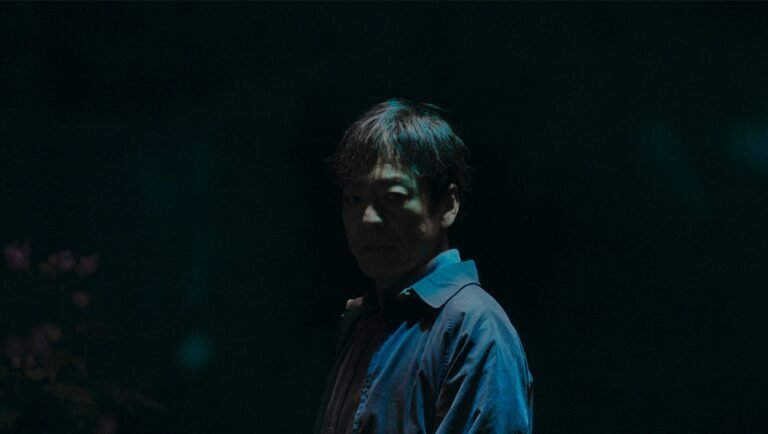
Based on its tepid reception in Cannes earlier this year, one might reasonably expect Hirokazu Kore-eda’s new film Sheep in the Box to be a major misfire. And it’s true that Sheep in the Box is a second-tier effort, roughly along the lines of Hana or Air Doll. But mainly it seems that the negative reaction to Kore-eda’s new film stems from his treatment of his chosen subject matter. After all, this is the story of a couple who are selected to test out a humanoid robot made in the likeness of their young son Kakeru (Kuwaki Remu), who died in a train accident two years earlier. The plot immediately brings to mind Spielberg’s A.I., along with lesser-known robot-replacement films such as Michael Almereyda’s Marjorie Prime, and it does suffer in the comparison. What’s more, Sheep in the Box opens itself to greater scrutiny because in 2026, artificial intelligence isn’t the stuff of Isaac Asimov futurism, but is instead reaching its corporate tentacles into all facets of daily life.
In other words, Sheep in the Box is cursed with topicality, and it’s true that Kore-eda isn’t necessarily interested in the scientific or ethical ramifications of tech that purports to be family. Instead, the premise is mostly a structure onto which Kore-eda can apply many of the concerns that have guided his cinematic career. What is love? What is the meaning of family? Are people defined by their circumstances, or does the human being maintain an innate spark regardless of external pressures? And above all, why does society allow children to experience abandonment and suffering? Although the scenario of Sheep in the Box butts up against cutting-edge technological questions, Koreeda seems less interested in exploring them for their own sake, and this might seem like a missed opportunity.
And it’s true, Sheep in the Box is not an entirely successful film, but for somewhat different reasons. Kore-eda is given to tackling the big questions, and in his best films — After Life, Still Walking, Maborosi, and Distance — he narrows his inquiry down by focusing on the specific parameters of his premise. After Life is about the art of dying well, leaving behind some small trace of meaning. Distance (Kore-eda’s most underrated film) considers mortality and the death drive, in the context of an Aum-like suicide cult. One might reasonably expect Sheep in the Box to operate in the same manner, using the advent of AI to explore the meanings of family attachment.
But in fact, the robotic replacement of a dead child doesn’t narrow down Kore-eda’s ideas so much as it gives them free rein. Kore-eda’s films are always formally precise, with a tonal and compositional evenhandedness that unconsciously communicates a level of intellectual control to the viewer, and for this reason it can be difficult to perceive just how scattershot Sheep in a Box actually is. Kore-eda’s post-Ozu style confers an audiovisual holism that the screenplay simply cannot follow through on. This can seem even more confusing given that Kakeru’s parents are themselves fastidious structuralists. The mother, Otone (Haruka Ayase), is an architect who specializes in combining modernism and traditional Japanese elements. The father, Ken (Daigo Yamamoto), is a master builder who helps Otone realize her visions.
In a more streamlined version of Sheep in the Box, the couple’s careers and general temperament would have been the main drivers of the plot, particularly their ability or inability to accept the robotic Kakeru. Time and change are significant throughlines in the film. Otone retains models of older, failed projects because she wants to have the option of recycling those ideas in new situations. Otone’s pushy, churlish mother (Mari Hoshino) summarily rejects the cyber child and tells Otone that she should just have another child. When our memories can be made “flesh” through technology, what does that do to those memories, or our fundamental relationship to time? Are we all simply data points that can be recycled infinitely, in new situations? How easily can we be replaced?
One of the most off-putting aspects of Sheep is the fact that Otone and Ken accept this brand-new technology with minimal resistance. Ken initially rejects his robot son, comparing him first to a Tamagotchi, and later on to a Roomba. Otone chooses to embrace their replacement son, but eventually becomes even more ambivalent than her husband. But neither of them really questions the ethics of adopting a mechanical replacement son. As the film progresses, Kore-eda introduces greater ambiguity about “life” as a meaningful category. An older woodworker, Akio (Min Tanaka), believes that all wood retains traces of the tree’s prior living state. And if wooden blocks or planks are “alive,” why isn’t Kakeru?
In other words, if the animatronic Kakeru isn’t the couple’s son, what is he? A toy? A pet? An appliance? Kore-eda chooses not to answer these questions, and this leads to a certain frustration. Why tackle one of society’s hottest hot-button issues and refrain from taking a stand? Given Kore-eda’s often diffident artistic voice, it is unrealistic to think he’d stake out a firm position. (We have Miyazaki for that.) But we did have a right to expect Kore-eda to take the premise seriously in terms of what it might mean for the future of the family unit. By the end, when Kakeru leaves his parents behind to join a community of other, mostly robotic children, Ken remarks that all children leave their parents eventually. Does this mean that all children “die” by growing up, and the loss of the original Kakeru was merely a more acute version of a universal parental loss? Kore-eda doesn’t have an answer for us, and while he certainly has the right to avoid prescriptive moralism, he might’ve offered something richer in return. Sheep in the Box ultimately does not. — MICHAEL SICINSKI
Sai: Disaster
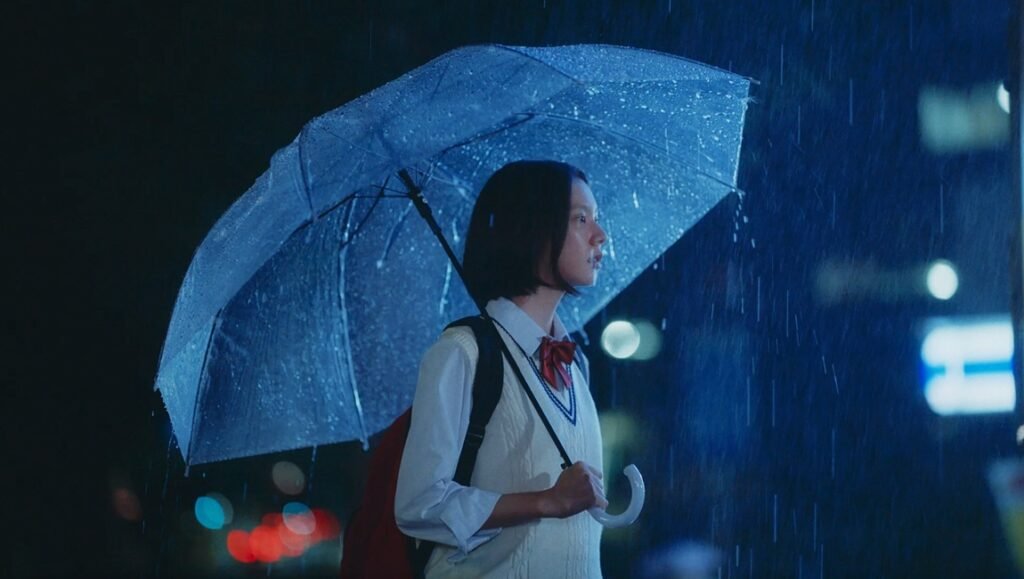
Let’s get this out of the way: Yutaro Seki and Kentaro Hirase’s Sai: Disaster is not a complete work, or at least not one that contains the whole scope of the filmmakers’ project, as it is a theatrical reedit of their original six-hour television series. Not having seen the longer version, this writer can’t speak to what’s been cut or rearranged, but all signs point to Disaster being a fairly radical restructuring of the material, presenting a nonlinear, mosaic take on Sai’s feel-bad mystery plot. That new structural game is one of the few engaging elements of the film, however, and unless all the best stuff was inadvisably left on the cutting room floor, this plodding movie does not inspire confidence in the quality of a version three times as long.
Since the film opens on a few murders, quickly suggesting the presence of a serial killer, the character portraits Sai: Disaster intercuts across its first hour or so are tinged with dread, though what’s on screen rarely suggests much danger or suspense even as the obtrusive score insists on portent. Each of the film’s narrative segments focuses on a character — a schoolgirl concerned with exams amidst her parents’ divorce, an alcoholic truck driver navigating the end of his own marriage after a tragic accident, a celebrated chef separated from his wife, and a mall custodian whose marital status is uniquely irrelevant — on what will turn out to be the last few days of their life. A strange man played by Teruyuki Kagawa appears at the fringes of the lives of each of these people. Meanwhile, we see short scenes of a detective on a murder case as her colleagues’ insistence that these deaths are random grows increasingly unbelievable.
Despite the body count and a few grisly images, Seki and Hirase elide scenes of violence entirely, which both keeps its focus squarely on the human cost of the crimes and justifies the film’s exasperating attempt at high-minded ambiguity. But its refusal to give in to genre pleasures leaves the film barren of anything engaging. Perhaps there was more meat to these characters’ lives in the longer, sequential television cut, but in this version they are archetypal figures ensnared in familiar stories. Plus, the philosophical musings spoken by several characters that suggest that murder, suicide, or accidental death are all the same thing, just another disaster that can befall a person, come across as little more than a juvenile gesture toward deep thinking, an attempt to paste meaning onto an otherwise pointless procession of corpses.
In tone and subject matter, Sai: Disaster is redolent of Kiyoshi Kurosawa’s influence — even the casting of Kagawa as an unnerving presence calls to mind Creepy. If inviting the comparison does the film no favors, it’s instructive in how it illuminates the master’s strengths beyond the doom-and-gloom worldview adopted here. Cure, another film that deals with the malevolence of a strange man and the mysterious death in his wake, is a classic not only for its vibe and musings on evil, but also for Kurosawa’s incredibly precise staging and his ability to extract dread from every inch of the frame, even when there’s little on screen. Sai: Disaster leaves little impression because it is, in contrast, desperate. It’s the type of film that shows you a slow-motion close-up of spilled water, drops a heavy-handed musical cue, and hopes that you feel shaken. — CHRIS MELLO
Tokyo Taxi
80 is the new 60! With healthcare improving and human longevity increasing, it’s a golden age for the Medicare-eligible filmmaker — in the last decade, we’ve had octogenarian triumphs in films like Killers of the Flower Moon, The Boy and the Heron, and Ex Libris: The New York Public Library. “But what of the nonagenarian?” The occasion of a new Yoji Yamada film, director of over 90 movies and himself 94 years old, gives us the opportunity to ask. Clint Eastwood proved a 90-year-old could make an elegant, Fleischerian film with Juror #2 in 2023. Equally ambiguously (or tersely) titled, does Tokyo Taxi match Juror #2’s twilit grace?
Not being fully fluent in the director’s previous work, this writer finds it difficult to say whether Yamada’s choices in Tokyo Taxi amount to late style — but it sure smells like kareishū. The cuts are hard, the frames are mostly static, and the story is as lean as could possibly be: Koji, a taxi driver in a financially precarious situation, reluctantly picks up a gig driving aging Sumire from Tokyo to a nursing home in Hayama, discovering her rich personal history along the way. A direct remake of the 2022 French film Une Belle Course and featuring distinct notes of Driving Miss Daisy and The Intouchables, Yamada transposes the odd-couple dynamic onto contemporary Japan as seen from the backseat of a cab — and rides the fine line between tastefully simple and perfunctory all the way to the film’s conclusion.
Two people in a taxi can absolutely produce movie magic. Kiarostami and Panahi have both done it in Ten and Taxi, respectively, evincing deep humanity by way of seemingly superficial conversation or the shifting of a gaze. Yamada, however, plays things broad: characters sigh and pout histrionically, eyes bulge when surprised, and the mundanity of the conversation remains just that — mundane. The film doesn’t coalesce into a testament to the beauty of a life well-lived (“In life, the most unimaginable things happen,” Sumire muses as if narrating a commercial for Disney World), nor does it offer a lived-in depiction of Tokyo circa 2026. It’s more comfortable hanging out in the car than being in the world, and any community that pokes in from the sidelines feels incidental. While far from a tourist’s picture, the cutaways to the city’s skyline don’t give the viewer anything to hold onto vis-à-vis Tokyo’s current state or the changes it has undergone over the course of Sumire’s long life.
To compensate for his lack of insight in the present tense, Yamada punts his observations about Japan’s past to flashbacks — functionally half of the movie. Interesting in the sense that a lot of things have happened to her, but never really placing us there with her, they mostly observe from the middle distance her melodramatic turns of fortune. The flashbacks recover from a heinous beige overlay Yamada implements when he introduces the structure, but they never inject the movie with spark, surprise, or verve.
Except once. From thin air, Yamada manages to turn Tokyo Taxi into a completely different film for a single shot. With deep focus and featuring several planes of action, it’s an image distinctly recalling Ozu: a boy plays with his toys while his disinterested stepfather reads the news and his mother (a young Sumire) does laundry behind them. Framed inside of a narrow doorway, we get an entire family dynamic in extreme microcosm. It’s a gorgeous, complicated image, but as if to dissuade us from hoping the movie we’re watching would continue down that path, the stepfather closes the door on the shot and the hope of any invigorating style to be found elsewhere in the movie.
Tokyo Taxi is, ultimately, more aligned with late-career curios Disclosure Day and Ella McCay than it is the tradition of Yasujiro Ozu: Yamada leans back in his rocking chair, waxing poetic about how far we’ve come since he was young and how much farther we’d be if we could just love our neighbors a little more deeply. He deserves credit for prioritizing the small trials and victories of everyday people — it stands as a testament to the durability of quaint humanism, a notion (one hopes) there will always be an audience for. But everyone has a sob story; it’s the telling that matters. — ETHAN J. ROSENBERG
Also Playing
Burn
Makoto Nagahisa’s Burn walks a very fine line, attempting to infuse a miserabilist, post-neo-realist tale of urban destitution with a candy-colored pop aesthetic while putting us inside the subjective experiences of young Ju-Ju (Nana Mori) as she flees home and takes up with a band of street urchins in a downtown Tokyo entertainment district. When we first meet Ju-Ju, she and her younger sister are being beaten by their father. They pray for his death nightly, and when it finally happens, their mother steps up to take over the deceased man’s brutal attacks. Fed up, Ju-Ju leaves home with a promise to eventually send for her sister. All of this is accompanied by Ju-Ju’s voiceover narration, a constant stream of verbiage that will last for the entire film.
Nagahisa shoots these early scenes alternating between extreme close-ups and oblique, claustrophobic compositions that isolate bodies with windows and doorways, often creating frames within frames. But the world explodes once Ju-Ju arrives in the city, the camera movements and editing becoming freer and more ecstatic. She meets a bevy of other lost children, including Wris (Ryosuke Sota) and potential interest AQ (Kanata Mori). The whole group is overseen by Kami (Wataru Ichinose), a seemingly friendly, benevolent man who rents a room for them to share, but who will eventually reveal a more sinister purpose. One might assume that the bulk of the film will follow Ju-Ju’s experiences with this newfound family, but it switches gears suddenly when Ju-Ju accidentally overdoses and is picked up by the authorities. She’s placed in a supervised outpatient home of some sort, and quickly makes friends with Mitsuba (Aoi Yamada). Mitsuba is outgoing and experienced in ways that Ju-Ju is not, and once the duo escapes the center and returns to the city, Mitsuba promptly introduces Ju-Ju to the lucrative act of sex work. Our intrepid heroine isn’t pleased by the work, but accepts it as the fastest way to save money to make a new life for her and her sister.
Given the subject matter on display — prostitution, drug addiction, mental and physical disabilities — one might suspect a moralizing slog of a film. And while the narrative does eventually arrive (or devolve) to that point, Nagahisa and cinematographer Hiroaki Takeda infuse the proceedings with a vivacious energy and joyfully anarchic spirit. Nagahisa spent time with actual people living on the streets while working on the screenplay, and Ju-Ju’s subjective experiences are coupled with a genuine feel for life on the fringe. Pastel colors pop everywhere, and expressionistic interludes allow for a sort of poetic counterpoint to the doldrums of drugs and suicides. There’s a sort of freedom here, even as the film refuses to sugarcoat the darker fringes of this story. Even Ju-Ju’s interactions with clients, while fairly disturbing, are carefully filmed to elide any hint of titillation. Things do sour, though, and it’s a shame that the filmmakers refuse to entertain any potential utopian ideals of a new makeshift society free from the binds of familial violence. There’s no escape here, only a fleeting, temporary reprieve. — DANIEL GORMAN
The Last Blossom
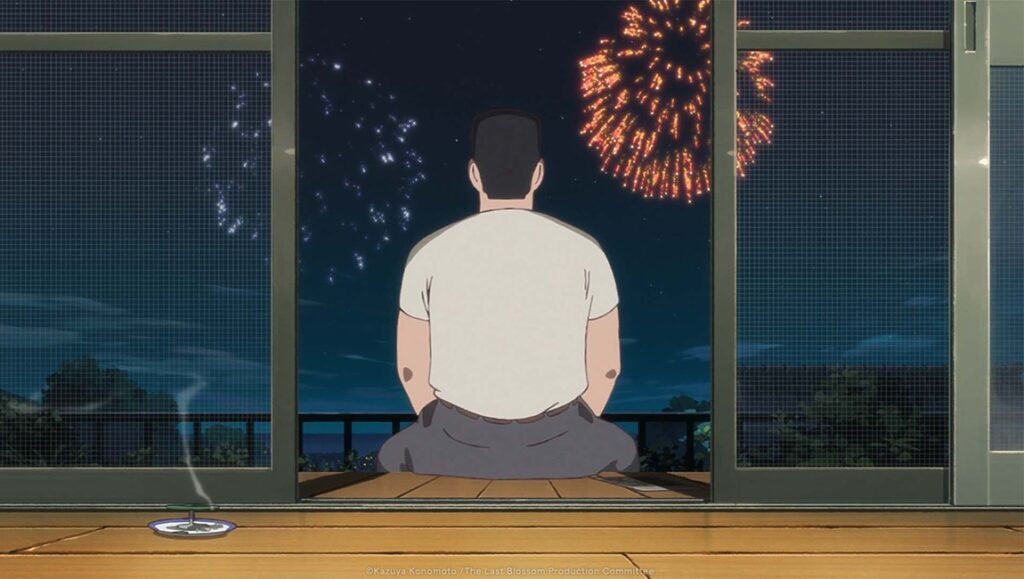
A life sentence would seem to afford you a good deal of thinking time. But for Akutsu, a former yakuza facing his last days on earth in a cell, prison is anything but quiet. Akutsu does his time with Hōsenka, a smartassed talking balsam plant who cracks one-liners as Akutsu stares down death behind bars. Such is life within Baku Kinoshita’s The Last Blossom, an anime that keeps one heel drifting over the mystic as it reckons with histories of violence, a broken family’s last traces of warmth, and the hope to turn it all around with one final move.
Before he caught a 30-year bid, Akutsu (voiced in old age by Kaoru Kobayashi and earlier in life by Junki Tozuka) was a quiet criminal who kept his head down. The Last Blossom portions the better half of its runtime in flashback, where we meet a young Akutsu building his life in 1987 Japan. Akutsu is straightlaced, aloof, and a bit severe, but his quiet passions can betray his austerity. He’s a gifted artist and spends his idle days wandering through town and drawing his own maps, which he insists are more precise than anything you can pick up at a store. But the biggest fissure in Akutsu’s asceticism is revealed by Nana (Hikari Mitsushima [young] and Yoshiko Miyazaki [old]) and her son Kensuke (Natsuki Hanae), with whom Akutsu shares his home under no pretense of money or romance. In fact, Akutsu does whatever he can to prevent the latter: the life of a yakuza is hard, he tells Nana, and even though love bubbles beneath their dates of ramen shops and rounds of Othello, he won’t make his found family official.
All that time spent in memory allows The Last Blossom to trade in its greatest strength: a serene and acute appreciation of the sensory. “Don’t touch them,” Nana admonishes Akutsu as he moves to pluck a flower from their yard. “What comes from nature should be left to nature. That’s the gods’ domain.” Baku Kinoshita exhibits a similar reverence for the gods’ domain. His anime’s attention is glued to the sounds that compose silence: a breeze over a sheaf of paper, birdsong muffled by a wall of trees, the shuffle of feet behind sliding screen doors. For a movie about the yakuza, The Last Blossom is surprising in how it revels in a patient, dogmatic sense of quiet. And while its computer-generated animation can’t capture the awe of older or more expensive hand-drawn anime, its character designs are striking, emotive, personal.
That’s especially true with Kensuke, the doughy and doe-eyed infant that Akutsu struggles to keep at arm’s length. Akutsu’s coldness is calculated and protective, but it pushes Nana to her limit. She wants the love of a traditional family — dangers of the mob be damned — and can’t seem to crack Akutsu’s disciplined refusal. Leave that to a deus ex machina: Kensuke is diagnosed with dilated cardiomyopathy, a potentially fatal condition at his young age, and it’s the key to cracking Akutsu’s icy façade. He decides to sacrifice his rising star within the yakuza and constructs a house-of-cards scheme to rob a rival mob boss, betray his own leader, and secure the funds for a heart transplant — even if it means spending the rest of his life incarcerated.
At 90 minutes, The Last Blossom can’t afford much breathing room around its plot, and Akutsu’s scheming can feel rushed as it eats through time better spent basking in the movie’s more patient moments. As Akutsu and Hōsenka (Pierre Taki), his ersatz Jiminy Cricket, reflect on the crimes that will eventually save Kensuke’s life, Akutsu recalls the nights he spent flipping Othello chips with Nana. It serves as the film’s central metaphor — the chance we get to right a morally tenuous life with one final move — and while it’s logically coherent, the connection is ideologically brittle. Akutsu pulls what strings he can from prison to provide for Nana and Kensuke; it makes for a saccharine ending for his modern family, one that glides vacantly across the screen, hobbled by serendipitous convenience.
The Last Blossom’s race toward the finish line is most frustrating in its betrayal of the precious quiet it lets bloom in its first half. Which, for what it’s worth, is what will endure after the credits roll. Baku Kinoshita’s serenity isn’t quite a rebuke of the maximalist anime (Chainsaw Man, Demon Slayer) reinventing Western box office expectations, but it does serve as an oasis, trading rivers of blood for the breeze of Ozu. For all Hōsenka’s wisecracking, Akutsu’s life — both free and behind bars — is lived in the gods’ domain. — CHRISTIAN CRAIG
Comments are closed.