
In This Dispatch
Every Contact Leaves a Trace
The latest experimental documentary by Lynne Sachs — her 49th film overall — is entirely organized around a formal conceit that simply doesn’t work. That’s not to say that Every Contact Leaves a Trace is an uninteresting film. Sachs lights upon a number of very compelling topics and ideas. However, because of the meta-structure she has adopted, none of those ideas really gets a fair hearing. It seems like a criticism to say that a film is “all over the place,” and it is true that Sachs’ film is frustrating more often than not, but one can’t be entirely sure whether this frustration may have been the point all along.
The premise is that Sachs is going through several decades’ worth of calling cards she has collected, over 600 in all. We see glimpses of these cards, and they are from fellow filmmakers, festival administrators, haircutters, gardeners, physicians, academics, plumbers, you name it. Sachs takes this opportunity to reflect on a life spent meeting people, some of whom she never encountered again, while others became lifelong friends. She is operating on the assumption that no matter how brief those contacts may have been, they were significant and left some mark on her life, with the collected cards representing that social encounter.
One could easily imagine Sachs using these cards the way a structurally inclined filmmaker, like Hollis Frampton or Peter Greenaway, might use the alphabet or a numerical sequence. All these different cards are identical in size and shape, all are assigned a name, and this could provide an abstract organizational method that could shape the overall inquiry. Instead, we see Sachs at a table sorting and piling the cards, muttering to herself as she tries to remember who all these people were. It’s worth noting that Sachs mismatches the sound and image during these sequences, so her remarks do not match up with the cards we see in her hands.
After introducing her concept, Sachs briefly meets with two forensic scientists who discuss how trace remnants of a person’s DNA remain on virtually everything we touch. They demonstrate how to lift faded fingerprints and microfibers, and so in a very material sense, Sachs has kept some small part of all the people who gave her their business cards. They are literally on there and could possibly be retrieved. But following this introduction, the question of exchanged genetic material is abandoned. This will be the primary pattern of the film going forward.
Sachs speaks to a small number of people whose cards she retained, and while they appear to have been selected at random, it’s possible they were just the people who were willing to talk to Sachs. We meet a fiber artist who was an old student of Sachs’, a woman who was Sachs’ therapist during a challenging time in her life, a film festival programmer in Germany, and — bonus for those of us involved in experimental cinema — we catch up with the late Lawrence Brose, a major film artist who fell off the radar, for reasons that others may have known but were news to this writer. There is no connection between these people other than Sachs herself, and so Every Contact leans a bit too heavily on her own memories and impressions. This means that the filmmaker places herself at the center of stories that aren’t really about her. This is a particular problem in the Brose section, which is particularly thorny and easily could have been a feature documentary in itself.
There is a refrain that occurs several times, involving Sachs talking with her young niece Viva and nephew Felix. They are mostly discussing why their aunt has kept all these things and what she should do with them. But some viewers will immediately recognize Viva and Felix as being the children of filmmaker/cinematographer Kirsten Johnson. This inevitably reminds us of Johnson’s film Cameraperson, which uses clips and outtakes she shot while traveling the world and assembles them into a quasi-biography. Obviously, there is a significant disparity here, since Johnson’s footage is more vibrant than a 2×3 inch piece of card stock, and the camera operator’s particular task means that Johnson is mostly occluding her own presence, so that when we see or hear her, it is a striking breach of professional protocol, one with ethical dimensions Johnson means to examine.
None of this is really present in Every Contact Leaves a Trace. Without a deeper structure, the fragments Sachs offers do not hang together, and don’t tell us very much through their juxtaposition. As it stands, the film feels like a collection of false starts. However, it does suggest that a larger project might productively emerge from this organizational premise. Given how each component implies that there is much more to see and hear, a viewer might have a richer, more variegated experience by being able to move through the material like a hypertext or an online database. After all, the cards are modular in nature, and a much more expansive exploration of these people and places would probably give each individual component an added weight. Every Contact Leaves a Trace feels unfinished, but that provides negative space that could be room for multi-directional movement. — MICHAEL SICINSKI

Aanikoobijigan [ancestor/great-grandparent/great-grandchild]
Museums always claim to be the home for lost religious art/anthropological objects — Alain Resnais’ and Chris Marker’s Statues Also Die tackled this patronizing and orientalist classification in 1955 — despite many of them being of dubious provenance, to put it rather mildly. Though I am not religious, a sharp dissonance overwhelms me whenever I see the religious idols of Hindu Gods I grew up with adorn the spaces of the museum. The religious object has now been secularized, but it has also been divorced from the space it was originally meant to be in, collapsing all the historical, traditional and (living) religious significance onto a few lines on the placard accompanying the object. Even objects from “dead” cultures emanate this loss, as an exceptional scene from Alice Rohrwacher’s La Chimera (2023) showed, where the protagonist, Arthur (Josh O’Connor), throws the statue of Cybele into the ocean because it was meant for the dead rather than the living. Some defenders might argue that museums allow us to appreciate these religious art objects better, individuating them and letting them breathe, rather than languishing in obscurity as one among many in houses of worship. Sometimes, these objects have no alternatives other than in museums to preserve them better, especially when their housing has been damaged. But thrown in an alienated space, these objects end up conversing with other alienated objects from different eras, histories, and aesthetics, lending a palpable sense of loss wrought by this severance of aesthetic, historical, and sociopolitical unity, a unity chiselled and molded by the vagaries of time, traditions, and cultures. They are now merely pretty art objects from a distant time and space, with their history and provenance being mere markers of their value as a commodity.
This rapacious colonial-capitalistic decontextualization in museums, subject to a small but insightful sub-chapter in Perry Anderson’s Imagined Communities, isn’t exactly unique to the Occident, with many countries following suit to showcase art objects as national pride. However, it does mask a power-differential when appropriating significant objects from oppressed communities in the name of preservation, science, and/or study. It is this injustice which is the subject of Zack and Adam Khalil’s Aanikoobijigan [ancestor/great-grandparent/great-grandchild], a film that documents the digging of tribal burials by archaeologists and the fight by a collection of Michigan tribes to retrieve them. Initially dismissing their concerns by branding Native Americans as enemies of science, the U.S. government finally ratified a law which mandated museums to return the remains of their ancestors to them. But museums, being cut from the same corporate cloth, played the bureaucratic loophole game on the tribes, shifting the burden of proof to the tribes while conveniently constructing dioramas of tribal life with information gleaned from these remains. And just like their corporate donors, they publicly bemoan their existence on “stolen land,” reducing repatriation to slogans of performative sentimentality. Zack and Adam Khalil dispel these illusions in their first few frames, showing tribal objects and dioramas reflecting off each other in their glass cages across different museums, immediately addressing the looting of objects and bodies through graphs that go hand in hand with their compositions.
Aanikoobijigan, which can mean ancestor, great-grandparent, or great-grandchild, is both a discursive film that addresses Native American concepts of time, nature, and space, the historical and political motivations of museums, and the biases and power dynamics undergirding “scientific” endeavors, and a heartfelt chronicling of the efforts of MACPRA (Michigan Anishinaabek Cultural Preservation and Repatriation Alliance) to repatriate their ancestors to their land. Zack and Adam Khalil are well aware that this is far from common knowledge, so they construct their film as a pedagogical tool, replete with talking heads, archival TV footage, and figures. Key points raised by the MACRA members and historians flash on the screen in giant caps bathed in a luminous glow to further emphasize them. This certainly embeds the ideas in the minds of the viewers, and while there is no denying the necessity of it, it certainly comes at the cost of the camera and editing being mere reinforcing agents, rather than conversants with the history. Their aesthetic ideas are sometimes cut short because of this approach, such as their rhyming tracking shots across museum vaults containing their ancestors’ remains and forests, accentuating the spiritual displacement wrought by the callous looting. The filmmakers did mention the need for centralizing the “content” in this documentary in an interview, but they also mention the felicity of cinema to handle this subject because of its malleability with respect to time and duration, concepts which come to the fore in dazzling, but alas, fleeting, shots of forests throttled by a vast array of colors and motions when a historian talks about the Native Americans’ fluid conception of time, where, as the title indicates, past, present, and future collapse onto each other. Though one understands the need to get these points across, such concepts need more room to breathe, and a pedagogical approach needn’t be incompatible with these aesthetic ideas.
But as a chronicling of the struggles and, eventually, the small successes of the MACPRA members, Aanikoobijigan takes care to emphasize out the emotional resonances affiliated with museum “objects” for the communities concerned, an aspect which most museums and museum-goers readily ignore. Their willingness to question “august” institutions and their operations certainly brings ideas seldom discussed to the fore, while also dismantling our assumptions and received wisdoms. The shots of the members finally burying their ancestors after their long drawn-out battle, though tinged with the feeling that more work needs to be done, are a beautiful reminder of the relations between objects, humans, and traditions, and how we callously and hypocritically disregard them whenever we encounter objects outside our own culture. — ANAND SUDHA
Uchronia
What better medium for communing with the spirits than film? Sights and sounds of eras since passed, or visions of things unknowable in reality — a memory machine and a dream machine in one. Fil Ieropoulos’ dense and experimental Uchronia, ostensibly both an imagined portrait of poet Arthur Rimbaud and a wild, free interpretation of his famous prose poem “A Season in Hell,” is both a memory of queer history and an anarchic dream of the collision of various eras and figures from within it. Ieropoulos depicts Rimbaud as a hermit, poring over histories he’d never come to know, boldly repurposed as a radical manifesto for queer identity in the modern age.
In Uchronia, the spirits of the past are not dead. The unreality of fictional storytelling is mitigated by the reality of its telling — that which is denied by conventional wisdom is permitted through an unconventional approach, a familiar experience for so many queer people. Death is rendered impermanent by recreation; film allows Arthur Rimbaud to commune with Marsha P. Johnson, David Wojnarowicz, Jack Smith, and others, and us to participate in the process. It’s a vibrant, sometimes bewildering process, and a work whose sheer volume of ideas and the conviction of their expression deserves sincere study, even if the quality of its execution varies considerably from moment to moment.
Most compelling is the first section, in which various figures provide various lectures in various languages to an audience (and, of course, to us, the audience). A few stilted line readings aside, the clarity of the political arguments made here, largely touching on colonialism and fascism in Europe since the mid-20th century, is extremely persuasive. The chaotic nature of its presentation, with rapid editing between speakers, interpretive performances, an atonal Greek chorus, and a barrage of assaultive sounds and images, means both that it requires excess concentration and that it maintains it; later, the film’s rhythms will slow somewhat, though the style — a collage of cacophony — will remain consistent.
Ieropoulos’ methods may be experimental, but they’re not entirely original, though they’re deployed with both force and sincerity. This is a blunt, uncompromising manifesto, but not a shallow one, and the style has thematic purpose, functioning as a reaction against the ideals of beauty that the film argues as fascist. Also falling under its fascist umbrella are modern technology, or at least its current figureheads, and sport — and it makes a pretty strong case for all of the above. Indeed, little escapes writer Foivos Dousos’ scorn, from pop art to AI, J. K. Rowling to Emilia Pérez. The general, and very deliberate, disregard for decency is, frankly, inspiring — a queer-punk cri de cœur for liberation from heteronormative, conservative constraints of respect and routine.
This can also make for an exhausting experience. The refusal to clearly identify specific figures, or to explain the meaning behind certain stylistic flourishes (of which there are many), may be an admirable refusal to coddle the viewer, though if the intent was to leave all open to interpretation in Uchronia, not all interpretations might be forgiving. A scene featuring a mud orgy accompanied by newsreel narration of war tragedies conveys little, any implied meaning lost in the awkward juxtaposition. A quasi-romantic scene is set to music by Wagner, of all people, shortly after a lengthy discussion on fascism, and again the juxtaposition raises more questions than answers. But, in the closing section, in which the film’s participants are interviewed on camera, only answers are provided. What one takes from Uchronia is, perhaps, purely what one takes from Uchronia.
As the film becomes quieter and more contemplative, though no less creative, its vitality starts to dwindle, yet it’s never long before something recaptures the viewer’s attention — the Andy Warhol sequence, followed by a drag musical performance, is a particular highlight. There’s simply so much to enjoy, endure, and unpack in Uchronia, that it’s only natural that some of it is more successful than the rest, and vice versa. Ieropoulos has run riot with this memory/dream machine. If the result is patchy in its effectiveness, it’s still a thrill to see a filmmaker display this much daring. — PADAI O’MAOLCHALANN
Also Playing
Afterlives
In 2020, Kevin B. Lee and Lého Galibert-Laîné released Bottled Songs 1-4, an epistolary essay film constructed via Lee’s desktop documentary method. Divvied up into 4 “letters,” or chapters, two by each filmmaker, Bottled Songs charts these artists cataloging and dissecting various extremist videos and other Internet-based images, attempting to make meaning of them and how they impact potential viewers. One of the chapters finds Lee investigating an Isis propaganda film that is purposefully designed to mimic the formal attributes of a mainstream Hollywood action spectacle, and which Lee makes efforts to interrogate via the language of a film critic. His new work, and his first feature-length effort, Afterlives uses that initial interrogation as a jumping off point for a much longer, more expansive look at the images and videos disseminated online by ISIS. Writing on Bottled Songs, critic Patrick Dahl said that “examining the production and consumption of horrific documentary imagery has gone from obscure academic study to basic life skill…. to work out some of the contours of a photographic regime that implicates us all.” Afterlives is Lee’s attempt to catalogue and make sense of this phenomenon, one that “implicates” not only the makers of these images, but also us, the viewer, simultaneously.
Afterlives is also a film very much about its own making; Lee is weaving together several different modes here. There is his own “desktop” style, where the flat, 2D surface of a computer screen becomes the film frame, and we see the step-by-step interactions of a cursor opening folders and navigating multiple windows of various images and text fields. There is also more traditional documentary footage, as Lee interviews subjects in typical talking head fashion, as well as a tour of an art exhibition that becomes a sort of fulcrum by which the rest of the film structures itself. Early scenes of Afterlives show Lee returning to the video Flames of War and his attempts to understand “the visual rhythms of terror.” But, as the filmmaker states “In trying to see through the violence, I only went deeper inside it.” Traditional formal analysis hits a brick wall when confronting such awful images. He then visits an art exhibit in Germany, where various still images and objects are arranged on a latticework of shelves, in effect mimicking Lee’s own desktop method but in a real, 3D space. Amongst the artifacts on display is a 3D-printed replica of a Medusa bust, an ancient bit of sculpture destroyed by ISIS in the efforts to obliterate Iraqi and Syrian culture. This Medusa bust is also an interactive hard drive that viewers are encouraged to plug into and interact with; it features numerous folders, each containing reams of digital images and information. Lee seizes upon the bust of Medusa not only as a physical object or even a symbol, but a broader metaphor of how we bear witness to the digital ephemera of the global War on Terror. As a curator states, the Medusa metaphor reflects how audiences become “petrified” when faced with images of terrorist acts.
Lee will go on to interview artist Morehshin Allahyari, responsible for the Medusa head, and two counter-extremism researchers, Nava Zarabian and Anne Speckhard. Allahyari speaks on the difficulties of rescuing destroyed culture, first making detailed files freely available so that anyone can reproduce her 3D-printed artifacts. But she soon changes course, concerned that her efforts to “collectively resist the act of forgetting” have instead turned into “digital colonialism.” She explicitly states her fears that such easy reproductions instead reinforce stereotypes of Western societies as “civilized” and Muslim societies as “barbaric terrorists” (Lee helpfully illustrates her point by juxtaposing her interview with a video of a politician unveiling a replica of the Arch of Triumph in London and referring to “barbarians in the Middle East”). Carrying on, Zarabian is a youth protection specialist, and is introduced speaking about a propaganda video made by some young boys praising the Islamic State. While showing this video on her screen to Lee’s camera (more images within images), she uses her hand to cover up the faces of the young boys onscreen, so as not to identify. She goes on to describe the difficulties in explaining her job to friends and family due to its extreme nature, but also how her colleagues have ingrained racist and sexist attitudes that cause them to miss certain signifiers — accordingly, Zarabian and Speckhard are both concerned with deprogramming.
For its part, Afterlives embarks on all manner of discursive asides, accruing more and more information as it proceeds but always careful to bring things back to Lee’s initial starting point. There are plenty of fascinating moments, like Lee pointing out while watching a German news program that they only show Isis footage on computer screens located behind whomever is speaking to the camera, as if to “contain” the images on a screen within a screen. He meets a researcher who develops PTSD from watching too much atrocity footage, who then in turn faces pushback from colleagues for “playing victim” because the researcher has a choice to watch these videos while the subjects on display do not. Ultimately, the lessons here become crystal clear: as the atrocities of the 21st century become more accessible than ever thanks to the proliferation of digital cameras, security footage, and social media, what are our responsibilities as viewers? How do we make sense of what we scroll past on our phones, images piling up on each other via a never-ending stream where everything becomes fleeting and ephemeral, a constant past-tense? Lee doesn’t have an answer, but he’s interested in giving viewers the tools to work things out for ourselves. — DANIEL GORMAN
Joy Boy: A Tribute to Julius Eastman
The Kinshasa-based media group known as Collectif Faire-Part takes its name from their 2018 debut featurette, Faire-Part, about Congolese street performers. Earlier this year the group was given a spotlight section at the IFFR in Rotterdam, showcasing their work to date. This program included the world premiere of their newest short film, What We Said to Brussels Airlines, a work that offers a fairly succinct introduction to the Collectif’s aesthetic ethos. Invited to screen some of their work on the airline’s in-flight entertainment channel, a gesture meant to celebrate the carrier’s anniversary of conducting the oldest direct flight from Europe to Kinshasa, CFP offered the company 2022’s L’Escale (“The Stopover”), a film about how two of the group’s members, Paul Shemisi and Nizar Saleh, were detained in transit in Angola, unable to board their return flight because the airline refused to accept their passports as real. As we learn from What We Said, the airline was a bit uncomfortable with this film. Did the group have anything, um, less political? Maybe something uplifting, like a documentary about street performers?
CFP’s latest film, Joy Boy: A Tribute to Julius Eastman, is the group’s longest work to date, and although it is quite a bit different from the Collectif’s previous efforts, it can be read as an oblique response to the Brussels Airlines debacle. The film is about a 20th century art music composer whose compositions, taken in isolation, might seem utterly apolitical. But when one learns more about the man and his music, one is taken aback by the radical nature of these thick sheets of sound. Eastman (1940-1990) was a Black gay man who studied classical composition and eventually became influenced by the post-minimalism of figures such as Morton Feldman and Rhys Chatham. His work tended to focus on loud, percussive use of the piano, with shifting but repetitive blocks of chords moving slightly in and out of phase with each other. Several compositions were confrontationally titled the “N****r” series, one of which we hear in Joy Boy, along with another of Eastman’s pulsating piano works, Gay Guerrilla.
Joy Boy is a cinematic suite in four parts, with CFP visually interpreting Eastman’s music while presenting the recorded voice of Eastman talking about his work. The first segment, “Evil N****r,” is accompanied by a densely layered experimental film that uses footage of a dancer to generate waves of abstracted movement, the performer rendered in spare, echoing colored lines. This section has much in common with the graphical cinema of Norman McLaren (especially his Pas de Deux), but the bright neon color scheme suggests a fantasia of neon city lights in the darkness. Part two, “Many Many Women,” employs rounded visual forms that present a variety of physical textures against a black background. It is a dance of shapes that eventually resolves into the Palestinian flag.
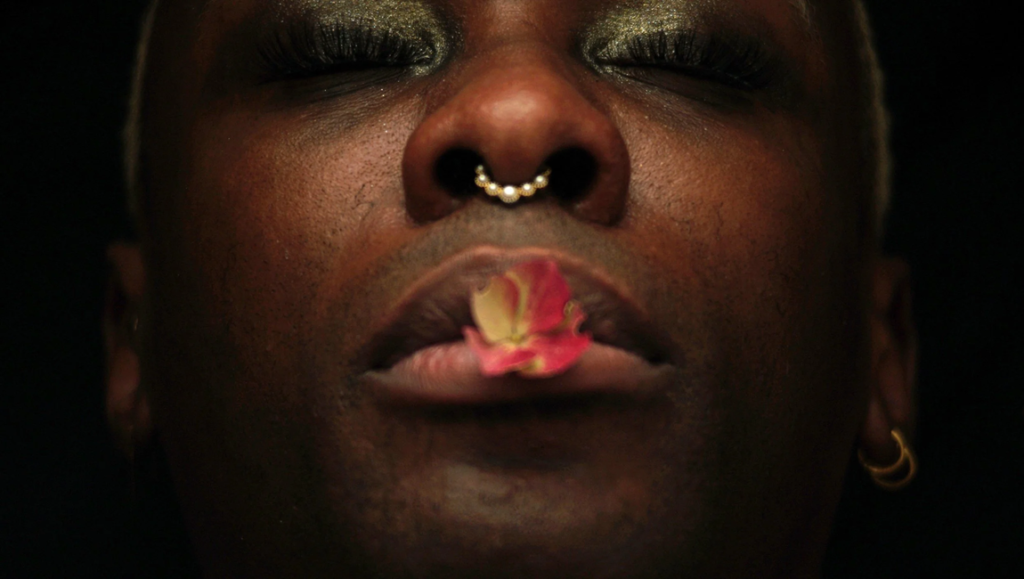
Part three, “Gay Guerrilla,” is in some ways the most striking segment in Joy Boy. Initially a solo dance, the performer is joined by three other dancers in queer-inflected dress, dancing in the middle of a busy Kinshasa street at night. As cars move past them, these dancers’ presence alludes to queer sex work, but in a bold conceptual twist, they move in the street rather than beside it. There is a defiance in this section that is reminiscent of Khalik Allah’s cinematic prose-poem Field N***as. These people are not offering themselves, but aggressively taking up space for fierce, self-expressive movement. The final section, “Joy Boy,” consists of images of hands on a Black male torso, fading in and out in tandem with Eastman’s titular composition. The images moves to the performer’s face, alternating with close-ups of plant matter, a series of snapshots that recalls Jodie Mack’s organic collage films.
Joy Boy is not a documentary in any conventional sense. Rather, it finds this current iteration of Collectif Faire-Part — three new members working alongside original members Rob Jacobs, Paul Shemisi, and Anne Reijniers — working to think alongside Eastman’s music, tapping into its radical abstract force. Eastman, who died of AIDS at the age of 50, was never fully appreciated in his lifetime, and is still not very well known even in new music circles. This is the Collectif’s first film that does not directly address the history of Belgian colonialism in the DRC, and in a sense Eastman serves as the perfect subject for this broadening of scope. His music was an attempt to compose one’s way out of a colonized subjectivity, taking the traditions of Bach and Beethoven and moving that European tradition to the streets of New York, on the assumption that this legacy belongs to anyone who wants to claim it. The Eastman compositions we hear in Joy Boy convey a restless but hesitant energy, a force that slowly but inexorably lurches forward, fighting its way into the listener’s consciousness. Joy Boy is both an overdue appreciation of Eastman’s contributions and an exciting new direction for this vital group of film artists. — MICHAEL SICINSKI
Comments are closed.