
In This Dispatch
Agon
What a strange thing, the Olympics. In 1896, with the tools for globalization just barely on the horizon, the world (or, rather, Greece, leveraging its historical claim to the games) decided to know each other better through friendly contests. World competition predated the world wars, which should strike one as a rather optimistic fact if it weren’t for everything that came after. Still, the games represent such naive optimism about world affairs, and most competing countries see them as equal parts diplomacy and opportunity to flex on the world stage. The overall winners are never a surprise, but any athlete from a smaller country who wins gold will immediately enter that country’s history books. It’s nice.
And yet, films have long struggled to communicate what’s so interesting about the games. Leni Riefenstahl’s Olympia is infamous for rather obvious reasons, but the body worship that frames the film wasn’t a commentary on the event itself. It was effectively a remake of UFA’s Ways to Strength and Beauty from a decade earlier; for Riefenstahl, the Olympics was simply a meeting of hygienic specimens who collect points. Kon Ichikawa’s Tokyo Olympiad abstracted this further, showing victory, defeat, slow-motion running, and the roar of spectators. It’s a beautiful commercial for the concept of sports, but the games could have easily been the World Cup or a local Little League. Only fiction films like Spielberg’s Munich seem to grasp what a bizarre and potentially dangerous thing it is to have all the world together.
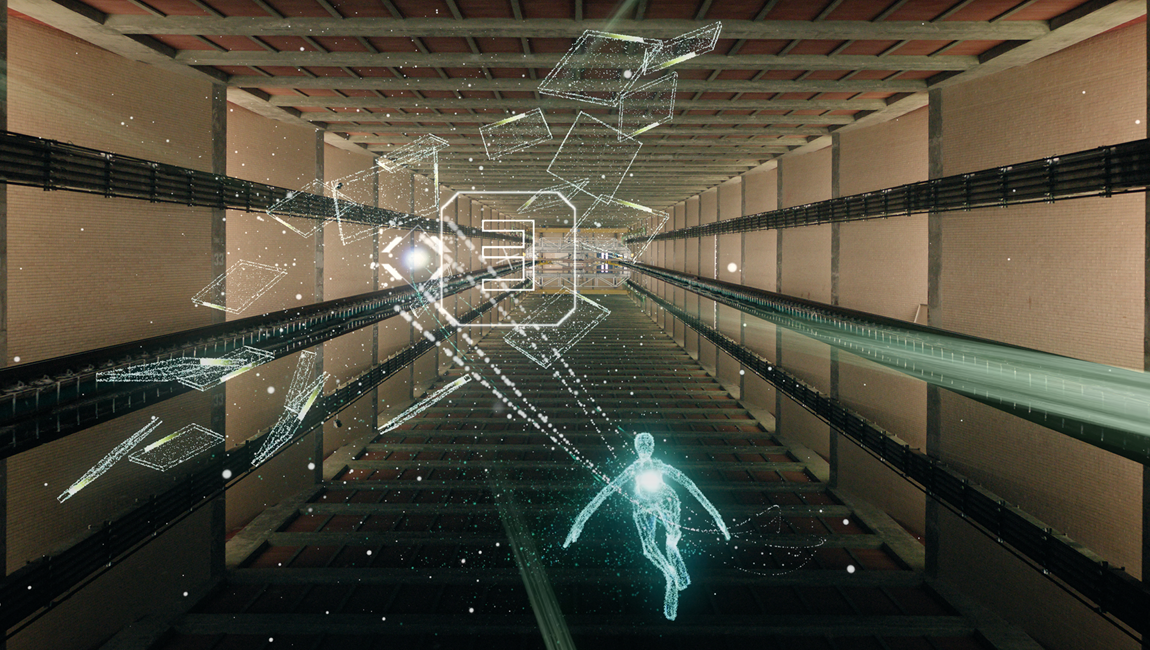
Giulio Bertelli’s Agon stands apart from this history by incorporating all of it. Like Olympia, it focuses on the body itself, documenting motion and — for rifling — the lack thereof. Like Tokyo Olympiad, it finds drama in the games themselves (”agon” being Greek for “struggle” or “contest” or “gathering” and the root for “protagonist” and “antagonist” and “agony”). But, like Munich, this is a fictional film, and one that knows that much of what makes the Olympics special lies behind the scenes.
Yet it would be easy to mistake Agon as a straightforward documentary on its subjects. The film features very little dialogue, and the narrative can only be parsed through bits of voiceover and blink-and-you-miss-it moments. The camera mostly keeps a respectful distance from its three Olympians — a fencer, a sports shooter, and a judoka — as they prepare for the games, much like the fitting room scenes of last year’s Afternoons of Solitude. Yet, as the games begin, these athletes fall into scandal and misfortune. Their attitudes and histories suddenly matter much more than sheer physical prowess, and their once surefire victories are challenged.
These little dramas are rarely interesting, but they serve as a solid foundation for some exceptional filmmaking. So much of Agon resembles the work of the Sensory Ethnography Lab as it records an environment full of specialists whose silent work begins to look like ritual. During judoka Alice’s (played by real judoka gold medalist Alice Bellandi) leg surgery, the film frames the doctors all in a row tending to the hole in the sheet, as if they’re priests consecrating holy ground. Just like De Humani Corporis Fabrica, the film often switches between this observational mode and the strange visual language of medical imaging technology like endoscopy cameras and MRI models of the human framework. Perhaps Riefenstahl wishes she could have been so intimate with the body.
The film is at its best when it’s effectively a documentary about the bizarre kinds of sports medicine software and equipment available to the best of the best. When Alice begins walking during her physical therapy, she’s placed in an anti-gravity treadmill, which inflates a plastic shield around her and which DP Mauro Chiarello frames to look like a Cronenbergian Bubble Boy suit. Similarly careful attention is given to the processes that make the Olympics possible: the manufacturing of Olympic-grade gear. Bullets are formed and sorted; the metal of the fencing masks is carefully woven into the impressive stitching that guards these combatants from injury or death. The accident that haunts fencer Giovanna (Yile Vianello) revolves around this manufacturing, one that, with any even slight mistake, results in a global investigation with fingers pointed in every direction. Every little stitch is political here.
And, just as the medical imagery accentuates the judoka, the rifle shooter Alex (Sofija Zobina) uses video game imagery to focus on holding her breath for her event. A particularly lengthy scene in the pool is suddenly overlapped with gameplay from the cult rhythm-shooter Rez Infinite; other training montages use clips from FPS aim trainer KovaaK’s. Their contextless bits of lights and colors rhyme with the equally surreal videos of human organs — all of these screen-based images and UI are seen as pertinent to these athletes’ training and recovery. Screens are also used to calm the athletes’ jitters such as when Alex wants to take her mind off her hunting scandal by masturbating to hentai. This technology plays more of a role in their lives than any of their trainers.
Much like Theo Anthony’s short Subject to Review, Agon seems interested in the ways that technology has redefined the athletic event by making everything so inhumanly precise. But it’s also interested in politics and scandal, such as in Alex’s inability to be represented by her country after her poaching photos were discovered or the kind of international blame game that arises when anything goes wrong. It’s good at asking these questions, but it quickly retreats from prodding further, lest it take a stance. Still, even if this is not quite a Farocki film, nearly every minute Agon is visually exciting, and many of its dozens of ideas stick the landing. Bertelli seems to be a deft painter of the weird-chic, and his Agon shows just how strange the Olympics can be. — ZACH LEWIS
Donkey Days
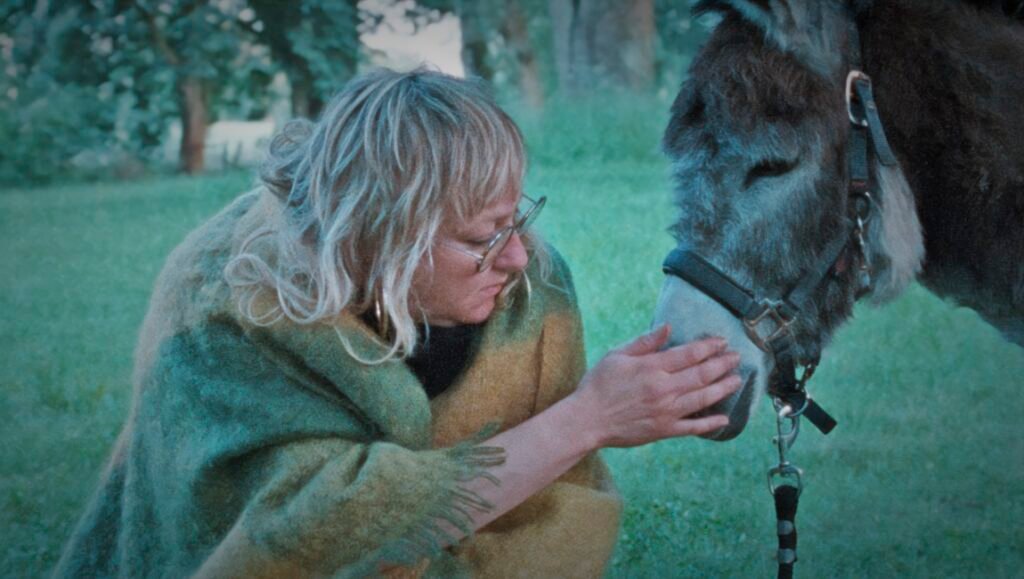
If one were being deliberately reductive, the logline for Dutch director-screenwriter Rosanne Pel’s sophomore film Donkey Days could read as a near-exact twin of Joachim Trier’s Oscar-winning Sentimental Value: two adult sisters, whose relationship is alternately tense and intimate, reckon with the influence of a self-centered and manipulative parent on their lives and relationships. Yet while Trier, in his pictorially tasteful and suitably sentimental film, draws his sisters closer together over the film’s duration, Pel risks alienating arthouse audiences by emphasizing the widening ruptures between the sisters — not only through the film’s loose narrative, but also through its jagged, near-collage aesthetics. Perhaps inevitably, Pel’s thorny family portrait has struggled to receive the broad esteem that more immediately approachable films like Trier’s have, but one hopes that Donkey Days’ selection as the closing night film for New Directors/New Films — almost a year after its inclusion in Locarno’s Golden Leopard competition — pushes the film to a wider audience. Pel’s startling, absurdly comic vision, performed with volcanic emotion by leading actors Jil Krammer and Susanne Wolff, certainly merits recognition.
The ambling story of Donkey Days begins in the aftermath of a fraught family vacation. Anna (Jil Krammer) has forced an annual trip to France to an early end, after much resistance from her older sister Charlotte (Susanne Wolff), because she feels that Charlotte and their mother, Ines (Hildegard Schmahl), neglected her and critiqued her harshly for her weight on the trip. What appears to be a two-against-one family setup, with Anna in the victim position, soon reveals itself to be more complex, as a visit to Ines’ home soon after the trip sees Anna and Ines treating each other with deep affection and icing out a distressed Charlotte. At other points, Anna and Charlotte commiserate over Ines’ emotional volatility and selective withholding of affection. The film follows a largely episodic structure, with shifting power balances revealing new aspects of the three women’s characters, relationships, and histories, until a sudden juncture forces the sisters to confront head-on how they have been shaped by their controlling mother.
Shot on 16mm film by director of photography Aafke Beernink, Donkey Days has a grainy, abrasive aesthetic, with plenty of jittery handheld camera and tight closeups corresponding with the characters’ simultaneous emotional volatility and vulnerability. A percussive, sometimes atonal score by Ella van der Woude and fractious editing by Xander Nijsten both contribute equally to the film’s sense of emotional unmooring and free-floating anxiety. Pel further destabilizes the viewer through techniques including unexpected plot detours and excursions into fantasy that are not neatly divided from the film’s base reality. Some may see Pel’s more abstract touches as confounding, rather than clarifying, but they contribute immeasurably to the film’s rendition of family life as perpetually, palpably disorienting.
Most important to the film, though, are the performances by Krammer and Wolff, who are tasked with long scenes of dialogue and one-shot monologues, and whose characters reveal ever-more layers and complications as the film progresses. Both meet the heavy lift of their tasks as actors with absolute command and live-wire energy.
The sisters are initially presented as foils. Anna does not have the slim frame of her sister or mother and has stepped outside of their wealthy sphere of living into a more bohemian, queer lifestyle, whereas Charlotte is appearance-minded, career-driven, and anxious to please. Pel, though, puts both in situations that undercut the archetypal versions of their characters: Anna is often the more rational and emotionally disciplined of the two, whereas Charlotte tends to break down and act out in response to stressors. What both have in common is a shared struggle to contain bottled-up anger and resentment; when they do release their festering feelings, their vitriol is almost always targeted at one another, rather than at their mother.
A climactic scene of a blow-out fight between the sisters is written and staged expertly by Pel and performed with boundless energy and emotion by Krammer and Wolff. Here, Krammer plays Anna as a sneakily cold manipulator, and Wolff plays Charlotte as a reflexively defensive fighter; both devolve into shouting insults that seem to emerge from deep wells of pain. Pel has the courage of her convictions to leave the relationship between the sisters unresolved, rather than closing with reconciliation. Equally bold is her decision not to give either sister a concrete, three-act arc of growth; rather, both act out patterns of pain and manipulation that are difficult for them to recognize, much less to disrupt. As cinematically exciting as it is emotionally honest, Donkey Days will not leave audiences with comfort, but the all-too-human family at the film’s center may spark uneasy, raw recognition. — ROBERT STINNER
Fantasy
In the first half of Fantasy, Isabel Pagliai’s feature debut, it is easy to become fixated on Fatty, the Calico-mix cat who lives with the protagonist (Louise Morel). This is partly because the cat is quite photogenic as things go, but it’s primarily because the cat is the one clear figure in a film defined by slippage and fleeting coherence. We see Louise (whose name we only learn in the film’s second half) soaking in a tub while Fatty lays in what appears to be a dry, disused bidet. Elsewhere, we see Louise lying around on the floor or in corners of a dark house pierced by the occasional shaft of light. There appears to be a mattress propped up against a wall, and portions of the house seem to be crumbling. At one point, Pagliai gives us a close-up of a fire, but it isn’t clear whether it’s actually contained in a fireplace. In the glow of the embers, we can notice a pair of old tennis shoes perilously close to the flames.
In other words, Fantasy hovers around its subject, refusing to allow us to really know who she is, where she is, or what she wants. Much like certain films by Pierre Creton or Valérie Massadian, events accrue but a narrative Gestalt never forms. This sense of temporal suspension is intensified by Pagliai’s strict separation of cinematic elements. For most of the film, sync sound is not used. We hear Louise’s words in voiceover, disconnected from her body. The effect resembles Marguerite Duras’ unique use of sound, particularly since Louise’s stream-of-consciousness dialogue in no way illustrates the static events we’re observing. We see Louise writing in a notebook, and pages of this notebook sometimes appear onscreen, so these words are obviously issuing forth from Louise, but in a disjointed manner.
The film’s second half introduces a second character, Thomas (Thomas Ducasse). The two of them are in the woods, and we see their bodies in proximity to each other as they talk with one another. Thomas asks Louise what parts of her body disgust her. Their conversations are intimate, but not overtly so. Pagliai offers us the suggestion of an unplaceable sexual tension, as if Thomas wants to carefully signal his attraction to Louise without frightening her, and Louise is gradually accessing her desire for another person. This sequence serves as a conceptual bridge between a passage in part one, in which Louise details her very specific masturbation habits, and the conclusion, when she recounts having been traumatized by a deeply unpleasant, only somewhat consensual sexual encounter.
Pagliai is a cinematographer, having previously worked with Maureen Fazendeiro, and she shoots Fantasy with a remarkable attention to textures of darkness and a painterly chiaroscuro that strongly recalls the work of Pedro Costa. There are sequences that unfold in complete darkness, while others, such as a scene of Louise and Thomas in the woods, are only intermittently lighted by the flick of a cigarette lighter. Very much in keeping with Fantasy’s narrative intangibility, Pagliai applies a visual sfumato that holds bodies and objects tantalizingly before the viewer without ever permitting total possession. This is in part a film about frustrated desire and the instability of identity, a film some will no doubt find a bit too emotionally withholding. But if you are able to get on its wavelength, Fantasy is one hell of a first date. — MICHAEL SICINSKI
Panda
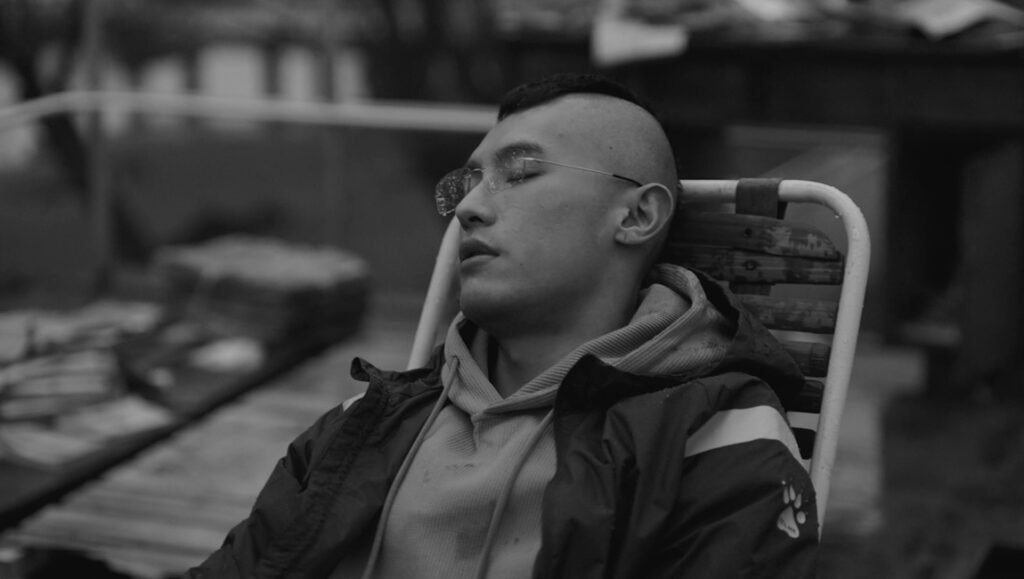
Over a small jetty, a cruise ship waits to dock and its passengers get ready to dismount. The process is unrushed, methodical; a throng of walkers, with the odd motorcyclist interspersed among them, head onto land while, from the other end, several people await their turn to board behind a gate. The camera completes one full circle, unhurriedly, capturing a boy seemingly caught in the act of littering a slip of paper and trying to pass it off by dancing the floss. From this quick ethnographic snapshot arrives a sprawling city symphony, running in parallel with the Qinhuai river that bisects the urban agglomeration of Nanjing. Over a calmly enervating runtime of 145 minutes, Xinyang Zhang’s Panda unspools its multiple narrative threads, each gently, fleetingly intersecting one another. Each thread charts the course of daily life for a denizen dwelling, apparently, on the periphery of modern city living — some tend to their routines, others seek out more esoteric, more revelatory ways of being.
Modern life is hereby watered down to its most stubborn elements: at once insignificant and rebellious, the margins of Chinese society linger in an eternal present, battered by the detritus of rapid development but not yet beaten into oblivion. Instead, a poetic logic traces through the flotsam, brimming with quiet defiance of the atomized and anonymized wider population that has come to represent the resplendent demographic success of contemporary China. A young woman (Jiahe Lyu), clocking in to work at her textile store, gets embroiled accidentally in an adjoining fistfight; at home, as her mother tends to her wounds, the absence of her abusive father lingers in the air. A cook (Ruyin Zhang) slices his finger off when startled by a passing mongrel; the dog swallows it, along with his wedding ring, the final thing to commemorate his dead wife. Wounds and healing, as with dying and resurrection, form the backdrop of Panda’s unvarnished yet elegiac tableaux, onto which the hazy skyline of its faraway city is etched. Both vanishingly distant and intimately corporeal, Nanjing becomes, for better or worse, a site for grand dreams to exist alongside more quotidian ones.
Zhang’s aimless, freewheeling structure proves conducive for moments of sublime visual poetry, as when a drifter (Han Chen), proclaiming himself a divine being on a quest to find a dragon, wanders into the sewers along the outskirts of town, a string of plastic bottles trailing haphazardly behind him. The man is unkempt, possibly schizophrenic; his presence nonetheless inspires a ragtag underground band to make their music, performing it in the subterranean confines beyond the reaches of the society they find so alien. Zhang, a protégé of Jia Zhangke, brashly reinvents the master’s strokes for his long-gestating debut, mounting a punishing if uncompromising paean to an impolite society in retreat from the world. Deferring less to vulgar taste, as did Guo Zhenming’s Tedious Days and Nights with the underground Rubbish Poetry movement, Panda instead romanticizes solitude, its titular animal symbolic not just of the film’s grayscale monotony, but also the inherent worth and sacredness bestowed on solitary individual life.
The film’s stylistic flourishes are numerous: some predictable, such as the smatterings of color dotted throughout the monochrome, others more elusive and moving, including the textual overlay of verses onscreen, as written and spoken by a doctor purporting to cure most ailments with the power of poetry. Bearing a strong conceptual similarity with Chen Deming’s Always, also a hybrid documentary about the irreversible tides of modernization in China, Panda is more sui generis in form than the prosaic realities it nonetheless depicts, of poverty, malady, and despondency. Its Mandarin title borrows from a treatise of cold diseases compiled some time in the 3rd century AD, and as with most compilations, the organizing principle can only dictate so much. The narrative is sometimes impenetrable, often unfocused. That may very well be the reason for its endangered status, and precisely the cause for its salvation. — MORRIS YANG
Also Playing
If On a Winter’s Night
The international breakthrough of All We Imagine as Light in 2024, which was the first Indian film to play in Cannes competition in 30 years, could be taken as a sign of life for, or at least an indicator of, renewed Western attention toward a resurgent parallel cinema in India. Director Payal Kapadia’s executive producer credit on Sanju Surendran’s If on a Winter’s Night signals a kinship between the film and Kapadia’s cinema that bears out on screen. Like Kapadia’s film, Surendran’s movie is a low-key, realistic portrait of life in one of India’s cities that turns its eye toward everyday characters and resists the bombast and melodrama of mass entertainment. While it trades much of the swoony, romantic style of Light for a more quotidian aesthetic approach, it’s easy to see what Kapadia finds compelling about Surendran’s film.
Despite taking its English title from the Italo Calvino novel, If on a Winter’s Night has nothing to do with postmodern fiction and has no structural or metafictional tricks up its sleeve. The title instead refers literally to a crucial winter’s night late in the film that serves as a stress test for its central relationship between Sarah (Bhanu Priyamvada), a film festival employee and aspiring researcher, and her art student boyfriend Abhi (Roshan Abdul Rahoof). The couple, originally from Kerala, has come to Delhi in search of the city’s opportunities. Here they live on little money — only Sarah has an income — and maintain an extremely small social circle. Abhi especially is isolated in Delhi since he does not speak Hindi. The two struggle to get by and stay together as financial tensions and Sarah’s obligations to her family back home mount.
Surendran’s film is impressively all of one piece as every thread emphasizes the intersection of love and money. Watching Sarah and Abhi’s relationship fray throughout the course of the movie over an unreturned loan she gave him and the increasingly dramatic consequences of that lost income is a pointed narrative center, while subplots — like their unhoused friend Simon’s lying to his long-distance girlfriend over video calls — bolster the film’s thematic argument. Elsewhere, Surendran takes time to explore the poorer communities around Delhi, contrasting the displayed visions of communal joy with the disdain of Sarah and Abhi’s landlord, the closest thing the film has to a villain and its most direct representation of a capitalist spectre. As the film goes on, it skillfully piles on incidents rapidly to convey the suffocating frustration of Sarah’s position, each new happening an anxiety inducing knife twist.
That the film’s cohesion and accumulated affect don’t come off as overbearing despite their relentlessness is credit to Surendran’s unshowy approach and the actors’ well-calibrated performances. It’s easy to imagine a bad version of If on a Winter’s Night that leans into sentimentality and melodrama, filled with scene-stealing hysterics and overlaid with a treacly score. But if the impulse toward such a film exists, Surendran has resisted it in favor of a subdued, natural direction which comes with its own pitfalls. Some sections, especially those early on, don’t leave much of an impression, and while the exterior photography is often beautiful — and the clearest link the film has with All We Imagine As Light — the drab interiors are just ugly. And despite the intense focus on class, the film’s analysis never gets anywhere particularly nuanced or revelatory, even as it remains broadly affecting and emotionally true. Like much of If on a Winter’s Night, it works even if it’s a little too simple. — CHRIS MELLO
Trial of Hein
In German, Kai Stänicke’s debut feature Trial of Hein bears the title Der Heimatlose, which translates as “the stateless person” or “the homeless.” This is an interesting discrepancy, since the original title places the film’s protagonist, Hein (Paul Boche), front and center, whereas the English title emphasizes the process whereby Hein is relentlessly judged. This is a film about the conflict between the individual and society, specifically how the social contract often relies on the individual subsuming their needs and desires in the interest of community cohesion. In its highly stylized way, Trial of Hein is about conservative small-mindedness and how it can persistently assert itself as an overriding virtue.
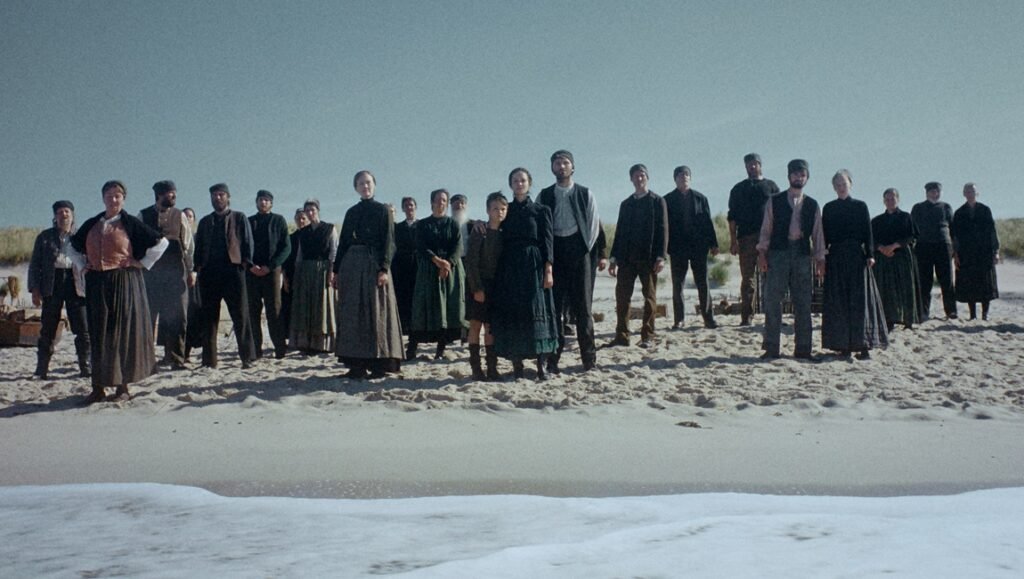
Hein left the small fishing village of his birth 14 years prior, and the action of Trial of Hein is precipitated by his unexpected return. Although Hein remembers everyone, no one in the village recognizes him. His younger sister Heide (Stephanie Amarell) was very young when Hein left, and their mother (Irene Kleinschmidt) is in the throes of dementia, so Hein has no family to vouch for him. The townsfolk fear he may be an impostor, and so a three-day trial has been established during which the community will determine whether Hein is who he says he is.
It is a highly artificial premise, and a viewer will recognize that these events do not exactly stand up to scrutiny. Why would someone return to this “godforsaken place” (as one outsider calls it) pretending to be a member of the community? One person suggests that “Hein” may be someone from the mainland looking to encroach on their fishing rights. As Hein interacts with the villagers, particularly his best friends Friedemann (Philip Froissant) and Greta (Emilia Schüle), the mass inability to recognize this man seems decreasingly plausible, more deliberate and performative. There are cracks in the community’s harsh façade, and it’s clear that Stänicke does not expect us to take this scenario at face value.
The formal organization of Trial of Hein is also a very big clue that we are observing something allegorical, and not a naturalistic depiction of genuine xenophobia. The buildings in the village are unnaturally close to one another, and each has at least two missing walls. Everybody can see everything everywhere. Most viewers will recognize right away that Stänicke has borrowed this stage-setting arrangement from Lars von Trier’s 2003 magnum opus, Dogville. This in itself is quite jarring. Dogville is a singular film with a format so radical that one would never expect to see it repeated. But Trial of Hein appears to be quite explicitly drawing not just on von Trier’s physical artifice, but also its primary theme of small-town insularity and paranoia. Like Dogville’s Grace (Nicole Kidman), Hein is a figure whose worldliness threatens to reveal this close-knit community’s darker nature to itself, something that will not be tolerated.
But unlike Grace, Hein was once part of this clan, and the implication is that by leaving, he renounced any potential right to return. Over the course of the trial, Hein discovers significant discrepancies between his own memories of childhood and those of the population at large. Even photographic evidence that Hein finds among his mother’s things seems to suggest that the past may not be exactly as he remembers it. Then again, we observe that aside from fishing, the primary preoccupation of the villagers is an inscrutable card game called “lies.” Hein’s readjustment to life in his hometown rests in part on remembering his ability to play this game and win.
Trial of Hein is an extremely well-crafted film, complex and engaging. If it has one real flaw, it is its overall perfection. Which is to say, we eventually discern what Stänicke is trying to say to us, and the film really admits of only one conclusion. Like a perfectly sculpted short story, Trial of Hein has a clear purpose and very little will divert it from accomplishing that goal. It unfolds with a certain inevitability, and while one cannot help but admire it, it also leaves very little for the viewer to chew on. Nevertheless, a debut film this accomplished bodes very well for Stänicke’s future endeavors. Not many filmmakers could wrestle with a titan like von Trier and end the match in a draw. — MICHAEL SICINSKI
Two Mountains Weighing Down My Chest
Originally popularized and coveted by the Western world, the esteemed traveler cut a formidable figure for its elites: the rationalists for their admiration of breathtaking human knowledge, and the epicureans for their worship of worldly, beautiful pleasures. Somewhere along the way, with maritime travel and industrialization settled, cosmopolitanism was born, and the world came to know itself as a smattering of communities and cultures, each inextricably linked but defiantly insular all the same. Which is why a cosmopolitan locale always invokes a paradox: in a city of travelers, who are the locals and wherein lie their ostensible travails? Viv Li’s autobiographical and semi-documentarian first feature, Two Mountains Weighing Down My Chest, frivolously embraces this uneasy state of being as a way of life unto itself. Set one half in Berlin, the other in Beijing, the film traverses both cities in seamless continuity, shuttling back and forth between two metropoles whose beliefs and customs are gently and beguilingly pitted against each other.
It’s not a didactic film for the most part, as Li steers clear of undercutting either her homeland or her found family, whether by trivializing their experiences or by essentializing them. Yet Two Mountains proves to be, for the most part, a lazily superficial reflection on cosmopolitanism’s joys and woes. Having left China after university to broaden her horizons and take in the sights and sounds of the globe, Li — now in her mid-30s — has tired, somewhat, of her erstwhile openness to experience. “I’m just constantly trying to be inside of communities,” she confesses to the camera in the middle of a desert retreat southeast of Berlin, where she lodges on an artist’s visa. The space around her, however, is barren and unpopulated. Her search for kinship and personal freedom outside of the communalistic hierarchies of Chinese society has led to its own form of exile and alienation, as its starting premise (that people would be as open to her as she them) never really came to be. Berlin, the city of wannabe artists and preferred pronouns, is exactly the myopic circlejerk of false intimacy and fashionable posturing illustrated in Lauren Oyler’s hyper-cynical Fake Accounts and, to a lesser extent, the Rohmerian musings of Ruan Lan-Xi’s The Plant from the Canaries.
Which is Li’s point, but all the same cut and edited down essentially to an incurious and speciously curated pastiche of carefree authenticity. Two Mountains’ images and sometimes dizzying juxtapositions do make for an electrifying watch; less alluring is the director’s faithful transcription of her so-called realities onto the screen. When she cries, or debates the merits of gender theory with more skeptical friends, or records her Chinese relatives’ plugged-in discussions on geopolitics over dinner and beer, there’s a keen sense that she is performing for the viewer. To the extent that such performance allows for the self-reflexivity necessary to reconcile one image with another, the film thrives in its myriad contradictions. But such awareness is frequently absent, swapped for a soon-trivial realization that the über-woke Germans don’t really care about Chinese culture as much as they obsess over parading their own. Having gestated since pre-COVID days and elongated into an unflinching if also brutally inane tale of two cities, Li’s film diary-cum-vlog skirts thoughtful, genuine authenticity. Its dual titular metaphors bear the weight both of familial, societal expectations and of the labors of living as a modern woman; its creator mostly shrugs in response to them. Everyone contains multitudes, and so the bar is set higher for the world-weary traveler to belabor her own. — MORRIS YANG
The River Train
When you see a lot of movies at film festivals, you begin to notice certain patterns in the cinema as a whole. One such pattern is that debut features are often overstuffed, containing more ideas than can be clearly articulated. This should come as no surprise. Music critics often remark that bands spend many years figuring out their debut albums, and so they sometimes possess a sprawling energy that the sophomore effort cannot always match. In film, though, debut features frequently display a tendency one might call “emptying the notebook.” When you manage to scrape together the funds to make that debut feature, you realize that you may never get to make another. So any and every idea can feel like something that simply has to be in there, coherence be damned.
The River Train is the debut feature by the Argentine duo of Lorenzo Ferro and Lucas A. Vignale. Ferro is perhaps best known as an actor. He starred in Luis Ortega’s 2018 film The Angel, which garnered significant notice. In its scant 75 minutes, The River Train seems to lurch from idea to idea, introducing themes and characters that never really carry through the film as a whole. In fact, the prologue to The River Train appears to set up a very different kind of film, only to abandon it abruptly. This may have been the point, but the results are jarring nonetheless.
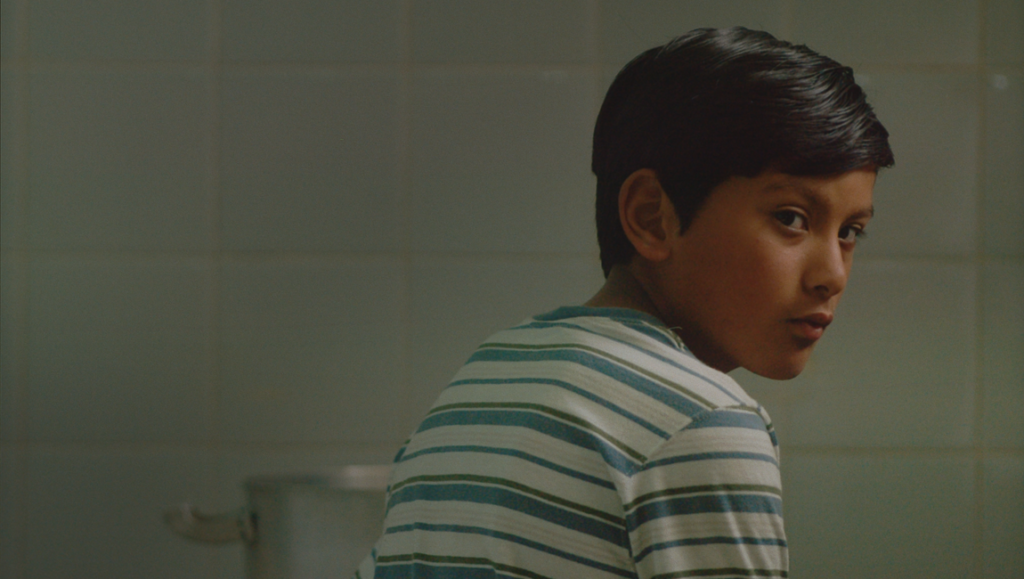
Milo (Milo Barria) is a nine-year-old boy living in northern Argentina. In the film’s best scene, we see his father Mariano (Mariano Barria) subjecting him to rapid-fire questioning that appears to be some kind of mental game. Mariano tells his son, “don’t think, speak,” over and over again. Each time, Milo responds with a random word-association reply: “moving,” “conquest,” “valley,” “watermelon,” “punishment,” etc. After this, we see Milo and three other boys participate in a dance contest, where they perform the traditional Northern step-dancing known as malambo. The dance is notable for its speed and vigor, a sort of rhythmic clogging that combines pageantry with a very masculine forcefulness. It’s clear soon enough that Mariano is the one pushing Milo to perform and compete. The dad is fairly aggressive with his son, even waking him up in the night for an impromptu rehearsal. Afterward, Milo tells his father, “good night,” to which he leaves without responding.
In an extended scene in the family home, Milo is entrusted by his mother (Lucrecia Pazos) to stir the stew they’re having for dinner. Milo doses the stew with a sleeping medicine he got from a friend at school. His parents and older sister (Mailen Barria) all fall asleep at the table, at which point Milo exits and boards a train to Buenos Aires. The boy is free, it seems, but it is unclear from what exactly. Milo then proceeds to have a very haphazard adventure in the city. He ends up in a flophouse with two grown men (Fabián Casas and Pehuén Pedre), one of whom tells Milo to go to an audition for a play. He does, and although his callback never quite works out, he does meet a young woman (Rita Pauls), whom he stalks before hiding out in her apartment under her bed. Simple questions that might occur to the attentive viewer remain unacknowledged. How did Milo pay for train fare? Did he have to pay for the flophouse? Why did he sneak into the woman’s house? And perhaps above all, how are we meant to respond to Milo’s actions and predicament?
Age play seems to be a driving force in The River Train. As a nine-year-old, the fact that he is alone in the city and staying with two strange men is cause for alarm, but the film doesn’t engage with this. Similarly, Milo’s stalking and home invasion for the young woman is presented matter-of-factly, but if he were any older, his behavior would seem very menacing. Ferro and Vignale are harking back to the classic tropes of the lone-kid-in-the-city story, recalling The 400 Blows, Little Fugitive, or The Mixed-Up Files of Mrs. Basil E. Frankweiler. But the world they have created is so hermetic that it’s difficult to feel either pity or admiration for Milo. Like the filmmakers themselves, Milo just seems bored, and wants to take in a few random sites before catching the train back home. The River Train is a scant outline of a movie, piquant but ultimately unsatisfying. — MICHAEL SICINSKI
Comments are closed.