
Follies
If the sex comedy has become a rare breed in the two decades since its American Pie-to-Apatow heyday in the aughts, the marriage comedy, a staple of the classical Hollywood screwball comedy with origins in Shakespearean romance, has been largely dead as the dodo since the 1940s. Perhaps that’s why a film like Québécois writer-director Eric K. Boulianne’s Follies, ostensibly a comedy of remarriage that might make Stanley Cavell smile as much as blush, needs to cloak its melodrama in so much fucking, sucking, spanking, yanking, cheating, and cumming. It’s The Awful Truth for an age averse to upper-class refinement, sophistication, and playful innuendo, one that privileges direct communication and therapy-speak over witty double entendres.
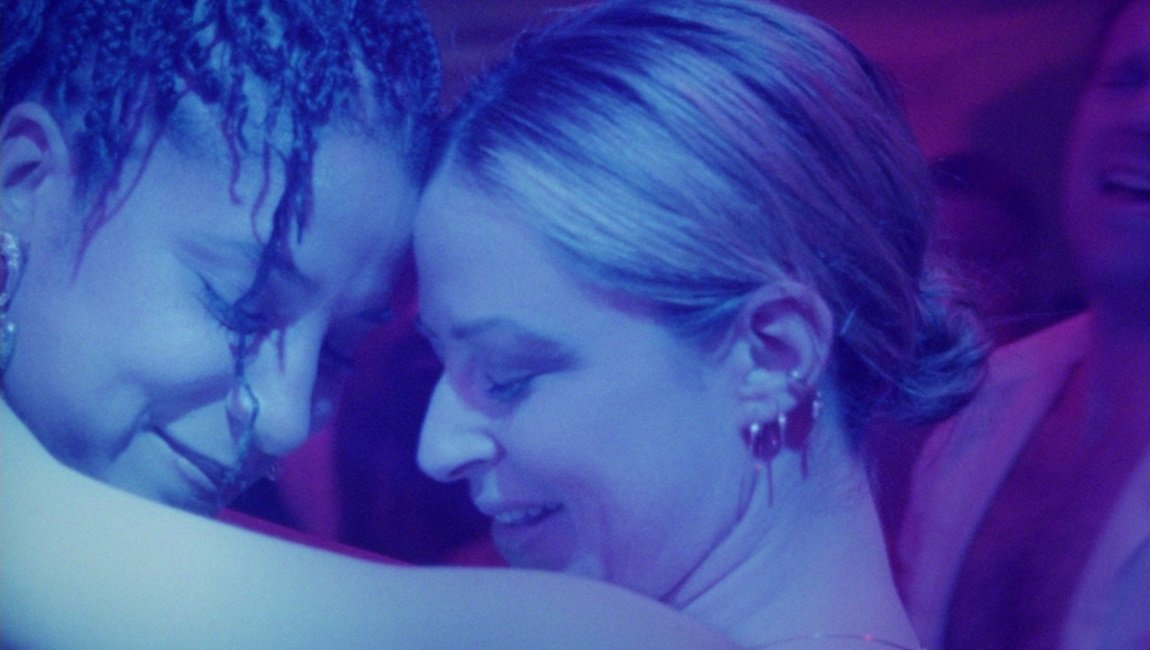
The first shot of the film is a wonderful encapsulation of how Boulianne is able to juggle these two styles in a mature, invigorating way. We open with a McCarey-esque sustained medium shot of our two protagonists, married couple Francois (Eric K. Boulianne) and Julie (Catherine Chabot), sitting next to each other at dinner with a younger, sexually open couple across from them and offscreen. As they silently watch the other couple go through the various minutiae and pitfalls of getting rim-jobs from their various lovers, Francois and Julie’s body language — they way they squirm, glance quickly at each other before averting their eyes, nod half-heartedly, chuckle when they shouldn’t — tells us everything we’ll need to know about where their 16 years of marriage have led them. They need a change, it’s obvious to both of them before they even talk about it, and, at Francois’s request, that comes in the form of opening up their relationship.
It’s a journey that leads through all of the expected awkwardness and jealousies — weird foursomes with swinger couples, casual hook-ups that end in acrimony, uncomfortable questions from their two 10-year-old daughters — while also dredging up all of the dormant problems of their coupledom and pushing it further toward its breaking point. Follies is, if nothing else, a very accurate portrait of an increasingly pervasive 21st century relationship pattern, and a lot will feel familiar to anyone who’s gone through similar situations or observed it amongst friends. Problems proliferate almost instantly, but when Julie starts falling for a lesbian couple who seduced her, Francois, who instigated the open relationship, becomes overbearingly disappointed and jealous. He childishly slams doors, pouts at the sex club, and obsessively prowls dating apps while Julie lovingly cooks breakfast and giggles with her lovers.
Shot on celluloid by François Messier-Rheault, Denis Côté’s frequent collaborator, the film has an intimate, subtly beautiful feel to its images. Boulianne is an adept naturalist with the frame, composing shots with comic grace and emotional depth without drawing too much attention to them. The film soars in its prolonged medium shots, allowing for actions and reactions to build across scenes, unfurling character depths through nuances of gesture that make for a rich viewing experience. Every dinner table conversation feels loaded, like an elaborate game of hide-and-seek where what the characters say and what they really mean never quite seem to spring out from the same hiding place. The cityscape of wintertime Montreal also becomes an essential element to the film, even as scenic sights and dense street sequences are smartly eluded. Details, like the way Francois walks alone down nearly empty streets at night or the erotic fixation one swinger couple has on a very bland hotel room, lend the film a wonderfully sharp sense of place.
If the film falters, and it does slightly, it’s in its rosiness. While occasionally erotic, Julie and Francois’ sex life looks far from fulfilling or desirable, so when the film lets them have their cake and eat it too, to stay together while fully living a life of hedonism, it feels strained. Boulianne knows how to separate and fracture the couple well, but he’s less adept at bringing them back together. The ostensible remarriage we witness at the end is almost depressing: it posits that the couple can still feel together while having very physically separate sex lives because they can still feel emotionally attached virtually, through brief sext exchanges. It comes across too much like therapy-speak, telling us we’ll all be okay so long as we learn to accept the lonely, isolating, and demeaning circumstances we’re given. If that’s what a happy modern couple looks like, two lonely people deluding themselves into feeling connected, God help us all.
Tales of the Wounded Land
Should war documentaries be fun? At the very least, we don’t expect them to be boring. It often feels like the whole genre is less a tool for peace and understanding than a secret fount of morbid perversity, a self-important propaganda endeavor that seduces us with visions of the macabre and grotesque just like the best horror films. Very few would admit to enjoying scenes of human suffering, but do we really watch a movie, engage in the artistic experience, if there isn’t some remote pleasure involved? Is there such a thing as pure educational value or a moral obligation when aesthetics are involved? We watch war and suffering because, as the cliché goes, we simply can’t look away. In the 2020s, in an age filled with hysterical rage and cultural conservatism, the genre is alive and strong. Festivals love them. Independent cinemas program them. Ukraine, Palestine, wherever’s next: Americans and wealthy Europeans might not actively fight anymore, but they sure do love to watch.
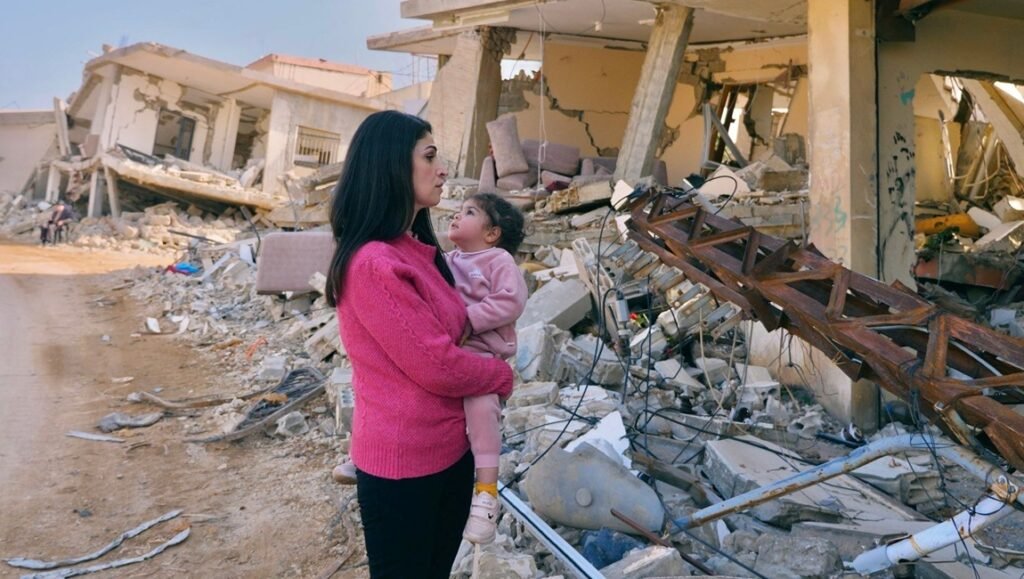
Abbas Fahdel’s latest film, Tales of the Wounded Land, which focuses on southern Lebanon during and after the 2023 Israel-Lebanon war, often feels like little more than an exercise in the complete de-aestheticization of the war film. This writer was bored out of their mind, but is that necessarily a bad thing. The question, then, is what else does one expect or, really, want to feel? And this doesn’t mean Fahdel doesn’t have real capabilities as a filmmaker or know how to grab the viewer’s attention. Opening with astounding drone shots over a large funeral march through decimated streets dozens of coffins long, the film is more than able to make the scale of the destruction palpable and affecting. A quick cut into Fahdel’s two-year-old daughter Camelia picking flowers and giggling every time she hears a nearby explosion — “Boom! Fart!” she yells — feels simultaneously emotionally manipulative and philosophically potent. How might a child understand these events? How might they reflect on them later? How do we understand them and reflect on them? Can we square these atrocious events as just one more part of life and almost take them for granted? And, much more immediately, how can we, as an entire species, stand to subject children to even the secondhand effects of war? Unfortunately, this inquisitiveness, while invigorating at first, simply doesn’t extend very far.
The bulk of what follows captures in astoundingly unadorned detail Fahdel, his wife Nour, and Camelia fleeing during Israeli bomb strikes on their southern Lebanese city of Nabatieh and then returning months later to a hometown now reduced to rubble. Shot largely on an iPhone with seemingly little concern paid to style or viewer engagement, the film consists mainly of lengthy interactions with local residents set against the ruins of war. That each scene lasts too long, that few provide more narrative or emotional information than the previous ones, that everything comes across in the same monotonous, affectless tone: this is either a mark of the film’s integrity or inanity. That Fahdel does make some, at least half-hearted, attempt to inject some poetry into the proceedings almost makes it worse. Between scenes, the film frequently cuts to poetic title cards that, while strained and pretentious — “It is a city where every stone is a raised fist/like a lily blooming among the ashes,” reads one — at least speak to an artistic aim that the relentlessly monotonous home movie footage never approaches.
To consider a film like this a failure — one that so ably presents a view of current events which many might find hard to find otherwise — might be a bit of a stretch, and it depends on how you look at it and what, exactly, you’re looking for. If you’re looking for a sense of curiosity, for an inducement to reflection, you’ll be disappointed. These are images that, for all their horror, provoke very little beyond their base reality. This writer wanted to leave out of frustration, but in a certain sense, was still moved in odd moments when approaching the subject matter in ways that it never feels Fahdel himself is provoking one to do. It’s a worthy failure, one that won’t necessarily reward tussling with, but there is no right way to capture war and there is no film that won’t have to grapple with the demands of both the market and the artform. To try to make an evaluative judgment on a film dealing with mass suffering feels not only impossible, but unnecessary. To many who don’t mind bad poetry, it might be moving. To those who believe in its cause, it will be noble. To those film festival denizens like myself who simply want a piece of art screaming at them from off the wall, it’ll stultify. It all depends on why exactly and for what hidden, maybe forbidden, reasons you sit down to watch scenes of mass suffering in the first place.
The Stories
“Life is cheesy sometimes,” says Liz (Valerie Pachner) in voiceover, moments before turning around at the airport and running back to embrace her lover, Ahmed (Amir El-Masry). Life might be cheesy, but it’s never that ironic and self-conscious. Great emotions don’t come to us in quotation marks. The Stories by Abu Bakr Shawky is a sincere and endearing movie, it wears its heart on its sleeve and formally doesn’t aspire to much more than well-executed classical storytelling. It’s got a bit of a self-referential streak that undermines its emotional capabilities — we don’t feel that aforementioned embrace for its romantic power, but instead almost as a joke, simply another twist in the plot — but one can largely forgive its excesses because it does all the simple things right. It’s got a well-drawn and endearing ensemble; it’s quickly paced; it knows how to deftly use framing and cutting in a competent, but not flashy, way; and it crafts a historical portrait of a time and a place — Egypt, from 1967-1984 — that one (namely this writer, an American cinephile) doesn’t often see on screen.
Ahmed is a classical pianist, interested not in the standards but, as he describes it, in “big loud nationalistic music” that suits the tenor of the times. The times being Cairo in 1967, with Egypt on the cusp of the third Arab-Israeli war where 15,000 Egyptians would die in only six days. Ahmed lives in a cramped two-bedroom flat with two brothers, a perpetually overstressed and aggressive mother, a father whose proudest achievement is having a photo with him and Egyptian president Gamal Abdel Nasser, a host of mysterious uncles and friends who seem to live on the family couch and do nothing but watch football on TV, and an upstairs neighbor who can’t stand the constant clamor of Ahmed’s piano playing. Ahmed, naturally, wants to escape. Which is why, as one brother is getting drafted into the war and another is desperate to join the local football team, Ahmed’s main focus is on writing letters to a pen pal in Vienna, Liz.
The music takes an even bigger role in the action as the film skips ahead to 1972 and we find Ahmed now enrolled in music school in Vienna where he’s vying for a concert, but the film unfortunately has little feel for the music despite how frequently it dwells on it. We accept it as a MacGuffin, but like much else in the dramatic world of the film, there feels very little weight to it. It’s as if it, and many other events in the film’s plot, have those same quotation marks around them that are invoked by the meta statement referenced in this review’s opening. We know that this all makes sense in the logical structure of a film, but it’s unfortunately flat and lacking in a certain vitality. Perhaps Bakr Shawky is simply trying too much: the importance of Ahmed’s music career soon takes second place to his burgeoning cross-cultural romance with Liz, but that soon gets supplanted by a survey of various political goings-on in Egypt. Each one makes room for the other just as we start to begin to feel like it might land.
The Stories aims for a national allegory for the squandered hopes and unrealized potential of a generation, and adept filmmakers have pulled material like this off before. However, whether it’s due to what might be a lack of budget — two-thirds of the films seems to take place on the exact same set, and we’re afforded very few glimpses of the wider world of 1960s and ’70s Cairo — or due to a certain lack of readiness on the part of the three-time feature filmmaker, The Stories, while often compelling and enjoyable, too often squanders its own potential. Encounters with famous figures like Vladimir Horowitz and Hosni Mubarak pass like mere pieces of trivia, bereft of emotional weight or deeper intellectual questions of history. The film’s strengths — specifically, its ensemble and Bakr Shawky’s facility with melodrama — feel underrealized or unresolved. It’s ultimately a fine film, one that is hard to get too upset about, but it’s also a film that fails to simply be what it wishes it was.
Comments are closed.